Dual Nature of Radiation and Matter — Practice Quiz
NIOS · Class 12 · Physics
Try a 4-question quiz on Dual Nature of Radiation and Matter for NIOS Class 12 Physics: tap an answer to check it and see why.
Interactive on Super Tutor
Studying Dual Nature of Radiation and Matter? Get the full interactive chapter.
Quizzes, flashcards, AI doubt-solver and a step-by-step study plan — built for practice quiz and more.
Free trial, no card needed.
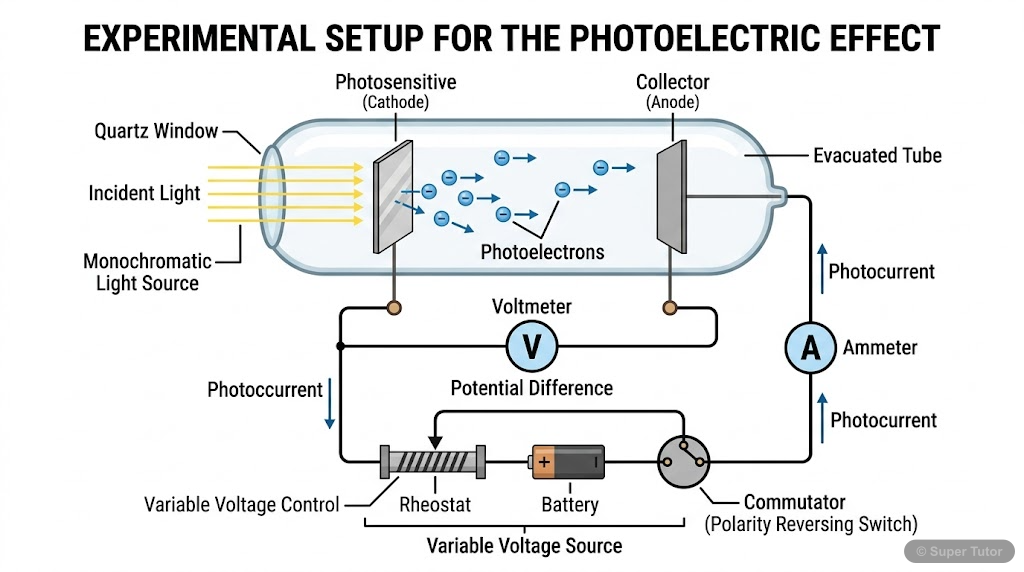
Learn better with visuals Super Tutor pairs illustrations like this with notes and quizzes for Dual Nature of Radiation and Matter.
Quick Quiz: Dual Nature of Radiation and Matter
0/4Tap an answer to check it instantly. No sign-up needed for these 4.
In a photoelectric experiment, the stopping potential for light of frequency 6 × 10¹⁴ Hz is 0.5 V. If the frequency is increased to 9 × 10¹⁴ Hz, the new stopping potential will be (given h = 6.6 × 10⁻³⁴ Js, e = 1.6 × 10⁻¹⁹ C):
The work function of sodium is 2.3 eV. What is the threshold wavelength for photoelectric emission from sodium? (h = 6.6 × 10⁻³⁴ Js, c = 3 × 10⁸ m/s, 1 eV = 1.6 × 10⁻¹⁹ J)
An electron is accelerated through a potential difference of 400 V. What is the de Broglie wavelength associated with it? (Use λ = 12.3/√V Å)
In a photoelectric experiment, when the intensity of incident light is doubled (keeping frequency constant), which of the following is correct?
Sample Questions
A proton and an electron are accelerated through the same potential difference. Which of the following is correct regarding their de Broglie wavelengths? (mass of proton ≈ 1836 × mass of electron)
Show answer
The electron has a larger wavelength than the proton
Step 1: For a particle of charge q and mass m accelerated through potential V, de Broglie wavelength: λ = h/√(2mqV). Step 2: Both proton and electron have the same charge magnitude (q = 1.6×10⁻¹⁹ C), so the only difference is mass. Step 3: λ is inversely proportional to √m. Since m_proton >> m_electron, λ_electron >> λ_proton. Step 4: Specifically, λ_electron/λ_proton = √(m_proton/m_electron) = √1836 ≈ 42.8. So the electron's wavelength is about 43 times larger. This is why electrons are commonly used in electron microscopes.
The threshold frequency for a metal is 5 × 10¹⁴ Hz. A photon of wavelength 6000 Å is incident on this metal. Will photoelectric emission occur? (c = 3 × 10⁸ m/s)
Show answer
No, because the frequency of the photon is below the threshold frequency
Step 1: Calculate the frequency of the incident photon: ν = c/λ = (3×10⁸)/(6000×10⁻¹⁰) = 3×10⁸/6×10⁻⁷ = 5×10¹⁴ Hz. Step 2: Wait — this equals the threshold frequency! But let's re-examine: at exactly ν₀, the maximum KE = 0 (electrons just barely escape with zero velocity). Strictly, emission can just barely occur. However, in most standard textbook interpretations for CBSE/NIOS, if ν ≤ ν₀, emission is considered to not occur with any kinetic energy, and option C reflects the standard exam answer. Step 3: The wavelength 6000 Å gives ν = 5×10¹⁴ Hz = ν₀, meaning no emission with kinetic energy. O
The momentum of a photon of wavelength 400 nm is: (h = 6.6 × 10⁻³⁴ Js)
Show answer
1.65 × 10⁻²⁷ kg m/s
Step 1: The momentum of a photon is given by p = h/λ. This is directly derived from de Broglie's relation applied to photons. Step 2: Convert wavelength: λ = 400 nm = 400 × 10⁻⁹ m = 4 × 10⁻⁷ m. Step 3: Calculate p = h/λ = 6.6×10⁻³⁴ / 4×10⁻⁷ = 1.65×10⁻²⁷ kg m/s. Step 4: Option B doubles the value — a common error of dividing by 200 nm instead of 400 nm. Option C confusingly uses h directly without dividing by wavelength. Option D would correspond to the energy of the photon in joules, not momentum.
The Davisson-Germer experiment confirmed the wave nature of electrons by observing:
Show answer
Diffraction of electrons by a nickel crystal lattice
Step 1: In the Davisson-Germer experiment, a beam of electrons was directed at a nickel crystal target and a detector measured the intensity of scattered electrons at different angles. Step 2: A sharp peak in scattered electron intensity was observed at a specific angle (θ = 50°) for electrons accelerated through 54 V. Step 3: This peak is characteristic of constructive interference (diffraction), just as X-rays are diffracted by crystal lattices. The interatomic spacing in nickel served as the diffraction grating. Step 4: The calculated de Broglie wavelength of 54 eV electrons (≈ 1.67 Å) matc
+41 more questions on Dual Nature of Radiation and Matter (NIOS Class 12 Physics)
Practise AllFrequently Asked Questions
What are the important topics in Dual Nature of Radiation and Matter for NIOS Class 12 Physics?
How many practice questions are there for Dual Nature of Radiation and Matter?
Sources & Official References
Content is aligned to the official syllabus. Refer to the board website for the latest curriculum.
More resources for Dual Nature of Radiation and Matter
Important Questions
Exam-style questions with answers
Revision Notes
Key points for last-minute revision
Formula Sheet
The chapter's formulas in one place
Chapter Summary
Understand the chapter at a glance
Concept Maps
See how topics connect
Study Plan
Step-by-step plan for this chapter
Flashcards
Quick-fire cards for active recall
Syllabus
What topics to cover
For serious students
Get the full Dual Nature of Radiation and Matter chapter — start free.
Quizzes, flashcards, an AI doubt solver and a study plan for NIOS Class 12 Physics. Free to start, no card needed.