Heat Transfer and Solar Energy — Chapter Summary
NIOS · Class 12 · Physics
Summary of Heat Transfer and Solar Energy for NIOS Class 12 Physics. Part of the NIOS Class 12 Physics syllabus.
Interactive on Super Tutor
Studying Heat Transfer and Solar Energy? Get the full interactive chapter.
Quizzes, flashcards, AI doubt-solver and a step-by-step study plan — built for chapter summary and more.
Free trial, no card needed.
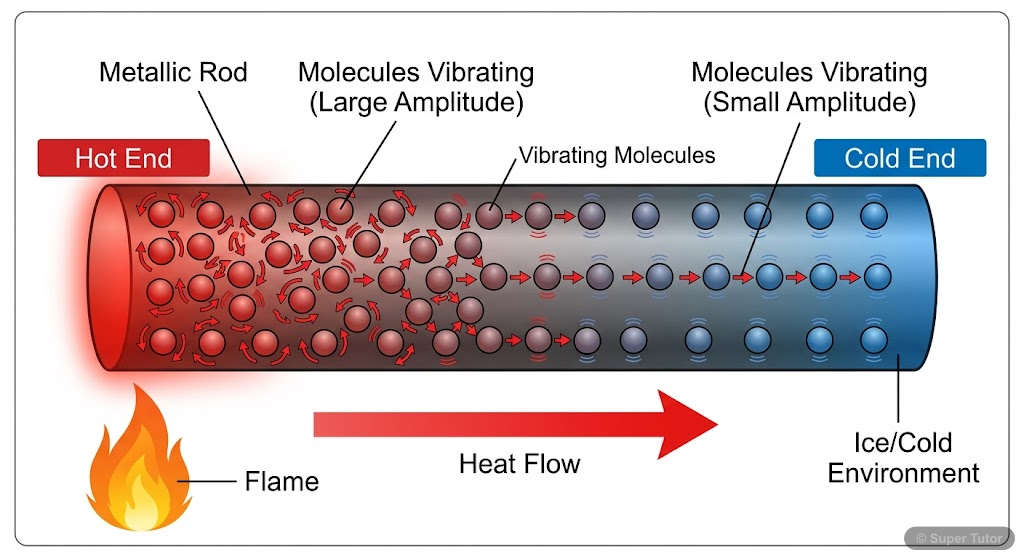
Learn better with visuals Super Tutor pairs illustrations like this with notes and quizzes for Heat Transfer and Solar Energy.
Overview
Heat is a form of energy that flows naturally from a body at higher temperature to a body at lower temperature. This chapter explores the three fundamental processes by which heat is transferred — conduction, convection, and radiation — and connects them to real-world phenomena like monsoons, solar
Key Concepts
Conduction is the transfer of heat
Conduction is the transfer of heat through a material medium without any actual movement of the molecules. In solids, atoms are tightly bound and cann
Convection is the transfer of heat
Convection is the transfer of heat through the actual bodily movement of fluid molecules (liquids or gases). When a fluid near a heat source gets hot,
Radiation is the transfer of heat
Radiation is the transfer of heat energy in the form of electromagnetic waves (infrared radiation). Unlike conduction and convection, radiation does N
Thermal conductivity K is a material
Thermal conductivity K is a material property that measures how easily heat flows through it. It is defined as the amount of heat transferred per seco
Wien's Displacement Law states that
Wien's Displacement Law states that the wavelength at which a black body emits maximum intensity of radiation (λm) is inversely proportional to the ab
Learning Objectives
- Distinguish clearly between conduction, convection, and radiation as processes of heat transfer
- Define and apply the coefficient of thermal conductivity (K) in numerical problems using the formula Q = KA(Th - Tc)t/d
- Define emissive power and absorptive power of a body and state Kirchhoff's Law of radiation
- State and apply Wien's Displacement Law (λm × T = constant) to find peak wavelength and temperature
- State and apply Stefan-Boltzmann Law (E = eσAT⁴) for calculating radiated power
Frequently Asked Questions
What are the important topics in Heat Transfer and Solar Energy for NIOS Class 12 Physics?
How should I revise Heat Transfer and Solar Energy for the NIOS Class 12 board exam?
Sources & Official References
Content is aligned to the official syllabus. Refer to the board website for the latest curriculum.
More resources for Heat Transfer and Solar Energy
Practice Quiz
Test yourself with a quick quiz
Important Questions
Exam-style questions with answers
Revision Notes
Key points for last-minute revision
Formula Sheet
The chapter's formulas in one place
Concept Maps
See how topics connect
Study Plan
Step-by-step plan for this chapter
Flashcards
Quick-fire cards for active recall
Syllabus
What topics to cover
For serious students
Get the full Heat Transfer and Solar Energy chapter — start free.
Quizzes, flashcards, an AI doubt solver and a study plan for NIOS Class 12 Physics. Free to start, no card needed.