Heat Transfer and Solar Energy — Important Questions
NIOS · Class 12 · Physics
45 important questions from Heat Transfer and Solar Energy for NIOS Class 12 Physics, with answers. Written for the board exams 2027.
Interactive on Super Tutor
Studying Heat Transfer and Solar Energy? Get the full interactive chapter.
Quizzes, flashcards, AI doubt-solver and a step-by-step study plan — built for important questions and more.
Free trial, no card needed.
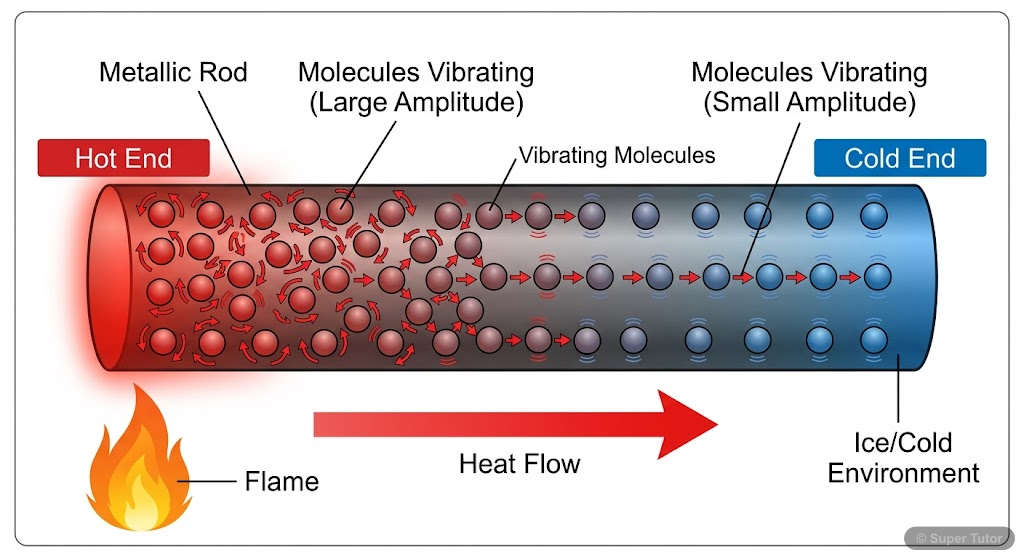
Learn better with visuals Super Tutor pairs illustrations like this with notes and quizzes for Heat Transfer and Solar Energy.
Important Questions from Heat Transfer and Solar Energy
According to Stefan-Boltzmann law, the energy radiated per second by a surface is proportional to which power of its absolute temperature?
Show answer
Fourth power (T⁴)
Step 1: The Stefan-Boltzmann law states: E = e·σ·A·T⁴. Step 2: Here, E is the energy radiated per second (power in watts), σ = 5.67 × 10⁻⁸ W m⁻² K⁻⁴ is the Stefan-Boltzmann constant. Step 3: The temperature T must be in Kelvin (not Celsius), and the relationship is with T⁴. Step 4: This means if temperature doubles (T → 2T), the energy radiated increases by a factor of 2⁴ = 16 times. Step 5: Newton's Law of Cooling (E ∝ T – T₀) is a linear relationship and is only a special approximation of the Stefan-Boltzmann law for small temperature differences.
Which gas in the atmosphere is primarily responsible for the greenhouse effect by trapping infrared radiation?
Show answer
Carbon dioxide (CO₂)
Step 1: The greenhouse effect is the trapping of heat (infrared radiation) in the Earth's atmosphere. Step 2: The atmosphere is transparent to visible (short-wavelength) light from the Sun – it passes through and warms the Earth's surface. Step 3: The Earth's surface then re-radiates this energy as infrared (long-wavelength) radiation. Step 4: CO₂ in the atmosphere is opaque to infrared radiation – it reflects it back to Earth, raising the surface temperature. Step 5: Oxygen and Nitrogen make up ~99% of the atmosphere but are transparent to infrared. CO₂, though present in trace amounts, has a
The solar constant for Earth is approximately:
Show answer
1.36 × 10³ W m⁻²
Step 1: The solar constant is defined as the amount of solar energy received per unit area per second at the Earth's surface (perpendicular to sunlight). Step 2: Its experimentally measured value is 1.36 × 10³ W m⁻² = 1360 W m⁻² (approximately 1.36 kW m⁻²). Step 3: This is used to calculate the total power received by Earth: Q = 2πR²C, where R is Earth's radius. Step 4: Q = 2 × 3.14 × (6.4 × 10⁶)² × 1360 ≈ 3.5 × 10¹⁷ W. Step 5: Note: Only half of Earth's surface is illuminated at any time, hence 2πR² (hemisphere) is used.
For a perfectly black body, the value of absorptive power (a) is:
Show answer
1
Step 1: A perfectly black body is defined as one that absorbs ALL incident radiation of every wavelength. Step 2: The absorptive power 'a' is the fraction of incident energy absorbed: a = Energy absorbed / Energy incident. Step 3: Since a perfectly black body absorbs 100% of incident energy, a = 1. Step 4: For a perfectly black body: reflectivity (r) = 0, transmissivity (t) = 0, and a = 1, satisfying r + a + t = 1. Step 5: A perfectly black body is also the best emitter of radiation at any given temperature. Lamp black (absorbs ~96%) and platinum black (~98%) are close approximations in practi
+41 more questions on Heat Transfer and Solar Energy (NIOS Class 12 Physics)
Practise AllFrequently Asked Questions
What are the important topics in Heat Transfer and Solar Energy for NIOS Class 12 Physics?
How many important questions are there in Heat Transfer and Solar Energy?
Sources & Official References
Content is aligned to the official syllabus. Refer to the board website for the latest curriculum.
More resources for Heat Transfer and Solar Energy
Practice Quiz
Test yourself with a quick quiz
Revision Notes
Key points for last-minute revision
Formula Sheet
The chapter's formulas in one place
Chapter Summary
Understand the chapter at a glance
Concept Maps
See how topics connect
Study Plan
Step-by-step plan for this chapter
Flashcards
Quick-fire cards for active recall
Syllabus
What topics to cover
For serious students
Get the full Heat Transfer and Solar Energy chapter — start free.
Quizzes, flashcards, an AI doubt solver and a study plan for NIOS Class 12 Physics. Free to start, no card needed.