Motion in a Plane — Practice Quiz
NIOS · Class 12 · Physics
Try a 4-question quiz on Motion in a Plane for NIOS Class 12 Physics: tap an answer to check it and see why. 45 questions in the full chapter test.
Interactive on Super Tutor
Studying Motion in a Plane? Get the full interactive chapter.
Quizzes, flashcards, AI doubt-solver and a step-by-step study plan — built for practice quiz and more.
Free trial, no card needed.
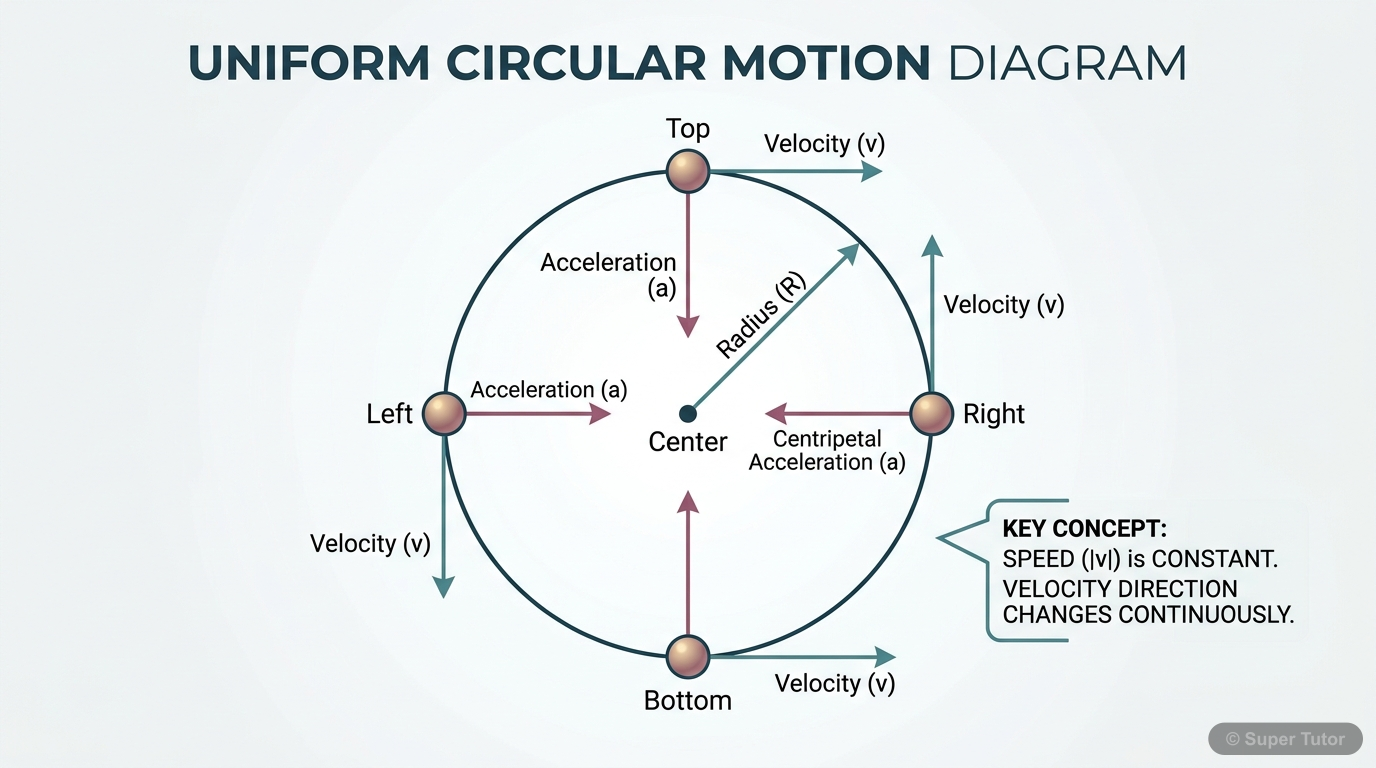
Learn better with visuals Super Tutor pairs illustrations like this with notes and quizzes for Motion in a Plane.
Quick Quiz: Motion in a Plane
0/4Tap an answer to check it instantly. No sign-up needed for these 4.
A ball is projected with an initial speed of 20 m/s at an angle of 30° with the horizontal. What is the maximum height reached by the ball? (Take g = 10 m/s²)
A javelin is thrown with an initial speed of 14 m/s at an angle of 45° to the horizontal. What is the horizontal range of the javelin? (Take g = 9.8 m/s²)
A cricket ball is hit at an angle of 60° with an initial speed of 20 m/s. What is the total time of flight of the ball? (Take g = 10 m/s²)
The equation of the trajectory of a projectile launched from the origin with initial speed v₀ at angle θ₀ is given by y = (tanθ₀)x − [g / (2v₀²cos²θ₀)]x². What shape does this trajectory represent?
Sample Questions
A discus thrower wants to achieve the maximum possible horizontal range. At what angle to the horizontal should the discus be thrown (ignoring air resistance)?
Show answer
45°
Step 1: The range formula is R = v₀² sin2θ / g. Step 2: For R to be maximum, sin2θ must be maximum. Step 3: Maximum value of sin2θ = 1, which occurs when 2θ = 90°, i.e., θ = 45°. At θ = 30° or 60°, sin2θ = sin60° or sin120° = √3/2 ≈ 0.866, which is less than 1. At θ = 90°, sin2θ = sin180° = 0 (no horizontal range).
An athlete runs along a circular track of radius 27 m at a speed of 9 m/s. What is the centripetal acceleration of the athlete?
Show answer
3 m/s²
Step 1: Centripetal acceleration formula: a = v²/r. Step 2: v = 9 m/s, r = 27 m. Step 3: a = (9)² / 27 = 81/27 = 3 m/s². The acceleration is always directed towards the centre of the circle. Wrong options: 9 m/s² is v/r instead of v²/r; 27 m/s² is just the radius; 0.33 m/s² is r/v².
A car of mass 1000 kg moves around a circular bend of radius 100 m at a speed of 20 m/s. What is the centripetal force required to keep it on the circular path?
Show answer
4000 N
Step 1: Centripetal force formula: F = mv²/r. Step 2: m = 1000 kg, v = 20 m/s, r = 100 m. Step 3: F = 1000 × (20)² / 100 = 1000 × 400 / 100 = 4000 N. Wrong options: 2000 N is mv/r (missing one power of v); 200 N is v²/r without mass; 8000 N is double the answer, a common arithmetic error.
A car negotiates a banked curve of radius 300 m at an ideal speed (no friction needed). If g = 10 m/s² and the banking angle is θ, which expression correctly gives the ideal speed v?
Show answer
v = √(rg tanθ)
Step 1: For a banked road without friction, resolve the normal force FN: horizontal component FN sinθ provides centripetal force, vertical component FN cosθ balances weight mg. Step 2: Dividing these two equations: FN sinθ / FN cosθ = (mv²/r) / mg, giving tanθ = v²/(rg). Step 3: Solving for v: v² = rg tanθ, so v = √(rg tanθ). The other options arise from incorrect resolution of forces.
+41 more questions on Motion in a Plane (NIOS Class 12 Physics)
Practise AllFrequently Asked Questions
What are the important topics in Motion in a Plane for NIOS Class 12 Physics?
How many practice questions are there for Motion in a Plane?
Sources & Official References
Content is aligned to the official syllabus. Refer to the board website for the latest curriculum.
More resources for Motion in a Plane
Important Questions
Exam-style questions with answers
Revision Notes
Key points for last-minute revision
Formula Sheet
The chapter's formulas in one place
Chapter Summary
Understand the chapter at a glance
Concept Maps
See how topics connect
Study Plan
Step-by-step plan for this chapter
Flashcards
Quick-fire cards for active recall
Syllabus
What topics to cover
For serious students
Get the full Motion in a Plane chapter — start free.
Quizzes, flashcards, an AI doubt solver and a study plan for NIOS Class 12 Physics. Free to start, no card needed.