Motion in a Plane — Revision Notes
NIOS · Class 12 · Physics
Motion in a Plane revision notes for NIOS Class 12 Physics: 4 topics in quick points. Part of the NIOS Class 12 Physics syllabus.
Interactive on Super Tutor
Studying Motion in a Plane? Get the full interactive chapter.
Quizzes, flashcards, AI doubt-solver and a step-by-step study plan — built for revision notes and more.
Free trial, no card needed.
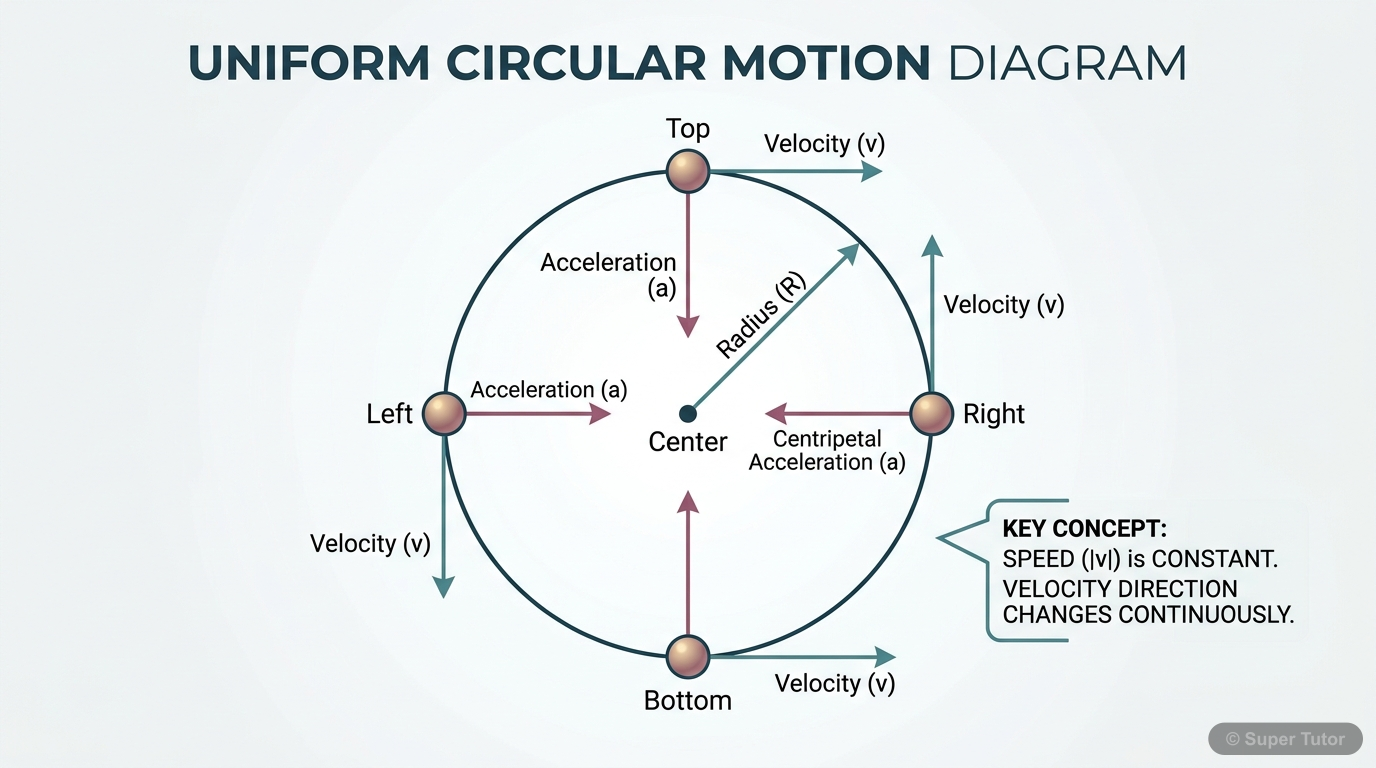
Learn better with visuals Super Tutor pairs illustrations like this with notes and quizzes for Motion in a Plane.
Key Topics to Revise
1. Projectile Motion – Fundamentals
- Galileo first established that horizontal and vertical motions of a projectile are completely INDEPENDENT of each other.
- A projectile is any object launched into the air that moves under the influence of gravity alone (ignoring air resistance).
- Two essential properties: (i) Constant horizontal velocity (no acceleration horizontally), (ii) Constant downward acceleration equal to g = 9.8 m/s² vertically.
2. Projectile Motion – Key Derived Quantities
- Three most important quantities derived from projectile motion: Maximum Height (h), Time of Flight (T), and Range (R).
- At maximum height, only the vertical component of velocity becomes zero. The projectile still has horizontal velocity.
- Time of flight is exactly double the time taken to reach maximum height, because the motion is symmetric (going up and coming down take equal time when launch and landing heights are same).
3. Circular Motion – Concepts and Centripetal Acceleration
- Uniform circular motion means moving in a circle at CONSTANT SPEED.
- Even though speed is constant, the VELOCITY is continuously changing because the direction changes continuously.
- Since velocity changes, there IS acceleration in uniform circular motion – this acceleration is called centripetal acceleration.
4. Motion in a Vertical Circle
- In a HORIZONTAL circle, speed (and hence angular velocity) can remain constant.
- In a VERTICAL circle, speed cannot remain constant due to gravity – it speeds up going down and slows down going up.
- Therefore, angular velocity also changes in vertical circular motion – this makes it NON-uniform circular motion.
Get complete notes with diagrams and examples
Full NotesKey Concepts
Frequently Asked Questions
What are the important topics in Motion in a Plane for NIOS Class 12 Physics?
How should I revise Motion in a Plane for the NIOS Class 12 board exam?
Sources & Official References
Content is aligned to the official syllabus. Refer to the board website for the latest curriculum.
More resources for Motion in a Plane
Practice Quiz
Test yourself with a quick quiz
Important Questions
Exam-style questions with answers
Formula Sheet
The chapter's formulas in one place
Chapter Summary
Understand the chapter at a glance
Concept Maps
See how topics connect
Study Plan
Step-by-step plan for this chapter
Flashcards
Quick-fire cards for active recall
Syllabus
What topics to cover
For serious students
Get the full Motion in a Plane chapter — start free.
Quizzes, flashcards, an AI doubt solver and a study plan for NIOS Class 12 Physics. Free to start, no card needed.