Motion in a Plane — Chapter Summary
NIOS · Class 12 · Physics
Summary of Motion in a Plane for NIOS Class 12 Physics. Key concepts: Projectile motion is a type, At the highest point of its and The time of flight T.
Interactive on Super Tutor
Studying Motion in a Plane? Get the full interactive chapter.
Quizzes, flashcards, AI doubt-solver and a step-by-step study plan — built for chapter summary and more.
Free trial, no card needed.
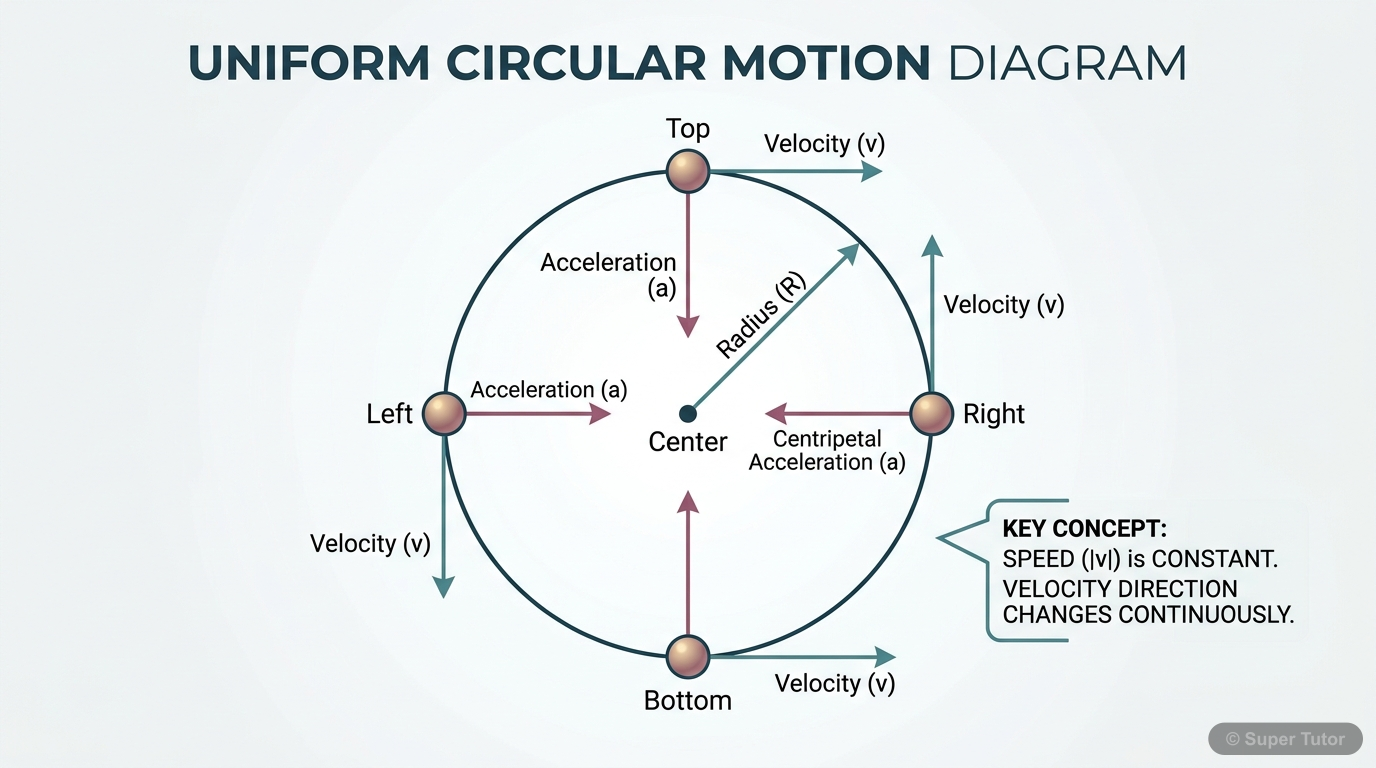
Learn better with visuals Super Tutor pairs illustrations like this with notes and quizzes for Motion in a Plane.
Overview
Motion in a Plane deals with the study of objects moving in two dimensions — that is, along both horizontal and vertical directions simultaneously. In real life, most objects do not move in straight lines. A cricket ball hit by a batsman, a javelin thrown by an athlete, a satellite orbiting the Eart
Key Concepts
Projectile motion is a type
Projectile motion is a type of two-dimensional motion where an object is launched at an angle θ₀ to the horizontal with an initial velocity v₀. After
At the highest point of its
At the highest point of its trajectory, the vertical component of velocity becomes zero (vᵧ = 0). Using vᵧ = v₀ sinθ₀ − gt, the time to reach maximum
The time of flight T
The time of flight T is the total time the projectile remains in the air, from launch to landing (assuming it returns to the same height from which it
The range R is the total
The range R is the total horizontal distance covered by the projectile during its flight. It is calculated as: R = Horizontal velocity × Time of fligh
The trajectory is the actual path
The trajectory is the actual path followed by the projectile. To find its equation, we eliminate the time variable t from the position equations. From
Learning Objectives
- Explain projectile motion and circular motion with real-life examples
- Derive expressions for maximum height, time of flight, and range of a projectile
- Derive the equation of trajectory of a projectile and identify it as a parabola
- Understand and derive expressions for centripetal acceleration and centripetal force
- Explain motion of a body in a vertical circle and find minimum velocities at highest and lowest points
Frequently Asked Questions
What are the important topics in Motion in a Plane for NIOS Class 12 Physics?
How should I revise Motion in a Plane for the NIOS Class 12 board exam?
Sources & Official References
Content is aligned to the official syllabus. Refer to the board website for the latest curriculum.
More resources for Motion in a Plane
Practice Quiz
Test yourself with a quick quiz
Important Questions
Exam-style questions with answers
Revision Notes
Key points for last-minute revision
Formula Sheet
The chapter's formulas in one place
Concept Maps
See how topics connect
Study Plan
Step-by-step plan for this chapter
Flashcards
Quick-fire cards for active recall
Syllabus
What topics to cover
For serious students
Get the full Motion in a Plane chapter — start free.
Quizzes, flashcards, an AI doubt solver and a study plan for NIOS Class 12 Physics. Free to start, no card needed.