Properties of Fluids — Flashcards
NIOS · Class 12 · Physics
40 flashcards for Properties of Fluids (NIOS Class 12 Physics) to test yourself on key terms and facts. Part of the NIOS Class 12 Physics syllabus.
Interactive on Super Tutor
Studying Properties of Fluids? Get the full interactive chapter.
Quizzes, flashcards, AI doubt-solver and a step-by-step study plan — built for flashcards and more.
Free trial, no card needed.
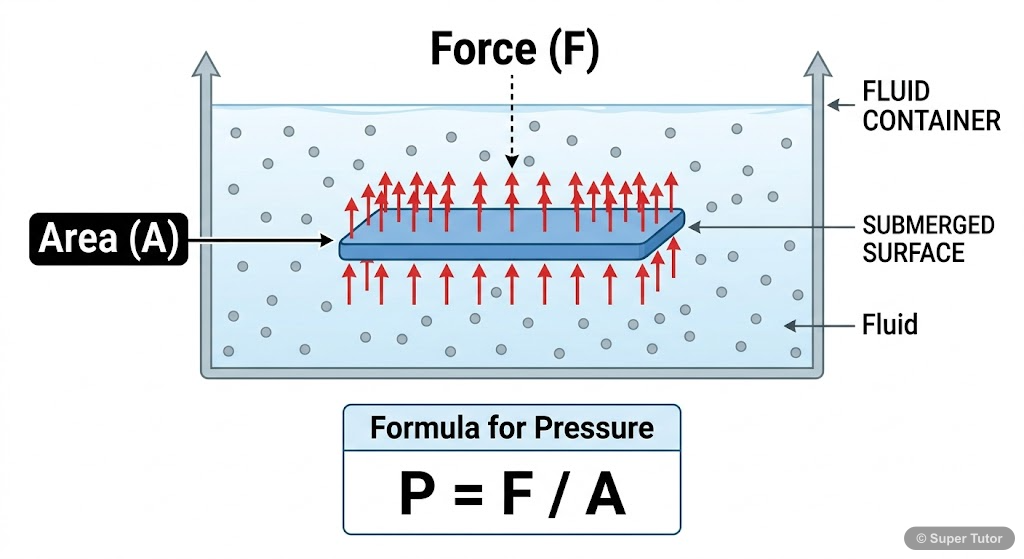
Learn better with visuals Super Tutor pairs illustrations like this with notes and quizzes for Properties of Fluids.
Define pressure and state its SI unit. How is pressure different from force?
Answer
Pressure is the normal force (thrust) acting per unit area of a surface. Formula: P = Force / Area = F / A SI Unit: N m⁻² (Pascal, Pa) — named after French scientist Blaise Pascal. Key Difference: …
Derive the expression for hydrostatic pressure at a depth h inside a liquid of density ρ.
Answer
Consider an imaginary cylinder of cross-section A and height h inside the liquid. Forces acting: • Upward force on bottom face = P₁A • Downward force on top face = P₂A • Weight of liquid in cylinder …
A water dam has a depth of 100 m. A 1 m thick cemented wall can withstand a pressure of 10⁵ N m⁻². Find the required thickness of the wall at the bottom. (ρ_water = 10³ kg m⁻³, g = 9.8 m s⁻²)
Answer
Given: • h = 100 m • ρ = 10³ kg m⁻³ • g = 9.8 m s⁻² • 1 m wall withstands 10⁵ N m⁻² Step 1: Calculate pressure at bottom. P = ρgh = 10³ × 9.8 × 100 P = 9.8 × 10⁵ N m⁻² Step 2: Use unitary method. 10…
Calculate the pressure at the bottom of an ocean at a depth of 1500 m. (ρ_seawater = 1.024 × 10³ kg m⁻³, Pₐₜₘ = 1.01 × 10⁵ Pa, g = 9.80 m s⁻²)
Answer
Given: • h = 1500 m • ρ = 1.024 × 10³ kg m⁻³ • Pₐₜₘ = 1.01 × 10⁵ Pa • g = 9.80 m s⁻² Formula: P = Pₐₜₘ + ρgh Step 1: Calculate ρgh ρgh = 1.024 × 10³ × 9.80 × 1500 = 1.024 × 9.80 × 1500 × 10³ = 1.505…
State Pascal's Law. Give two real-life applications.
Answer
Pascal's Law: When pressure is applied at any part of an enclosed liquid, it is transmitted undiminished to every point of the liquid as well as to the walls of the container. Also called: Law of Tra…
An elephant of weight 5000 kg-f stands on the bigger piston (area = 10 m²) of a hydraulic lift. A boy of mass 25 kg stands on the smaller piston (area = 0.05 m²). Can the boy balance or lift the eleph
Answer
Given: • Weight on large piston (W₂) = 5000 kg-f, A₂ = 10 m² • Mass of boy = 25 kg, A₁ = 0.05 m² Using Pascal's Law: F₁/A₁ = F₂/A₂ ⟹ F₂ = F₁ × (A₂/A₁) Force boy can create on large piston: F₂ = 25 ×…
State Archimedes' Principle. Define buoyant force and explain why objects feel lighter in water.
Answer
Archimedes' Principle: When an object is submerged partially or fully in a fluid, the magnitude of the buoyant force on it is always equal to the weight of the fluid displaced by the object. Buoyant …
Why does a hot air balloon float in the atmosphere? What is the physical principle involved?
Answer
Physical Principle: Archimedes' Principle (Buoyancy) Explanation: • Hot air has less density than cold (surrounding) air. • When the balloon is filled with hot air, it displaces a volume of surroundi…
+32 more flashcards
Practise AllFrequently Asked Questions
What are the important topics in Properties of Fluids for NIOS Class 12 Physics?
How many flashcards are available for Properties of Fluids?
How should I revise Properties of Fluids for the NIOS Class 12 board exam?
Sources & Official References
Content is aligned to the official syllabus. Refer to the board website for the latest curriculum.
More resources for Properties of Fluids
Practice Quiz
Test yourself with a quick quiz
Important Questions
Exam-style questions with answers
Revision Notes
Key points for last-minute revision
Formula Sheet
The chapter's formulas in one place
Chapter Summary
Understand the chapter at a glance
Concept Maps
See how topics connect
Study Plan
Step-by-step plan for this chapter
Syllabus
What topics to cover
For serious students
Get the full Properties of Fluids chapter — start free.
Quizzes, flashcards, an AI doubt solver and a study plan for NIOS Class 12 Physics. Free to start, no card needed.