Properties of Fluids — Chapter Summary
NIOS · Class 12 · Physics
Summary of Properties of Fluids for NIOS Class 12 Physics. Key concepts: Pressure is defined as, When an object is submerged and Pascal's Law states.
Interactive on Super Tutor
Studying Properties of Fluids? Get the full interactive chapter.
Quizzes, flashcards, AI doubt-solver and a step-by-step study plan — built for chapter summary and more.
Free trial, no card needed.
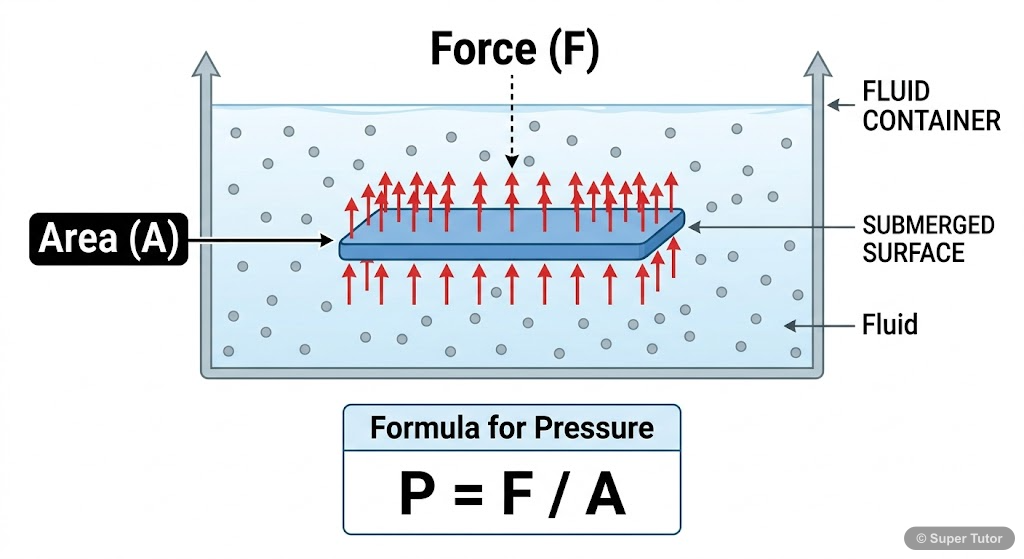
Learn better with visuals Super Tutor pairs illustrations like this with notes and quizzes for Properties of Fluids.
Overview
Fluids — which include both liquids and gases — are substances that flow and take the shape of their container. Unlike solids, fluids cannot sustain shearing stress. This chapter explores the fascinating physical properties of fluids that explain everyday phenomena: why dam walls are thicker at the
Key Concepts
Pressure is defined as the normal
Pressure is defined as the normal force (thrust) exerted per unit area: P = F/A. The SI unit is Pascal (Pa) or Nm⁻². For a liquid of density ρ at a de
When an object is submerged (fully
When an object is submerged (fully or partially) in a fluid, the fluid exerts an upward force called the buoyant force. Archimedes' Principle states:
Pascal's Law states
Pascal's Law states: when pressure is applied to any part of an enclosed liquid at rest, it is transmitted equally and undiminished to every point wit
Surface tension arises due to intermolecular
Surface tension arises due to intermolecular cohesive forces. Molecules deep inside a liquid are attracted equally from all sides (net force = zero).
The angle of contact (θ)
The angle of contact (θ) is the angle between the tangent to the liquid surface and the wall of the container, measured from within the liquid. If adh
Learning Objectives
- Calculate hydrostatic pressure at a given depth inside a liquid using P = ρgh
- Describe buoyancy and state Archimedes' Principle with examples
- State Pascal's Law and explain hydraulic press, hydraulic lift, and hydraulic brakes
- Explain surface tension in terms of intermolecular forces and surface energy
- Derive the expression for capillary rise: h = 2T cosθ / rρg
Frequently Asked Questions
What are the important topics in Properties of Fluids for NIOS Class 12 Physics?
How should I revise Properties of Fluids for the NIOS Class 12 board exam?
Sources & Official References
Content is aligned to the official syllabus. Refer to the board website for the latest curriculum.
More resources for Properties of Fluids
Practice Quiz
Test yourself with a quick quiz
Important Questions
Exam-style questions with answers
Revision Notes
Key points for last-minute revision
Formula Sheet
The chapter's formulas in one place
Concept Maps
See how topics connect
Study Plan
Step-by-step plan for this chapter
Flashcards
Quick-fire cards for active recall
Syllabus
What topics to cover
For serious students
Get the full Properties of Fluids chapter — start free.
Quizzes, flashcards, an AI doubt solver and a study plan for NIOS Class 12 Physics. Free to start, no card needed.