Properties of Fluids — Important Questions
NIOS · Class 12 · Physics
44 important questions from Properties of Fluids for NIOS Class 12 Physics, with answers. Includes multiple choice and multiple correct questions.
Interactive on Super Tutor
Studying Properties of Fluids? Get the full interactive chapter.
Quizzes, flashcards, AI doubt-solver and a step-by-step study plan — built for important questions and more.
Free trial, no card needed.
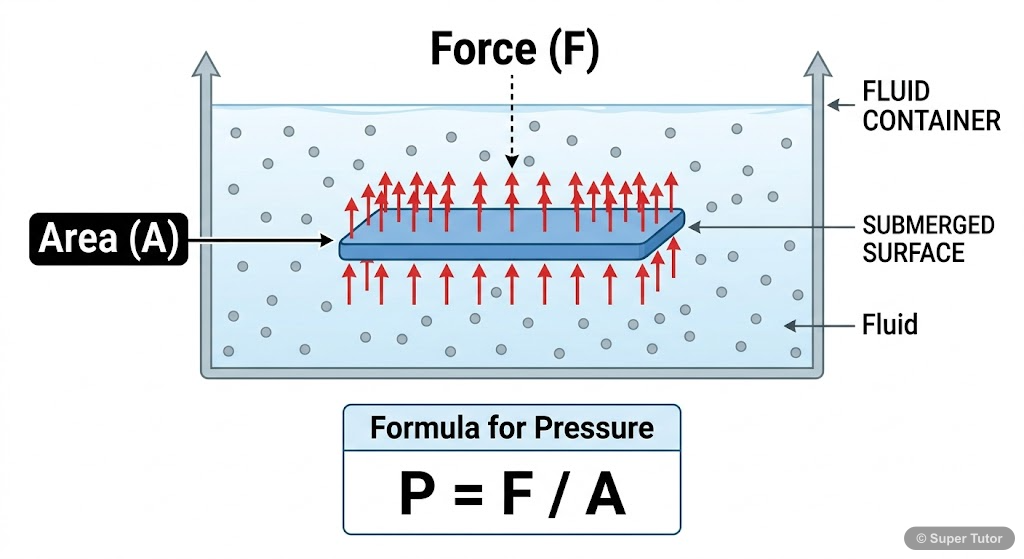
Learn better with visuals Super Tutor pairs illustrations like this with notes and quizzes for Properties of Fluids.
Important Questions from Properties of Fluids
The SI unit of surface tension is:
Show answer
N/m
Step 1: Surface tension T is defined as the force per unit length: T = F/L. Step 2: Unit of force = Newton (N), unit of length = metre (m). Step 3: Therefore, unit of surface tension = N/m. Alternatively, surface tension = surface energy per unit area = J/m², which equals N/m. N/m² is the unit of pressure, N·m is the unit of torque/energy. These are common confusions.
The excess pressure inside a soap bubble of radius r and surface tension T is:
Show answer
4T/r
Step 1: A soap bubble has TWO surfaces — an inner surface and an outer surface, both in contact with air. Step 2: Each surface contributes an excess pressure of 2T/r. Step 3: Total excess pressure = 2T/r + 2T/r = 4T/r. For a liquid drop or air bubble in water (only ONE surface), excess pressure = 2T/r. The factor of 4T/r is specific to soap bubbles because of the two surfaces.
The height to which a liquid rises in a capillary tube of radius r is given by h = 2T cosθ / (rρg). If the radius of the capillary is doubled, what happens to the height of the liquid column?
Show answer
It becomes half
Step 1: The capillary rise formula is h = 2T cosθ / (rρg). Step 2: From the formula, h is inversely proportional to r: h ∝ 1/r. Step 3: If r is doubled (r → 2r), then h → 2T cosθ / (2r × ρg) = (1/2) × original h. So the height becomes half. This explains why water rises much higher in very thin capillaries (like in plant stems) compared to wider ones.
The SI unit of coefficient of viscosity is:
Show answer
N·s/m²
Step 1: Newton's law of viscosity: F = -η A (dv/dx). Step 2: Rearranging: η = F / [A × (dv/dx)]. Step 3: Units: η = N / (m² × (m/s)/m) = N / (m² × s⁻¹) = N·s/m². This is also written as Pa·s (Pascal-second). The CGS unit is 'poise', where 1 poise = 0.1 N·s/m². N/m² alone is the unit of pressure, not viscosity.
+40 more questions on Properties of Fluids (NIOS Class 12 Physics)
Practise AllFrequently Asked Questions
What are the important topics in Properties of Fluids for NIOS Class 12 Physics?
How many important questions are there in Properties of Fluids?
Sources & Official References
Content is aligned to the official syllabus. Refer to the board website for the latest curriculum.
More resources for Properties of Fluids
Practice Quiz
Test yourself with a quick quiz
Revision Notes
Key points for last-minute revision
Formula Sheet
The chapter's formulas in one place
Chapter Summary
Understand the chapter at a glance
Concept Maps
See how topics connect
Study Plan
Step-by-step plan for this chapter
Flashcards
Quick-fire cards for active recall
Syllabus
What topics to cover
For serious students
Get the full Properties of Fluids chapter — start free.
Quizzes, flashcards, an AI doubt solver and a study plan for NIOS Class 12 Physics. Free to start, no card needed.