Properties of Fluids — Revision Notes
NIOS · Class 12 · Physics
Properties of Fluids revision notes for NIOS Class 12 Physics: 4 topics in quick points. Part of the NIOS Class 12 Physics syllabus.
Interactive on Super Tutor
Studying Properties of Fluids? Get the full interactive chapter.
Quizzes, flashcards, AI doubt-solver and a step-by-step study plan — built for revision notes and more.
Free trial, no card needed.
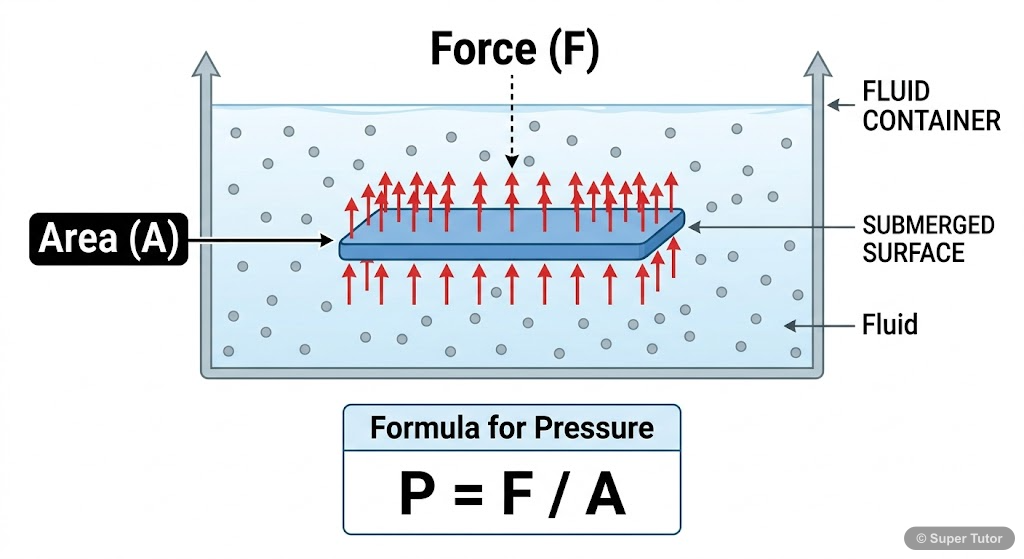
Learn better with visuals Super Tutor pairs illustrations like this with notes and quizzes for Properties of Fluids.
Key Topics to Revise
9.1 Hydrostatic Pressure
- Pressure is defined as force (thrust) per unit area: P = F/A. SI unit is Pascal (Pa) = N m⁻².
- Hydrostatic pressure is the pressure exerted by a fluid at rest.
- Pressure at depth h below free surface: P = P_atm + ρgh. The term ρgh is the gauge pressure.
9.2 Buoyancy and Archimedes' Principle
- Buoyant force is the upward force exerted by a fluid on a submerged (partially or fully) object.
- Archimedes' Principle: Buoyant force = weight of fluid displaced by the object.
- A body floats when buoyant force equals its weight — it displaces fluid equal to its own weight.
9.3 Pascal's Law and Its Applications
- Pascal's Law: Pressure applied at any part of an enclosed liquid is transmitted undiminished to every point of the liquid and to the walls of the container.
- Also called the Law of Transmission of Liquid Pressure.
- Applications: Hydraulic Press, Hydraulic Lift/Jack, Hydraulic Brakes.
9.4 Surface Tension
- Surface tension arises due to intermolecular cohesive forces — molecules at the surface experience a net inward force.
- Surface layer has extra potential energy (surface energy) because work is done to bring molecules to the surface.
- A system tends to minimize surface area to minimize potential energy — hence free liquid drops are spherical.
Get complete notes with diagrams and examples
Full NotesKey Concepts
Frequently Asked Questions
What are the important topics in Properties of Fluids for NIOS Class 12 Physics?
How should I revise Properties of Fluids for the NIOS Class 12 board exam?
Sources & Official References
Content is aligned to the official syllabus. Refer to the board website for the latest curriculum.
More resources for Properties of Fluids
Practice Quiz
Test yourself with a quick quiz
Important Questions
Exam-style questions with answers
Formula Sheet
The chapter's formulas in one place
Chapter Summary
Understand the chapter at a glance
Concept Maps
See how topics connect
Study Plan
Step-by-step plan for this chapter
Flashcards
Quick-fire cards for active recall
Syllabus
What topics to cover
For serious students
Get the full Properties of Fluids chapter — start free.
Quizzes, flashcards, an AI doubt solver and a study plan for NIOS Class 12 Physics. Free to start, no card needed.