Agriculture in India - II: Food Crops — Chapter Summary
ICSE · Class 10 · Geography
Summary of Agriculture in India - II: Food Crops for ICSE Class 10 Geography. Part of the ICSE Class 10 Geography syllabus.
Interactive on Super Tutor
Studying Agriculture in India - II: Food Crops? Get the full interactive chapter.
Quizzes, flashcards, AI doubt-solver and a step-by-step study plan — built for chapter summary and more.
Free trial, no card needed.
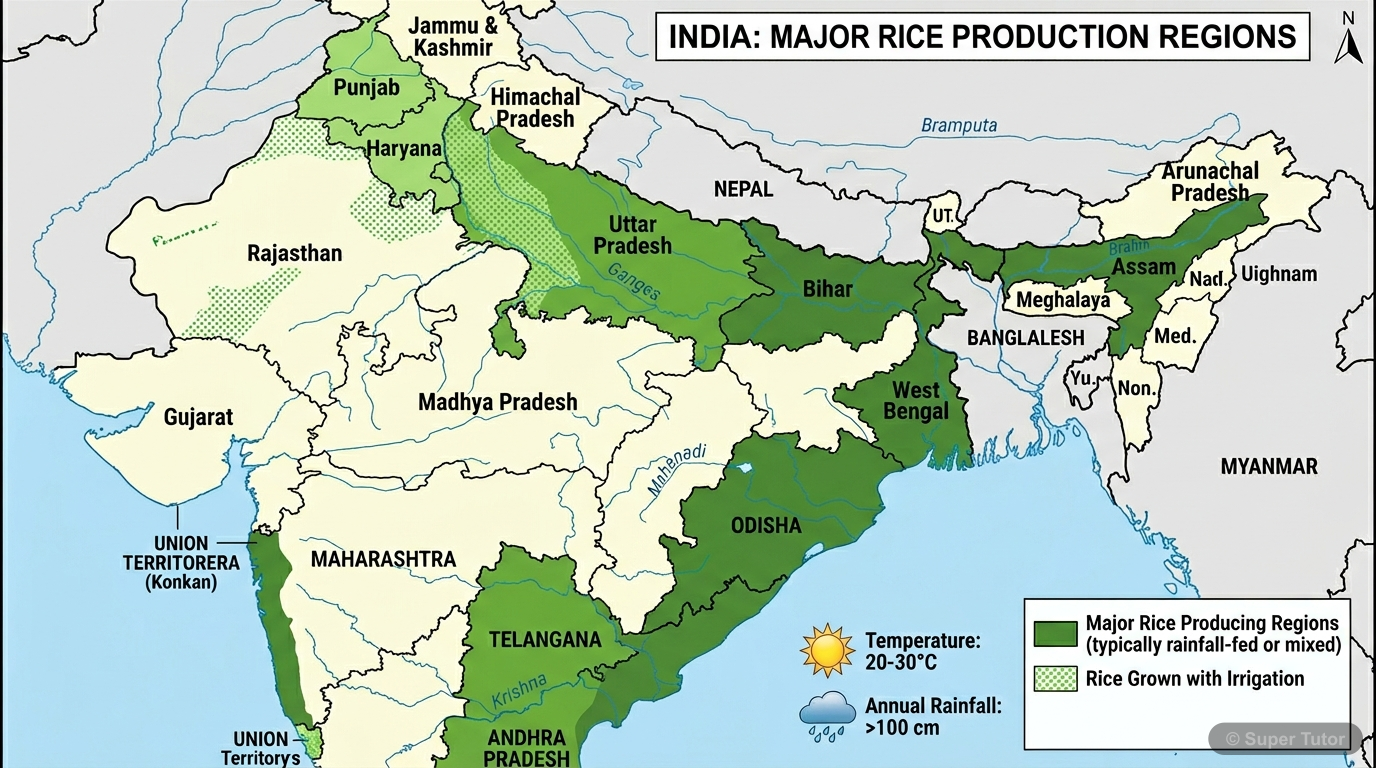
Learn better with visuals Super Tutor pairs illustrations like this with notes and quizzes for Agriculture in India - II: Food Crops.
Get startedOverview
Food crops form the base of Indian agriculture and the daily diet of millions of people. Rice and wheat are the two most important cereal crops, while gram, maize, jowar, bajra and ragi also play major roles in food supply, fodder and soil use. Their growth depends mainly on climate, soil, rainfall,
Key Concepts
Rice is the most important crop
Rice is the most important crop of India and supports half of the Indian population. It is a kharif crop, a tropical as well as sub-tropical crop, and
Rice needs deep fertile clayey
Rice needs deep fertile clayey or friable loam soils, or even black lava soil because it can hold moisture well. It requires plenty of sunshine, an av
Rice is grown by broadcasting
Rice is grown by broadcasting, dibbling, drilling and transplantation. Broadcasting is used for inferior seeds and gives low yield. Drilling saves see
Rice is grown in almost all
Rice is grown in almost all parts of India except the higher parts of the Himalayas. West Bengal is the largest producer of rice in India, and Tamil N
Wheat is the most important foodgrain
Wheat is the most important foodgrain of India and the staple food of people in north and north-west India. It is a temperate crop and a rabi crop, gr
Learning Objectives
- Identify the major food crops of India and their seasonal classification
- Explain the climatic and soil requirements of rice, wheat, gram, maize and millets
- Compare the growing conditions of rice and wheat
- Understand methods of rice cultivation and wheat sowing
- Recognize the main producing states and regions of important food crops
Frequently Asked Questions
What are the important topics in Agriculture in India - II: Food Crops for ICSE Class 10 Geography?
How should I revise Agriculture in India - II: Food Crops for the ICSE Class 10 board exam?
Sources & Official References
Content is aligned to the official syllabus. Refer to the board website for the latest curriculum.
More resources for Agriculture in India - II: Food Crops
For serious students
Get the full Agriculture in India - II: Food Crops chapter — start free.
Quizzes, flashcards, an AI doubt solver and a study plan for ICSE Class 10 Geography. Free to start, no card needed.