Interpretation of Topographical Maps-II
ICSE · Class 10 · Geography
Summary of Interpretation of Topographical Maps-II for ICSE Class 10 Geography. Key concepts, important points, and chapter overview.
Interactive on Super Tutor
Studying Interpretation of Topographical Maps-II? Get the full interactive chapter.
Quizzes, flashcards, AI doubt-solver and a step-by-step study plan — built for chapter summary and more.
1,000+ Class 10 students started this chapter today
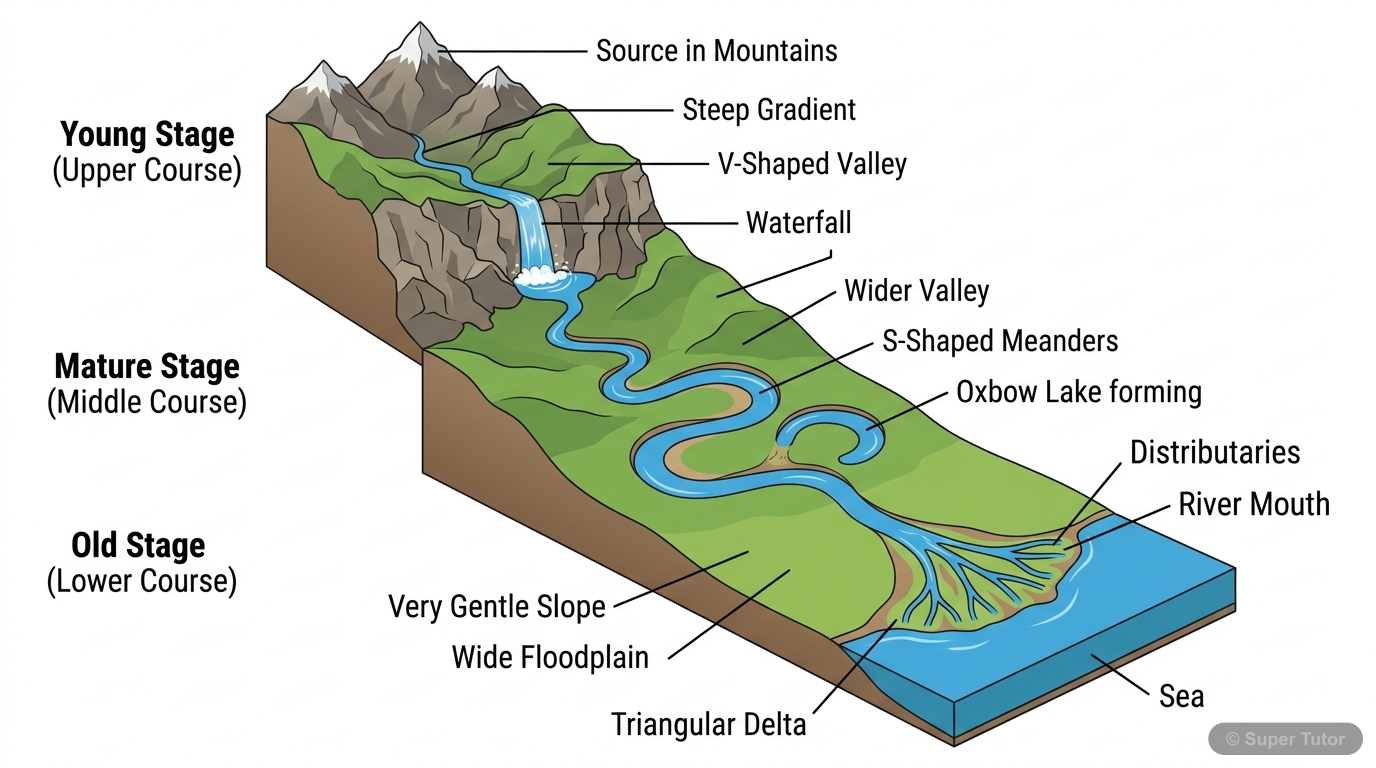
Super Tutor has 9+ illustrations like this for Interpretation of Topographical Maps-II alone — flashcards, concept maps, and step-by-step visuals.
See them allOverview
Topographical map interpretation is the skill of reading land forms, drainage, settlements, transport routes, irrigation, and other features from map symbols, colours, contours, and grid lines. A topographical sheet presents both natural and human features in a compact form, so careful observation m
Key Concepts
The surveyed territory is divided into
The surveyed territory is divided into 100 km x 100 km squares, each named by two English alphabets. Each large sheet is further divided into 10,000 s
Vertical lines are Eastings and
Vertical lines are Eastings and are numbered from West to East. Horizontal lines are Northings and are numbered from South to North. While writing a g
The grid is read from
The grid is read from the South-West corner as the origin. Four-figure grid references give a general location, while six-figure grid references pinpo
A contour is an imaginary line
A contour is an imaginary line joining places at the same height above mean sea level. Contours represent relief in three dimensions on a flat map.
Every fifth contour line in multiples
Every fifth contour line in multiples of 20 m is accentuated to make the pattern distinct.
Learning Objectives
- Identify topographical sheet features using grid reference, scale, contours, and symbols
- Read four-figure and six-figure grid references correctly by stating Eastings before Northings
- Interpret relief using contour spacing, index contours, and landform patterns
- Understand drainage patterns such as dendritic, trellis, and radial
- Recognize man-made and natural features such as causeways, aqueducts, wells, roads, and settlements
Frequently Asked Questions
What are the important topics in Interpretation of Topographical Maps-II for ICSE Class 10 Geography?
How to score full marks in Interpretation of Topographical Maps-II — ICSE Class 10 Geography?
Sources & Official References
Content is aligned to the official syllabus. Refer to the board website for the latest curriculum.
More resources for Interpretation of Topographical Maps-II
Practice Quiz
Test yourself with a quick quiz
Important Questions
Practice with board exam-style questions
Revision Notes
Key points for last-minute revision
Formula Sheet
All formulas in one place
Concept Maps
See how topics connect visually
Study Plan
Step-by-step plan to ace this chapter
Flashcards
Quick-fire cards for active recall
Syllabus
What topics to cover
NCERT Solutions
Every textbook question solved step by step
For serious students
Get the full Interpretation of Topographical Maps-II chapter — for free.
Quizzes, flashcards, AI doubt-solver and a step-by-step study plan for ICSE Class 10 Geography.