Agriculture in India - III: Cash Crops
ICSE · Class 10 · Geography
Summary of Agriculture in India - III: Cash Crops for ICSE Class 10 Geography. Key concepts, important points, and chapter overview.
Interactive on Super Tutor
Studying Agriculture in India - III: Cash Crops? Get the full interactive chapter.
Quizzes, flashcards, AI doubt-solver and a step-by-step study plan — built for chapter summary and more.
1,000+ Class 10 students started this chapter today
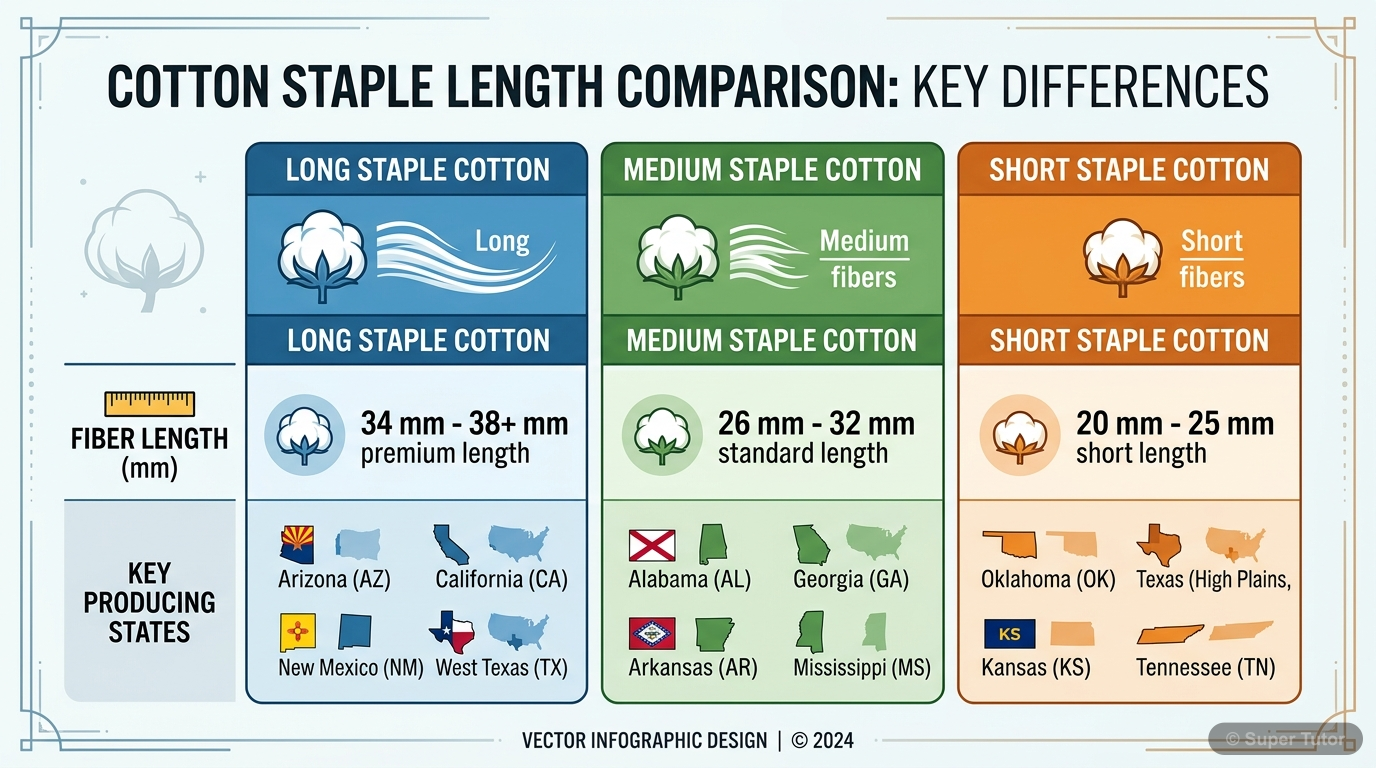
Learn better with visuals Super Tutor has hundreds of illustrations like this across every chapter — all free to try.
Get startedOverview
Cash crops are grown mainly for sale and industrial use rather than for direct food consumption. In India, important cash crops include fibre crops, oilseeds, sugarcane, tea, and coffee. These crops are important because they provide raw material for industries, support trade, and earn foreign excha
Key Concepts
Cotton is an important fibre crop
Cotton is an important fibre crop of India and the basic raw material for the cotton textile industry. It is a rabi as well as a kharif crop, dependin
Jute is the second most important
Jute is the second most important fibre crop of India and is called the golden fibre. It needs a tropical climate with high temperature between 24°C a
Mesta is a substitute for jute
Mesta is a substitute for jute plant. It has coarse fibre, is tolerant of drought, and is grown mainly in Bihar, Assam, and Odisha.
Oilseeds are important commercial crops grown
Oilseeds are important commercial crops grown for edible and non-edible oil. India has the largest area in production of oilseeds, and major oilseeds
Groundnut is the most important oilseed
Groundnut is the most important oilseed of India and accounts for about half of the major seeds produced in India. It is both a kharif and rabi crop,
Learning Objectives
- Understand the meaning of cash crops and their importance in the Indian economy.
- Identify the major cash crops of India and their uses.
- Explain the climate, soil, and regional conditions needed for each crop.
- Distinguish between different crop varieties and related farming processes.
- Recognise the importance of processing methods such as ginning, retting, and ratooning.
Frequently Asked Questions
What are the important topics in Agriculture in India - III: Cash Crops for ICSE Class 10 Geography?
How to score full marks in Agriculture in India - III: Cash Crops — ICSE Class 10 Geography?
Sources & Official References
Content is aligned to the official syllabus. Refer to the board website for the latest curriculum.
More resources for Agriculture in India - III: Cash Crops
Practice Quiz
Test yourself with a quick quiz
Important Questions
Practice with board exam-style questions
Revision Notes
Key points for last-minute revision
Formula Sheet
All formulas in one place
Concept Maps
See how topics connect visually
Study Plan
Step-by-step plan to ace this chapter
Flashcards
Quick-fire cards for active recall
Syllabus
What topics to cover
NCERT Solutions
Every textbook question solved step by step
For serious students
Get the full Agriculture in India - III: Cash Crops chapter — for free.
Quizzes, flashcards, AI doubt-solver and a step-by-step study plan for ICSE Class 10 Geography.