Location, Extent and Physical Features of India — Chapter Summary
ICSE · Class 10 · Geography
Summary of Location, Extent and Physical Features of India for ICSE Class 10 Geography. Part of the ICSE Class 10 Geography syllabus.
Interactive on Super Tutor
Studying Location, Extent and Physical Features of India? Get the full interactive chapter.
Quizzes, flashcards, AI doubt-solver and a step-by-step study plan — built for chapter summary and more.
Free trial, no card needed.
Learn better with visuals Super Tutor pairs illustrations like this with notes and quizzes for Location, Extent and Physical Features of India.
Get startedOverview
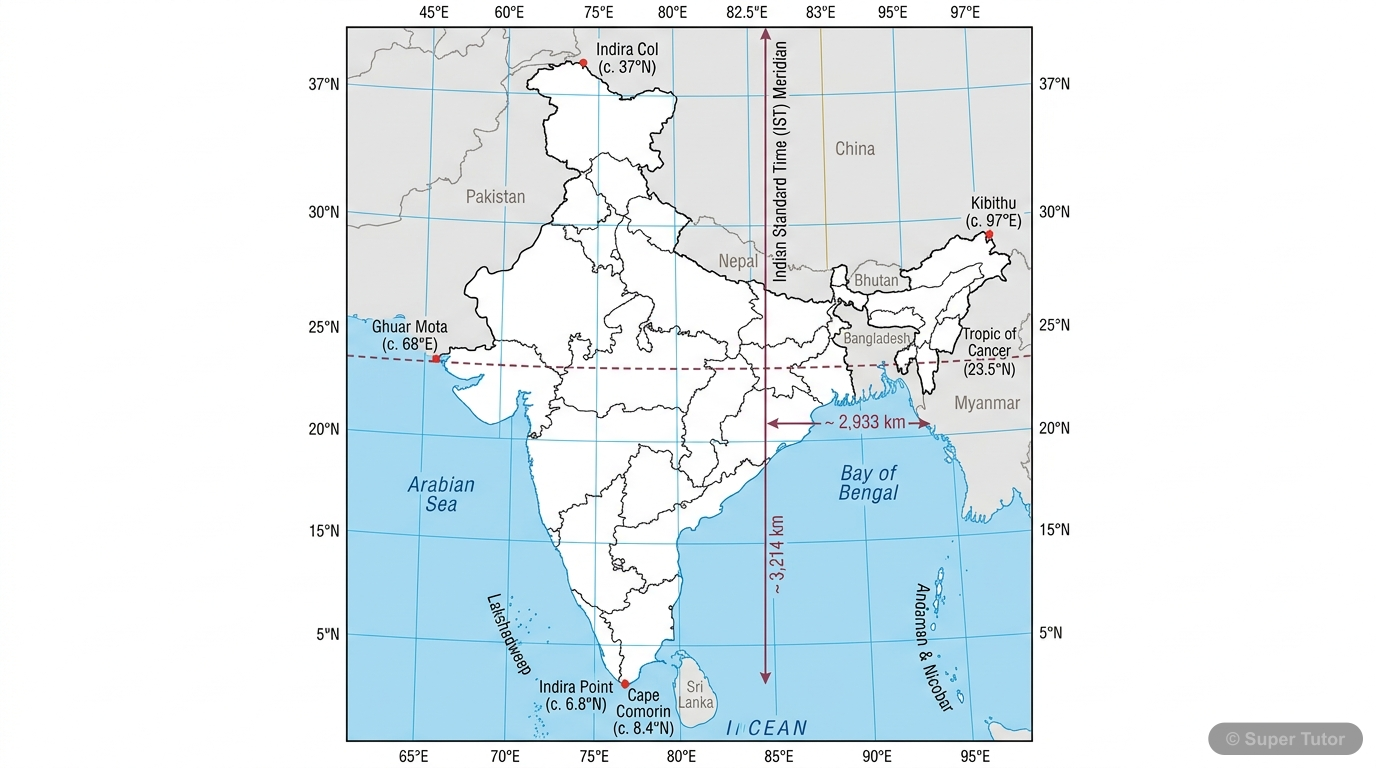
India is the world's seventh largest country and has a varied landscape rich in natural resources. Its location extends from 8°N to 37°N latitude and 68°E to 97°E longitude. The mainland stretches nearly thirty degrees both latitudinally and longitudinally, with the Andaman and Nicobar Islands exten
Key Concepts
India extends from 8°N to 37°N
India extends from 8°N to 37°N latitudes and from 68°E to 97°E longitudes. Its area is 3,287,240 sq km. The precise coordinates are Lat. 8°4'N to 37°6
The Tropic of Cancer passes through
The Tropic of Cancer passes through the middle of India and divides it into north temperate and south tropical lands. India is still classified as a t
India shares land boundaries with countries
India shares land boundaries with countries in the north, north-west, north-east, east, and west. Pakistan lies to the west, China and Nepal lie to th
India has five major physical divisions
India has five major physical divisions: the Himalayan Mountains, the Great Plain of North India, the Peninsular Plateau, the Coastal Plains, and the
The Himalayas form India’s northern wall
The Himalayas form India’s northern wall and are divided into the North-West Range, the Northern Himalayan Range or Northern Arc, and the North-East H
Learning Objectives
- Understand the location and extent of India using latitudes, longitudes, and coordinates.
- Identify India’s neighbouring countries and major surrounding water bodies.
- Explain why India is considered a tropical country despite the Tropic of Cancer dividing it into two parts.
- Describe the major physical divisions of India.
- Recognize the main features of the Himalayas, the Northern Plain, the Peninsular Plateau, the Coastal Plains, and the Islands.
Frequently Asked Questions
What are the important topics in Location, Extent and Physical Features of India for ICSE Class 10 Geography?
How should I revise Location, Extent and Physical Features of India for the ICSE Class 10 board exam?
Sources & Official References
Content is aligned to the official syllabus. Refer to the board website for the latest curriculum.
More resources for Location, Extent and Physical Features of India
For serious students
Get the full Location, Extent and Physical Features of India chapter — start free.
Quizzes, flashcards, an AI doubt solver and a study plan for ICSE Class 10 Geography. Free to start, no card needed.