Agriculture in India - III: Cash Crops — Flashcards
ICSE · Class 10 · Geography
46 flashcards for Agriculture in India - III: Cash Crops (ICSE Class 10 Geography) to test yourself on key terms and facts.
Interactive on Super Tutor
Studying Agriculture in India - III: Cash Crops? Get the full interactive chapter.
Quizzes, flashcards, AI doubt-solver and a step-by-step study plan — built for flashcards and more.
Free trial, no card needed.
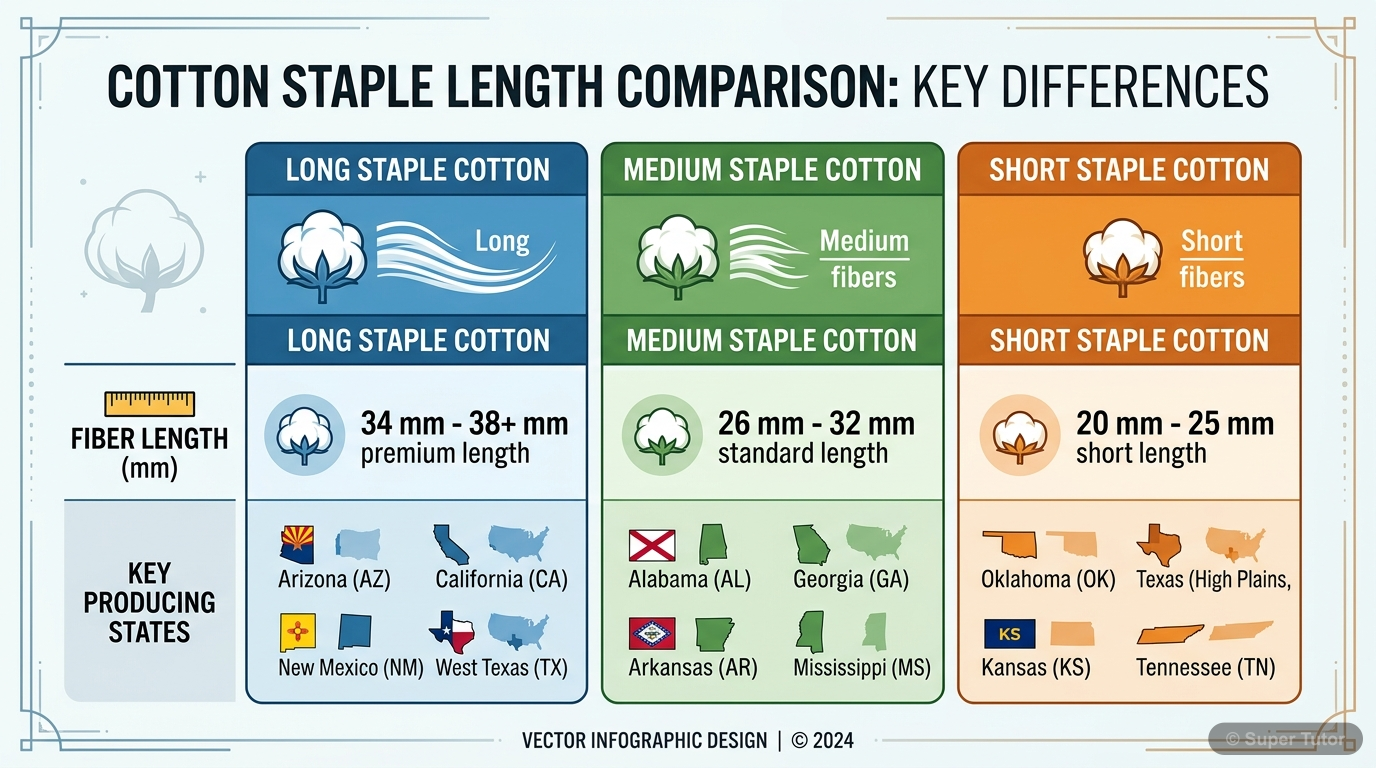
One of 8 illustrations for Agriculture in India - III: Cash Crops in Super Tutor — alongside flashcards, concept maps and practice questions.
See them allWhat are cash crops in agriculture?
Answer
Cash crops are crops grown mainly as raw material for industries or for sale in the market, not mainly for direct food use. Examples include cotton, jute, sugarcane, tea, coffee, and oilseeds such as …
Why is cotton considered an important fibre crop of India?
Answer
Cotton is an important fibre crop because it provides the basic raw material for the cotton textile industry. It is also a major commercial crop and India is one of the main producers of cotton in the…
What kind of climate does cotton need?
Answer
Cotton needs a warm climate with bright sunshine with temperature between 21°C and 27°C. It needs 200 frost-free days and moderate rainfall of 50 to 80 cm, well distributed through the year.
Why is cotton grown as a kharif crop in peninsular India?
Answer
Cotton is grown as a kharif crop in peninsular India because there is no fear of frost damaging the crop. Frost is harmful for cotton, so cropping season depends on the region.
What is long staple cotton?
Answer
Long staple cotton is a cotton variety with fibre length of 24 to 27 mm. It is used to make fine quality cotton cloth. Egyptian cotton is the world-famous example of this variety. About half of India'…
Which states produce long staple cotton?
Answer
Long staple cotton is produced in Punjab, Haryana, Maharashtra, Tamil Nadu, Andhra Pradesh, and Telangana. Punjab produces good quality long stapled cotton, while Gujarat is the largest producer in In…
What is the difference between ginning and retting?
Answer
Ginning is the cotton-specific process in which cotton fibre is separated from the seed. Retting is the jute-specific microbiological process in which bundles are submerged in water so that the bark l…
Why is jute called the golden fibre?
Answer
Jute is called the golden fibre because of the versatile nature of its colour. It is also an important fibre crop after cotton and is used for items such as gunny bags, ropes, carpets, tarpaulins, and…
+38 more flashcards
Practise AllFrequently Asked Questions
What are the important topics in Agriculture in India - III: Cash Crops for ICSE Class 10 Geography?
How many flashcards are available for Agriculture in India - III: Cash Crops?
How should I revise Agriculture in India - III: Cash Crops for the ICSE Class 10 board exam?
Sources & Official References
Content is aligned to the official syllabus. Refer to the board website for the latest curriculum.
More resources for Agriculture in India - III: Cash Crops
Practice Quiz
Test yourself with a quick quiz
Important Questions
Exam-style questions with answers
Revision Notes
Key points for last-minute revision
Chapter Summary
Understand the chapter at a glance
Concept Maps
See how topics connect
Study Plan
Step-by-step plan for this chapter
Syllabus
What topics to cover
For serious students
Get the full Agriculture in India - III: Cash Crops chapter — start free.
Quizzes, flashcards, an AI doubt solver and a study plan for ICSE Class 10 Geography. Free to start, no card needed.