Mineral and Energy Resources II — Flashcards
ICSE · Class 10 · Geography
62 flashcards for Mineral and Energy Resources II (ICSE Class 10 Geography) to test yourself on key terms and facts.
Interactive on Super Tutor
Studying Mineral and Energy Resources II? Get the full interactive chapter.
Quizzes, flashcards, AI doubt-solver and a step-by-step study plan — built for flashcards and more.
Free trial, no card needed.
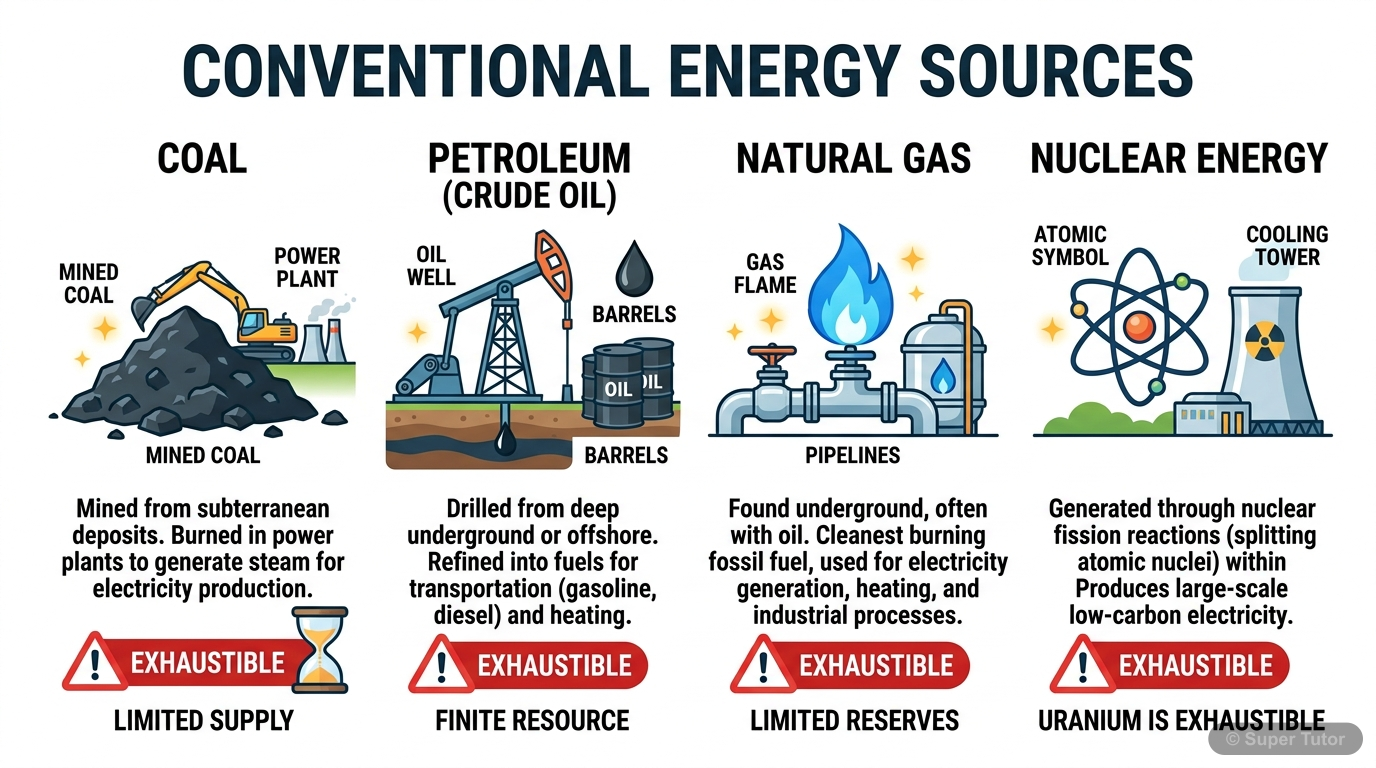
Learn better with visuals Super Tutor pairs illustrations like this with notes and quizzes for Mineral and Energy Resources II.
Get startedWhat are conventional energy sources?
Answer
Conventional energy sources are energy sources that cannot be replaced quickly after use. Coal, petroleum, and natural gas are conventional or non-renewable energy sources.
What is coal?
Answer
Coal is a conventional source of energy. It is an inflammable organic substance composed of hydrocarbons found in sedimentary rocks, and it is the main source of power generation in India.
What are the four varieties of coal by carbon content?
Answer
The four varieties are anthracite, bituminous coal, lignite, and peat. They are classified by the percentage of carbon present in them.
What is anthracite coal?
Answer
Anthracite is the best quality of coal. It contains over 80% carbon. It is hard, compact, and black in colour, and is found only in Jammu and Kashmir in small quantity.
Why is bituminous coal important?
Answer
Bituminous coal is the most widely used variety of coal. It contains about 60-80% carbon, has high calorific value, and is used for heating, steam raising, and coke production. It is found in Jharkhan…
What is lignite?
Answer
Lignite is also called brown coal. It is of inferior quality, friable in nature, and contains more moisture and less combustible matter. It is found in Palna in Rajasthan, Neyveli in Tamil Nadu, Lakhi…
What is peat in the coal formation process?
Answer
Peat is the first stage of transformation of wood to coal. It contains about 50-60% carbon and emits more smoke and ash after burning.
Why is coal called the backbone of power generation in India?
Answer
Coal is the main source of power generation in India. It also supplies energy to iron and steel industries and many chemical industries. Its wide availability and low cost make it very important for i…
+54 more flashcards
Practise AllFrequently Asked Questions
What are the important topics in Mineral and Energy Resources II for ICSE Class 10 Geography?
How many flashcards are available for Mineral and Energy Resources II?
How should I revise Mineral and Energy Resources II for the ICSE Class 10 board exam?
Sources & Official References
Content is aligned to the official syllabus. Refer to the board website for the latest curriculum.
More resources for Mineral and Energy Resources II
Practice Quiz
Test yourself with a quick quiz
Important Questions
Exam-style questions with answers
Revision Notes
Key points for last-minute revision
Formula Sheet
The chapter's formulas in one place
Chapter Summary
Understand the chapter at a glance
Concept Maps
See how topics connect
Study Plan
Step-by-step plan for this chapter
Syllabus
What topics to cover
For serious students
Get the full Mineral and Energy Resources II chapter — start free.
Quizzes, flashcards, an AI doubt solver and a study plan for ICSE Class 10 Geography. Free to start, no card needed.