Interpretation of Topographical Maps-II — Flashcards
ICSE · Class 10 · Geography
40 flashcards for Interpretation of Topographical Maps-II (ICSE Class 10 Geography) to test yourself on key terms and facts.
Interactive on Super Tutor
Studying Interpretation of Topographical Maps-II? Get the full interactive chapter.
Quizzes, flashcards, AI doubt-solver and a step-by-step study plan — built for flashcards and more.
Free trial, no card needed.
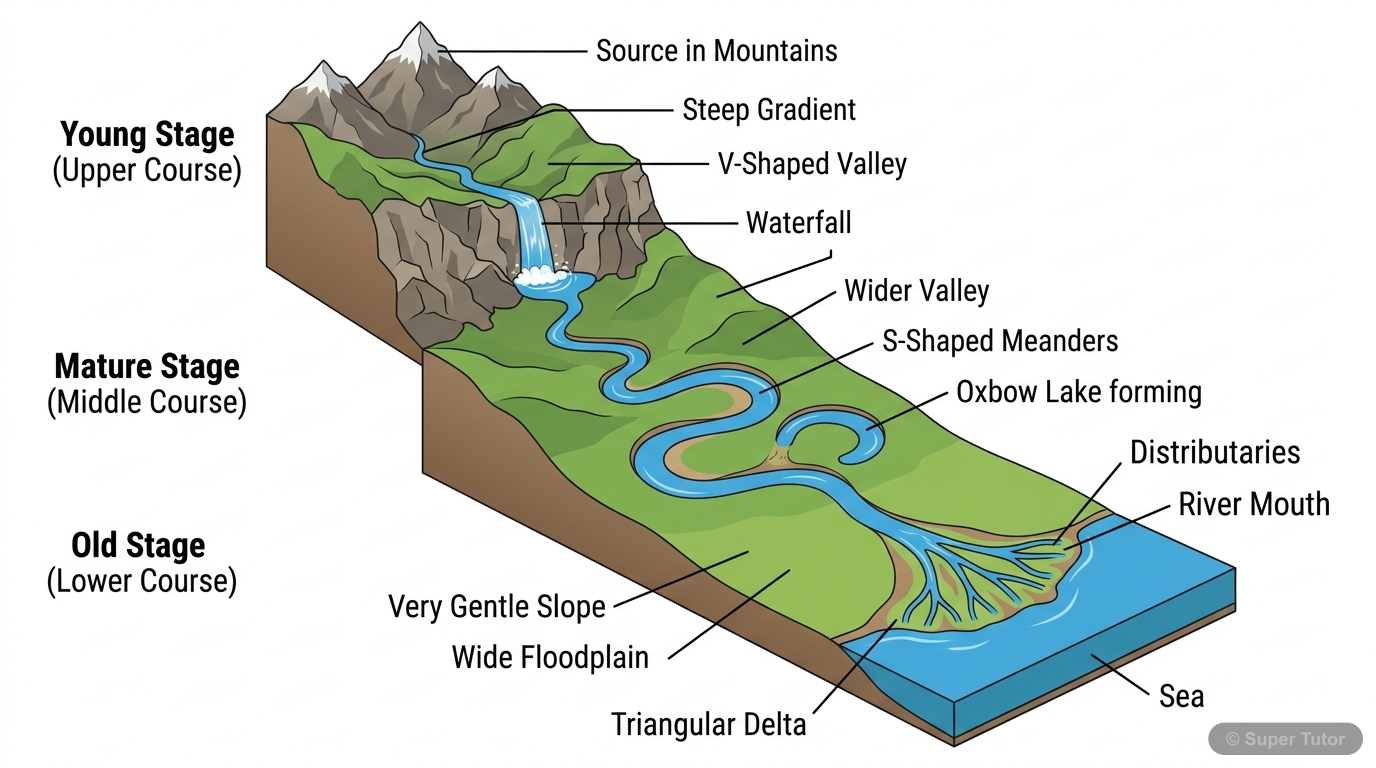
One of 9 illustrations for Interpretation of Topographical Maps-II in Super Tutor — alongside flashcards, concept maps and practice questions.
See them allWhat is a topographical map used for?
Answer
A topographical map shows both natural features and man-made features of an area. It helps in understanding relief, drainage, vegetation, roads, settlements, and land use by using symbols, colours, co…
What is the National Grid Reference?
Answer
The National Grid Reference is the system in which surveyed territory is divided into 100 km x 100 km squares, each identified by two English alphabets. Each 100 km x 100 km sheet is further divided i…
What are Eastings and Northings?
Answer
Eastings are vertical lines on a topographical map’s grid, numbered from West to East. Northings are horizontal lines, numbered from South to North. Eastings are stated first in a grid reference, foll…
How is the origin of a grid reference read?
Answer
The origin is the South-West corner of the map. Reading on the map is always taken with reference to this origin. Eastings are read to the East of the origin, and Northings are read to the North of th…
Why is Easting written before Northing in a grid reference?
Answer
Eastings are always stated first, followed by the Northings. This fixed order prevents confusion and gives the correct location of a point on the map.
How is a six-figure grid reference found?
Answer
First, note the four-figure grid reference. Then divide the square into ten equal parts along both axes. Read the Easting to the right of the Easting line and the Northing above the Northing line. For…
What is scale in a topographical map?
Answer
Scale is the ratio between the distance on the map and the corresponding distance on the ground in the same units. It shows how map distance relates to real distance.
State the formula for Representative Fraction.
Answer
Representative Fraction = Distance on the map / Distance on the ground. It is written as a ratio, such as 1:50,000, which means 1 unit on the map represents 50,000 units on the ground.
+32 more flashcards
Practise AllFrequently Asked Questions
What are the important topics in Interpretation of Topographical Maps-II for ICSE Class 10 Geography?
How many flashcards are available for Interpretation of Topographical Maps-II?
How should I revise Interpretation of Topographical Maps-II for the ICSE Class 10 board exam?
Sources & Official References
Content is aligned to the official syllabus. Refer to the board website for the latest curriculum.
More resources for Interpretation of Topographical Maps-II
Practice Quiz
Test yourself with a quick quiz
Important Questions
Exam-style questions with answers
Revision Notes
Key points for last-minute revision
Formula Sheet
The chapter's formulas in one place
Chapter Summary
Understand the chapter at a glance
Concept Maps
See how topics connect
Study Plan
Step-by-step plan for this chapter
Syllabus
What topics to cover
For serious students
Get the full Interpretation of Topographical Maps-II chapter — start free.
Quizzes, flashcards, an AI doubt solver and a study plan for ICSE Class 10 Geography. Free to start, no card needed.