The Second World War (1939-45)
ICSE · Class 10 · History & Civics
Flashcards for The Second World War (1939-45) — ICSE Class 10 History & Civics. Quick Q&A cards covering key concepts, definitions, and formulas.
Interactive on Super Tutor
Studying The Second World War (1939-45)? Get the full interactive chapter.
Quizzes, flashcards, AI doubt-solver and a step-by-step study plan — built for flashcards and more.
1,000+ Class 10 students started this chapter today
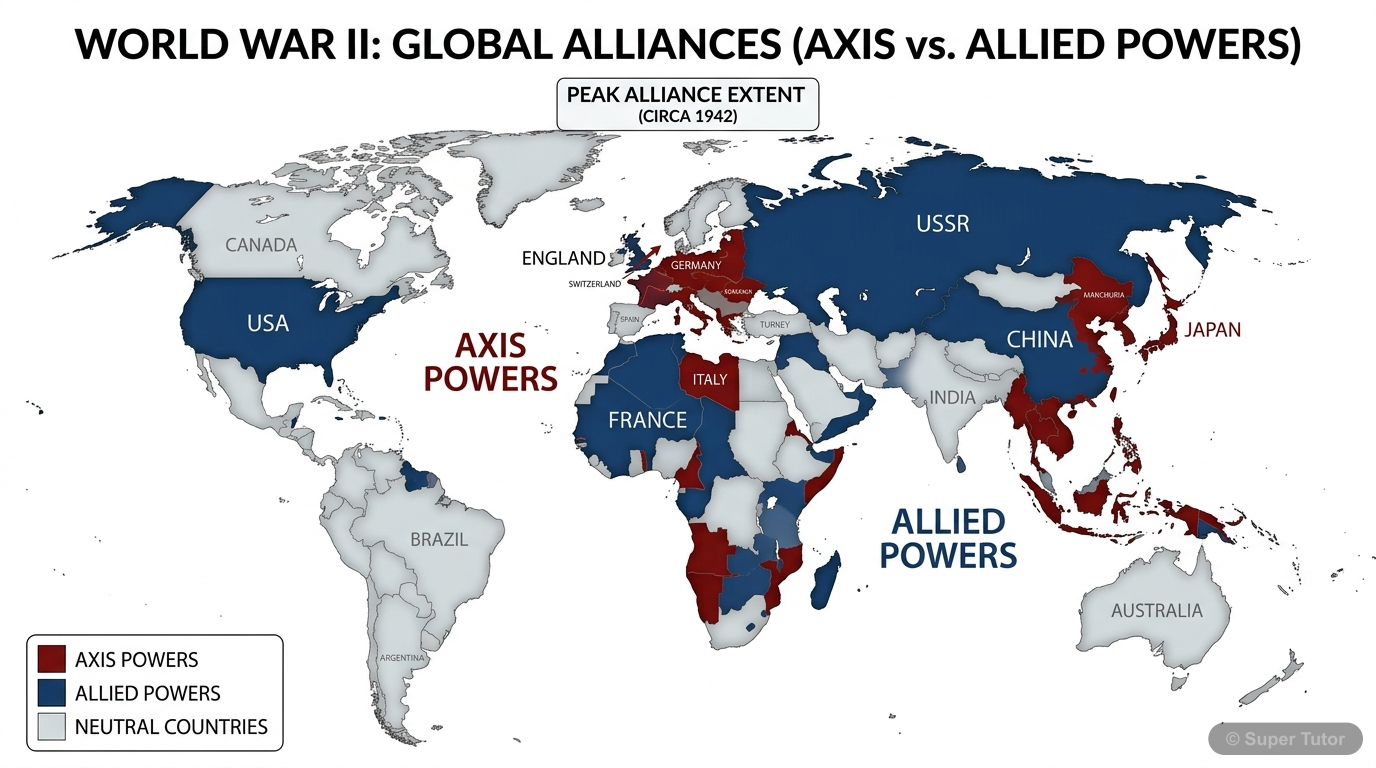
Super Tutor has 5+ illustrations like this for The Second World War (1939-45) alone — flashcards, concept maps, and step-by-step visuals.
See them allWhy did the Second World War begin in 1939?
Answer
The war began because aggressive policies by Germany, Italy, and Japan created a tense world situation. The immediate trigger was Germany's attack on Poland on 1 September 1939, after which Britain an…
What was the effect of the Treaty of Versailles on Germany?
Answer
The Treaty of Versailles was very harsh on Germany. It took away territories and colonies, reduced military power, and imposed a huge war-indemnity. Germans felt humiliated, and this created hatred an…
Who was Adolf Hitler and why was he important in the outbreak of the war?
Answer
Adolf Hitler became the Dictator of Germany by 1934 with all powers in his hands. He rejected the Treaty of Versailles, increased military power, and annexed Rhineland, Austria, Sudetenland, and Czech…
What does fascism mean in the context of Italy?
Answer
Fascism in Italy was a dictatorship under Benito Mussolini. He wanted to revive the glory of the Old Roman Empire, built military strength, and followed an aggressive policy. Italy captured Abyssinia …
How did Japan contribute to the rise of conflict before the war?
Answer
Japan followed a policy of expansion. It seized Manchuria from China in 1931 and fought another war with China in 1937. Later, Japan joined the Rome-Berlin-Tokyo Axis and entered the war in 1941 to ga…
What was the Munich Conference?
Answer
The Munich Conference was held on 29 and 30 September 1938 between Britain, France, Hitler, and Mussolini. It dealt with the Sudetenland issue, and the leaders of Britain and France accepted Hitler's …
Why did Churchill call the Munich agreement "the disaster of the first magnitude"?
Answer
Churchill used this phrase because the agreement gave in to Hitler's demands and encouraged aggression. It became a symbol of weakness and showed that force was being rewarded instead of stopped.
What is meant by appeasement?
Answer
Appeasement means trying to avoid war by giving in to the demands of an aggressive power. Britain and later France followed this policy to avoid conflict with Germany and Italy, but it failed to preve…
+24 more flashcards available
Practice AllFrequently Asked Questions
What are the important topics in The Second World War (1939-45) for ICSE Class 10 History & Civics?
How to score full marks in The Second World War (1939-45) — ICSE Class 10 History & Civics?
How many flashcards are available for The Second World War (1939-45)?
Sources & Official References
Content is aligned to the official syllabus. Refer to the board website for the latest curriculum.
More resources for The Second World War (1939-45)
Practice Quiz
Test yourself with a quick quiz
Important Questions
Practice with board exam-style questions
Revision Notes
Key points for last-minute revision
Formula Sheet
All formulas in one place
Chapter Summary
Understand the chapter at a glance
Concept Maps
See how topics connect visually
Study Plan
Step-by-step plan to ace this chapter
Syllabus
What topics to cover
NCERT Solutions
Every textbook question solved step by step
For serious students
Get the full The Second World War (1939-45) chapter — for free.
Quizzes, flashcards, AI doubt-solver and a step-by-step study plan for ICSE Class 10 History & Civics.