The Second World War (1939-45)
ICSE · Class 10 · History & Civics
Summary of The Second World War (1939-45) for ICSE Class 10 History & Civics. Key concepts, important points, and chapter overview.
Interactive on Super Tutor
Studying The Second World War (1939-45)? Get the full interactive chapter.
Quizzes, flashcards, AI doubt-solver and a step-by-step study plan — built for chapter summary and more.
1,000+ Class 10 students started this chapter today
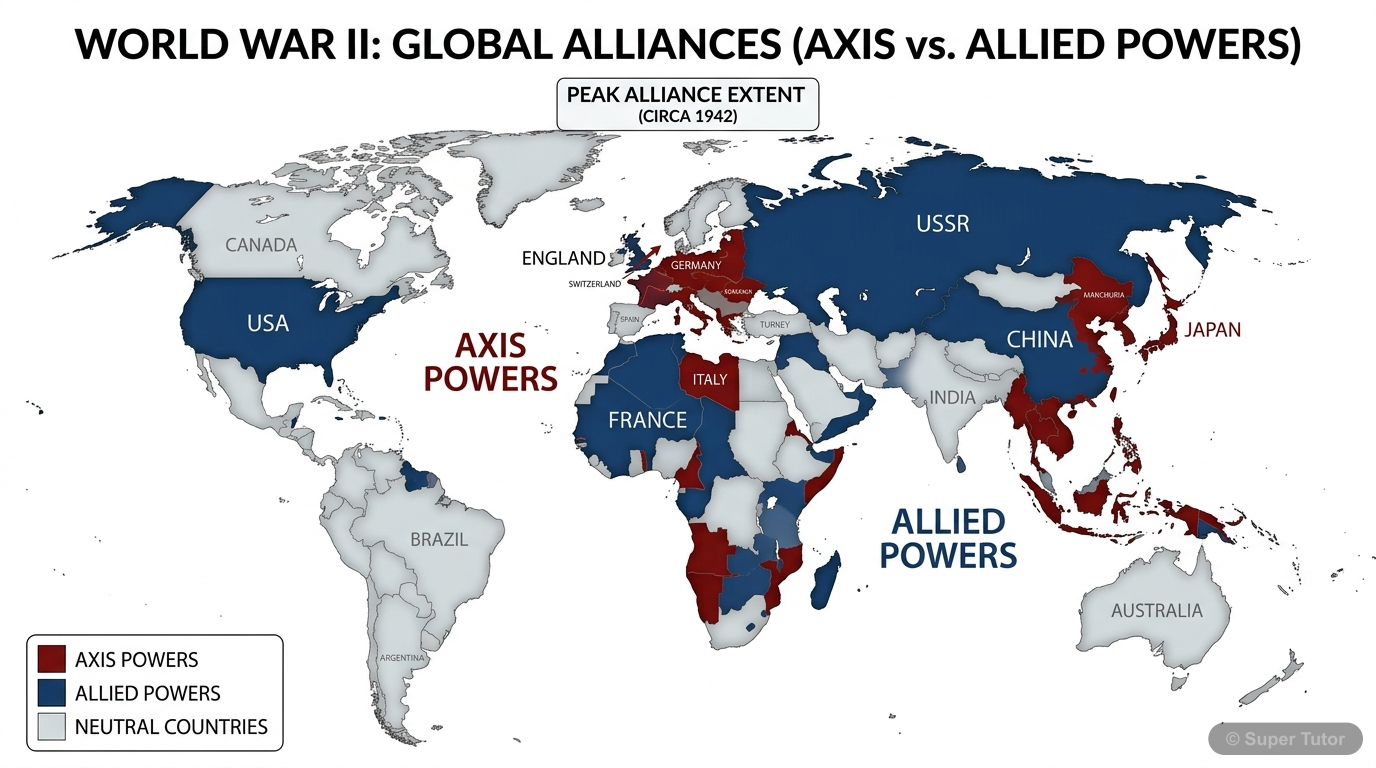
Super Tutor has 5+ illustrations like this for The Second World War (1939-45) alone — flashcards, concept maps, and step-by-step visuals.
See them allOverview
The Second World War began after years of tension created by the harsh Treaty of Versailles, the rise of Hitler in Germany, Mussolini in Italy, and Japan's expansion in Asia. The League of Nations failed to stop aggression, and Europe slowly split into rival camps. Germany's attack on Poland on 1 Se
Key Concepts
The Treaty of Versailles was very
The Treaty of Versailles was very harsh on Germany. Germany lost territories, colonies, military strength, and had to accept humiliating terms. This c
Hitler became the Dictator of Germany
Hitler became the Dictator of Germany by 1934, rejected the Treaty of Versailles, increased military power, and annexed Rhineland, Austria, Sudetenlan
Mussolini established dictatorship in Italy
Mussolini established dictatorship in Italy, wanted to revive the glory of the Old Roman Empire, and captured Abyssinia and Albania.
Japan seized Manchuria from China
Japan seized Manchuria from China in 1931, fought another war with China in 1937, and entered the Second World War in 1941 by joining the Rome-Berlin-
Britain and later France followed
Britain and later France followed a policy of avoiding direct war with aggressive powers like Germany and Italy. This only encouraged further aggressi
Learning Objectives
- Understand the major causes of the Second World War
- Identify the role of Hitler, Mussolini, and Japanese militarism in the outbreak of war
- Explain why the League of Nations failed to prevent war
- Trace the main events of the war in Europe and Asia
- Describe the defeat of Italy, Germany, and Japan
Frequently Asked Questions
What are the important topics in The Second World War (1939-45) for ICSE Class 10 History & Civics?
How to score full marks in The Second World War (1939-45) — ICSE Class 10 History & Civics?
Sources & Official References
Content is aligned to the official syllabus. Refer to the board website for the latest curriculum.
More resources for The Second World War (1939-45)
Practice Quiz
Test yourself with a quick quiz
Important Questions
Practice with board exam-style questions
Revision Notes
Key points for last-minute revision
Formula Sheet
All formulas in one place
Concept Maps
See how topics connect visually
Study Plan
Step-by-step plan to ace this chapter
Flashcards
Quick-fire cards for active recall
Syllabus
What topics to cover
NCERT Solutions
Every textbook question solved step by step
For serious students
Get the full The Second World War (1939-45) chapter — for free.
Quizzes, flashcards, AI doubt-solver and a step-by-step study plan for ICSE Class 10 History & Civics.