Respiration in Plants — Chapter Summary
ICSE · Class 11 · Biology
Summary of Respiration in Plants for ICSE Class 11 Biology. Part of the ICSE Class 11 Biology syllabus. Cellular respiration is the release of energy from.
Interactive on Super Tutor
Studying Respiration in Plants? Get the full interactive chapter.
Quizzes, flashcards, AI doubt-solver and a step-by-step study plan — built for chapter summary and more.
Free trial, no card needed.
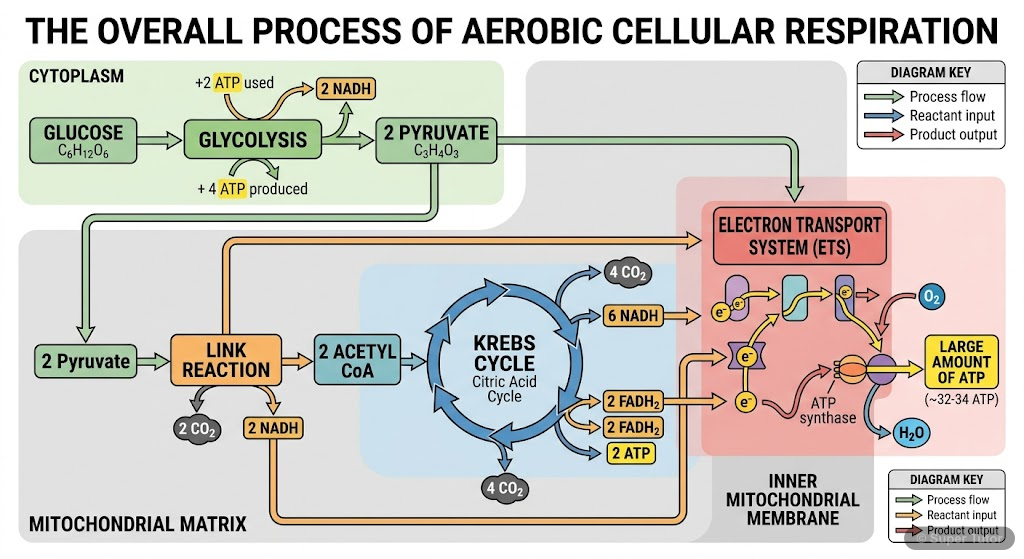
One of 10 illustrations for Respiration in Plants in Super Tutor — alongside flashcards, concept maps and practice questions.
Overview
Cellular respiration is the release of energy from organic substances in a controlled way inside living cells. In plants, it supplies usable energy for growth, transport, movement, secretion, and the synthesis of cell materials. Respiration may be aerobic, using oxygen and occurring in mitochondria,
Key Concepts
Cellular respiration is an exothermic oxidative
Cellular respiration is an exothermic oxidative process in which the chemical energy of organic substances is converted into metabolically usable ener
Aerobic respiration requires molecular oxygen
Aerobic respiration requires molecular oxygen and occurs in mitochondria. Glucose is completely oxidised to carbon dioxide and water, and a large amou
Anaerobic respiration does not require oxygen
Anaerobic respiration does not require oxygen and is catalyzed by enzymes in the cytoplasm. In fermentation, glucose is broken down into ethanol and c
Glycolysis is a series of reactions
Glycolysis is a series of reactions in the cytoplasm in which glucose is converted into pyruvic acid. It does not require oxygen and is common to both
In the mitochondrial matrix
In the mitochondrial matrix, pyruvic acid undergoes oxidative decarboxylation to form acetyl CoA. This reaction needs five essential cofactors and pro
Learning Objectives
- Understand the meaning and importance of cellular respiration in plants
- Distinguish between aerobic and anaerobic respiration
- Describe glycolysis as the first step common to both types of respiration
- Explain the formation of acetyl CoA from pyruvic acid
- Outline the Krebs cycle and its main products
Frequently Asked Questions
What are the important topics in Respiration in Plants for ICSE Class 11 Biology?
How should I revise Respiration in Plants for Class 11 exams?
Sources & Official References
Content is aligned to the official syllabus. Refer to the board website for the latest curriculum.
More resources for Respiration in Plants
Practice Quiz
Test yourself with a quick quiz
Important Questions
Exam-style questions with answers
Revision Notes
Key points for last-minute revision
Formula Sheet
The chapter's formulas in one place
Concept Maps
See how topics connect
Study Plan
Step-by-step plan for this chapter
Flashcards
Quick-fire cards for active recall
Syllabus
What topics to cover
For serious students
Get the full Respiration in Plants chapter — start free.
Quizzes, flashcards, an AI doubt solver and a study plan for ICSE Class 11 Biology. Free to start, no card needed.