Gravitation : Planets and Satellites — Chapter Summary
ICSE · Class 11 · Physics
Summary of Gravitation : Planets and Satellites for ICSE Class 11 Physics. Part of the ICSE Class 11 Physics syllabus.
Interactive on Super Tutor
Studying Gravitation : Planets and Satellites? Get the full interactive chapter.
Quizzes, flashcards, AI doubt-solver and a step-by-step study plan — built for chapter summary and more.
Free trial, no card needed.
Learn better with visuals Super Tutor pairs illustrations like this with notes and quizzes for Gravitation : Planets and Satellites.
Overview
Gravitation is the universal force of attraction between any two material bodies. It explains planetary motion, the motion of satellites, the value of acceleration due to gravity, and the energy of bodies in a gravitational field. Kepler’s laws describe how planets move, while Newton’s law of gravit
Key Concepts
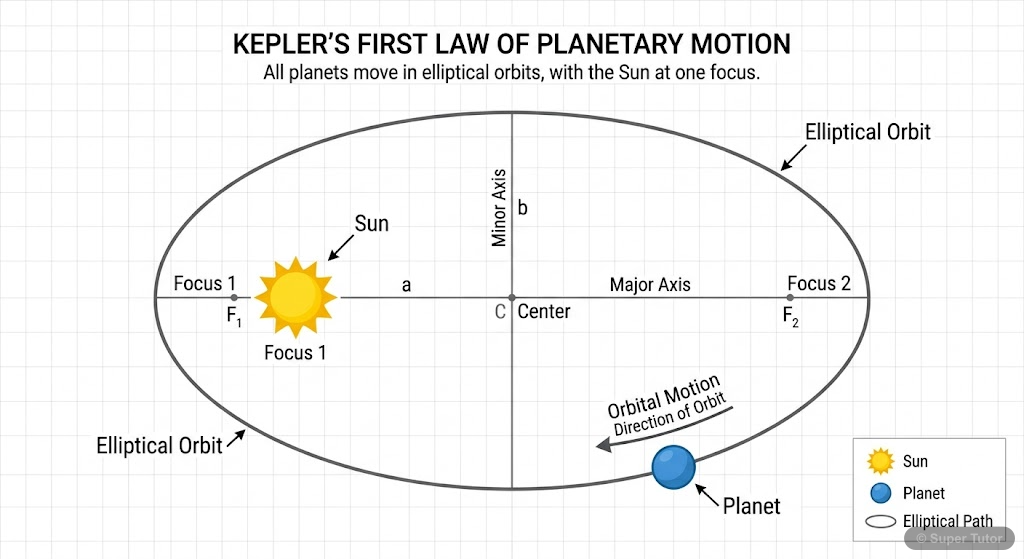
Kepler’s First Law states that planets
Kepler’s First Law states that planets move in elliptical orbits with the sun at one focus. Kepler’s Second Law states that the line joining a planet
Any two material particles attract each
Any two material particles attract each other with a force directly proportional to the product of their masses and inversely proportional to the squa
G is the universal constant
G is the universal constant of proportionality in the law of gravitation. Its value is 6.67×10^-11 N m^2 kg^-2, and its dimensions are [M^-1 L^3 T^-2]
The acceleration due to gravity
The acceleration due to gravity is the rate of increase of velocity of a body falling freely towards the earth. It is a vector quantity, has dimension
The earth has radius Re =
The earth has radius Re = 6.37×10^6 m. The mass of the earth is approximately 6.0×10^24 kg and its average density is about 5.5×10^3 kg m^-3. The moon
Learning Objectives
- Understand Kepler’s three laws of planetary motion.
- Apply Newton’s universal law of gravitation to two bodies.
- Distinguish between gravitation, gravity, G, and g.
- Calculate acceleration due to gravity and its variation with altitude, depth, and latitude.
- Find mass and density of the earth using gravitational relations.
Frequently Asked Questions
What are the important topics in Gravitation : Planets and Satellites for ICSE Class 11 Physics?
How should I revise Gravitation : Planets and Satellites for Class 11 exams?
Sources & Official References
Content is aligned to the official syllabus. Refer to the board website for the latest curriculum.
More resources for Gravitation : Planets and Satellites
Practice Quiz
Test yourself with a quick quiz
Important Questions
Exam-style questions with answers
Revision Notes
Key points for last-minute revision
Formula Sheet
The chapter's formulas in one place
Concept Maps
See how topics connect
Study Plan
Step-by-step plan for this chapter
Flashcards
Quick-fire cards for active recall
Syllabus
What topics to cover
For serious students
Get the full Gravitation : Planets and Satellites chapter — start free.
Quizzes, flashcards, an AI doubt solver and a study plan for ICSE Class 11 Physics. Free to start, no card needed.