Gravitation : Planets and Satellites — Revision Notes
ICSE · Class 11 · Physics
Gravitation : Planets and Satellites revision notes for ICSE Class 11 Physics: 4 topics in quick points. Part of the ICSE Class 11 Physics syllabus.
Interactive on Super Tutor
Studying Gravitation : Planets and Satellites? Get the full interactive chapter.
Quizzes, flashcards, AI doubt-solver and a step-by-step study plan — built for revision notes and more.
Free trial, no card needed.
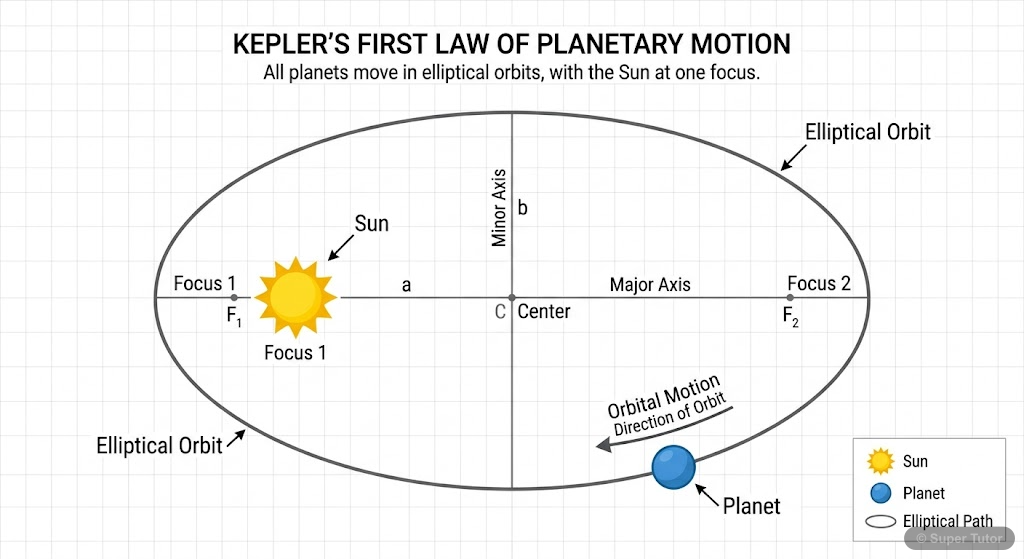
Learn better with visuals Super Tutor pairs illustrations like this with notes and quizzes for Gravitation : Planets and Satellites.
Key Topics to Revise
1. Kepler's Laws and Planetary Motion
- The solar system has eight planets: Mercury, Venus, Earth, Mars, Jupiter, Saturn, Uranus, and Neptune.
- Mercury is the closest planet to the Sun and Neptune is the farthest.
- Saturn has the maximum number of satellites.
2. Newton's Universal Law of Gravitation and Gravitational Constant
- Every particle in the universe attracts every other particle.
- Gravitation is the general force between any two bodies.
- Gravity is the special case of gravitation when one body is the Earth.
3. Acceleration Due to Gravity and Earth's Mass and Density
- Acceleration due to gravity is the rate of increase of velocity of a body falling freely towards the Earth.
- It is denoted by g.
- g does not depend on the mass of the falling body.
4. Variation of g with Altitude, Depth, Latitude, and Shape of Earth
- g decreases with altitude.
- At height h much smaller than Re, the decrease in g is approximately 2gh/Re.
- At height h = Re, g becomes one-fourth.
Get complete notes with diagrams and examples
Full NotesKey Concepts
Frequently Asked Questions
What are the important topics in Gravitation : Planets and Satellites for ICSE Class 11 Physics?
How should I revise Gravitation : Planets and Satellites for Class 11 exams?
Sources & Official References
Content is aligned to the official syllabus. Refer to the board website for the latest curriculum.
More resources for Gravitation : Planets and Satellites
Practice Quiz
Test yourself with a quick quiz
Important Questions
Exam-style questions with answers
Formula Sheet
The chapter's formulas in one place
Chapter Summary
Understand the chapter at a glance
Concept Maps
See how topics connect
Study Plan
Step-by-step plan for this chapter
Flashcards
Quick-fire cards for active recall
Syllabus
What topics to cover
For serious students
Get the full Gravitation : Planets and Satellites chapter — start free.
Quizzes, flashcards, an AI doubt solver and a study plan for ICSE Class 11 Physics. Free to start, no card needed.