Gravitation : Planets and Satellites — Practice Quiz
ICSE · Class 11 · Physics
Try a 4-question quiz on Gravitation : Planets and Satellites for ICSE Class 11 Physics: tap an answer to check it and see why.
Interactive on Super Tutor
Studying Gravitation : Planets and Satellites? Get the full interactive chapter.
Quizzes, flashcards, AI doubt-solver and a step-by-step study plan — built for practice quiz and more.
Free trial, no card needed.
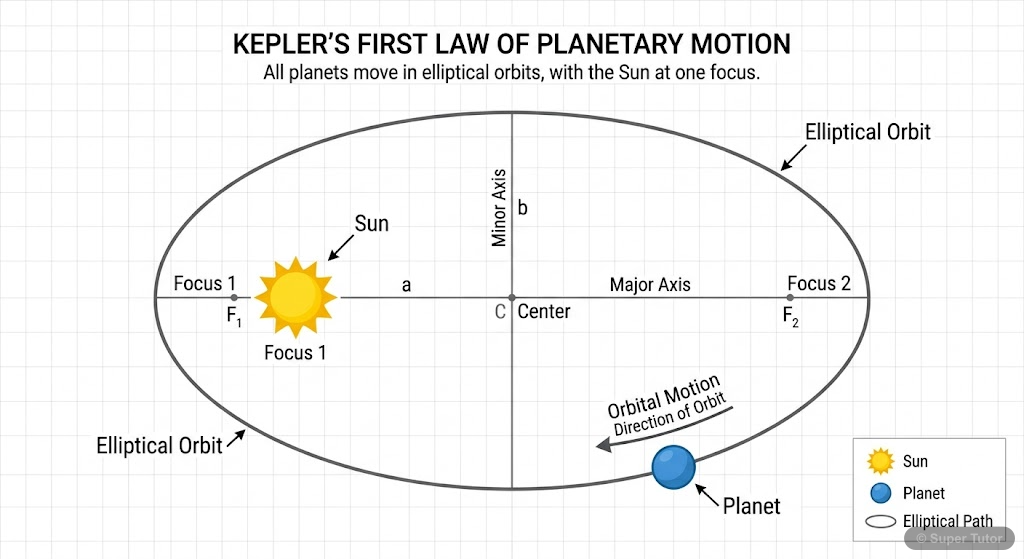
Learn better with visuals Super Tutor pairs illustrations like this with notes and quizzes for Gravitation : Planets and Satellites.
Quick Quiz: Gravitation : Planets and Satellites
0/4Tap an answer to check it instantly. No sign-up needed for these 4.
A satellite is moving close to Earth with orbital speed 8.0 km/s. Using the relation between orbital velocity and escape velocity, find the escape velocity of Earth.
A body is projected from Earth with speed 2 times the escape velocity. Find the speed of the body in interstellar space.
A projectile is launched from Earth with speed equal to one-fourth of Earth’s escape velocity. Find the maximum height attained in terms of Earth’s radius.
An artificial satellite revolves very close to Earth. If its period is 84 minutes, find the approximate orbital radius using the relation T = 2π√(r^3/GMe). Take the standard close-orbit result from the chapter and identify the correct radius.
Sample Questions
A geostationary satellite has orbital radius 42200 km and period 24 h. Find its orbital speed.
Show answer
3.1 km/s
Use v = 2πr/T. With r = 42200 km and T = 24 h, v ≈ 2 × 3.14 × 42200 / 24 ≈ 11042 km/h = 3.1 km/s.
At Earth’s surface, g = 9.8 m/s^2 and R_e = 6.37 × 10^6 m. Find the escape velocity using v_e = √(2gR_e).
Show answer
11.2 km/s
v_e = √(2gR_e) = √(2 × 9.8 × 6.37 × 10^6) ≈ √1.248 × 10^8 ≈ 1.12 × 10^4 m/s = 11.2 km/s.
A satellite of mass m moves in a circular orbit of radius r around Earth. If its orbital speed is v_o, find the total energy in terms of G, Me, m and r.
Show answer
-1/2 GMe m / r
For a circular orbit, K = GMe m /(2r) and U = -GMe m / r. So E = U + K = -GMe m/r + GMe m/(2r) = -1/2 GMe m/r.
A satellite orbits Earth in a circle of radius 2R_e. Find its orbital speed in terms of the orbital speed close to Earth’s surface, v_0.
Show answer
v_0/√2
Orbital speed varies as 1/√r. If r becomes 2R_e, speed becomes √(R_e/2R_e) = 1/√2 times the close-orbit speed v_0.
+68 more questions on Gravitation : Planets and Satellites (ICSE Class 11 Physics)
Practise AllFrequently Asked Questions
What are the important topics in Gravitation : Planets and Satellites for ICSE Class 11 Physics?
How many practice questions are there for Gravitation : Planets and Satellites?
Sources & Official References
Content is aligned to the official syllabus. Refer to the board website for the latest curriculum.
More resources for Gravitation : Planets and Satellites
Important Questions
Exam-style questions with answers
Revision Notes
Key points for last-minute revision
Formula Sheet
The chapter's formulas in one place
Chapter Summary
Understand the chapter at a glance
Concept Maps
See how topics connect
Study Plan
Step-by-step plan for this chapter
Flashcards
Quick-fire cards for active recall
Syllabus
What topics to cover
For serious students
Get the full Gravitation : Planets and Satellites chapter — start free.
Quizzes, flashcards, an AI doubt solver and a study plan for ICSE Class 11 Physics. Free to start, no card needed.