Rotational Motion of a Rigid Body: Moment of Inertia — Chapter Summary
ICSE · Class 11 · Physics
Summary of Rotational Motion of a Rigid Body: Moment of Inertia for ICSE Class 11 Physics. Part of the ICSE Class 11 Physics syllabus.
Interactive on Super Tutor
Studying Rotational Motion of a Rigid Body: Moment of Inertia? Get the full interactive chapter.
Quizzes, flashcards, AI doubt-solver and a step-by-step study plan — built for chapter summary and more.
Free trial, no card needed.
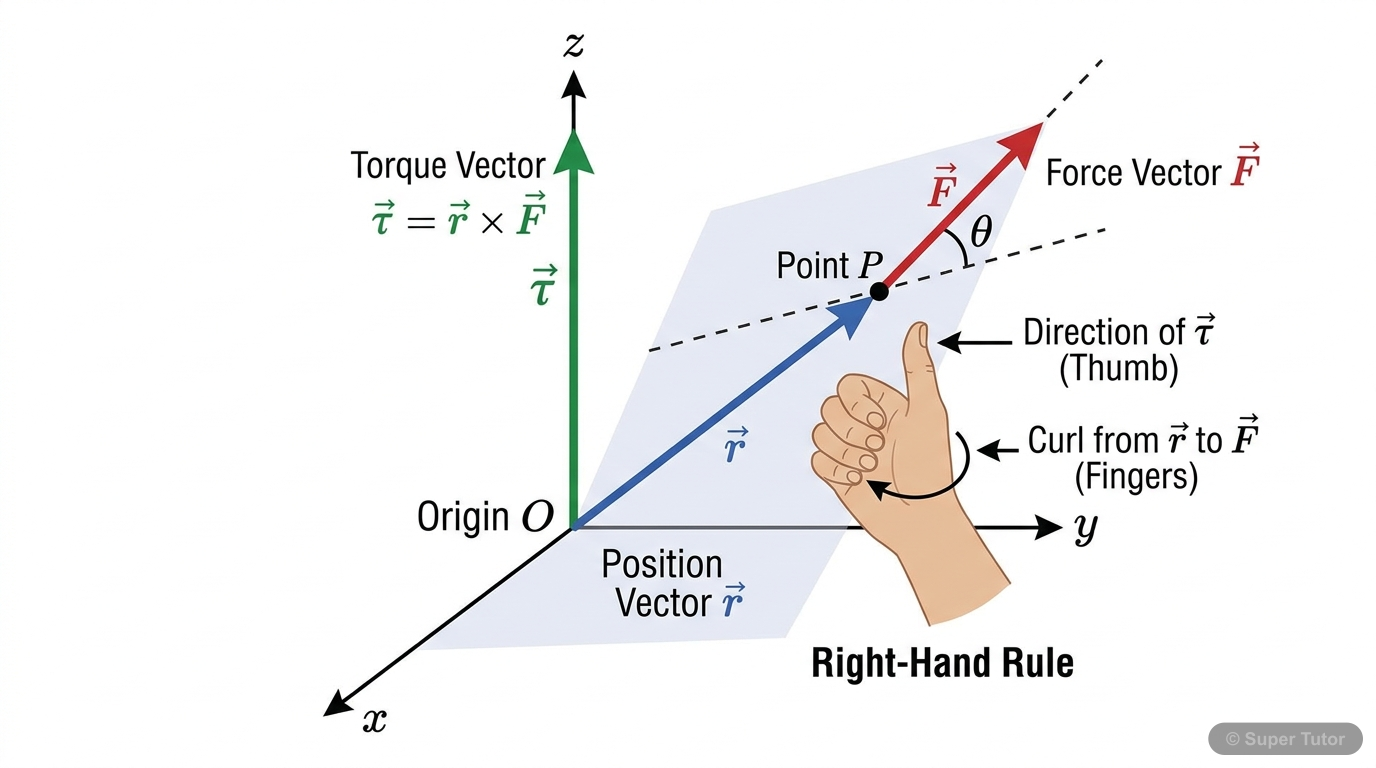
Learn better with visuals Super Tutor pairs illustrations like this with notes and quizzes for Rotational Motion of a Rigid Body: Moment of Inertia.
Overview
Rotational motion describes the turning of a body about a fixed axis. Torque produces angular acceleration in the same way that force produces linear acceleration. Moment of inertia measures resistance to change in rotational motion and depends on how mass is distributed about the axis. Angular mome
Key Concepts
Torque is the vector product
Torque is the vector product of position vector and force: τ = r × F. Its magnitude is τ = rF sinθ, so it is maximum when force is perpendicular to r.
Angular momentum is the vector product
Angular momentum is the vector product of position vector and linear momentum: L = r × p. Its magnitude is L = rp sinθ. It becomes zero if p = 0, r =
A rigid body is one
A rigid body is one in which external force does not produce relative displacement between its particles. Real bodies are not perfectly rigid, but man
Moment of inertia is the resistance
Moment of inertia is the resistance of a body to change in rotational motion about an axis. For particles, I = Σmr², and for continuous bodies, I = ∫r
Radius of gyration k is defined
Radius of gyration k is defined by I = Mk², so k = √(I/M). It is the distance from the axis at which the whole mass may be assumed concentrated to giv
Learning Objectives
- Understand torque as the rotational effect of a force
- Relate angular momentum to position vector and linear momentum
- Define rigid body, moment of inertia, and radius of gyration
- Use the parallel axes theorem and perpendicular axes theorem
- Recognize standard moments of inertia for simple bodies
Frequently Asked Questions
What are the important topics in Rotational Motion of a Rigid Body: Moment of Inertia for ICSE Class 11 Physics?
How should I revise Rotational Motion of a Rigid Body: Moment of Inertia for Class 11 exams?
Sources & Official References
Content is aligned to the official syllabus. Refer to the board website for the latest curriculum.
More resources for Rotational Motion of a Rigid Body: Moment of Inertia
Practice Quiz
Test yourself with a quick quiz
Important Questions
Exam-style questions with answers
Revision Notes
Key points for last-minute revision
Formula Sheet
The chapter's formulas in one place
Concept Maps
See how topics connect
Study Plan
Step-by-step plan for this chapter
Flashcards
Quick-fire cards for active recall
Syllabus
What topics to cover
For serious students
Get the full Rotational Motion of a Rigid Body: Moment of Inertia chapter — start free.
Quizzes, flashcards, an AI doubt solver and a study plan for ICSE Class 11 Physics. Free to start, no card needed.