Rotational Motion of a Rigid Body: Moment of Inertia — Flashcards
ICSE · Class 11 · Physics
38 flashcards for Rotational Motion of a Rigid Body: Moment of Inertia (ICSE Class 11 Physics) to test yourself on key terms and facts.
Interactive on Super Tutor
Studying Rotational Motion of a Rigid Body: Moment of Inertia? Get the full interactive chapter.
Quizzes, flashcards, AI doubt-solver and a step-by-step study plan — built for flashcards and more.
Free trial, no card needed.
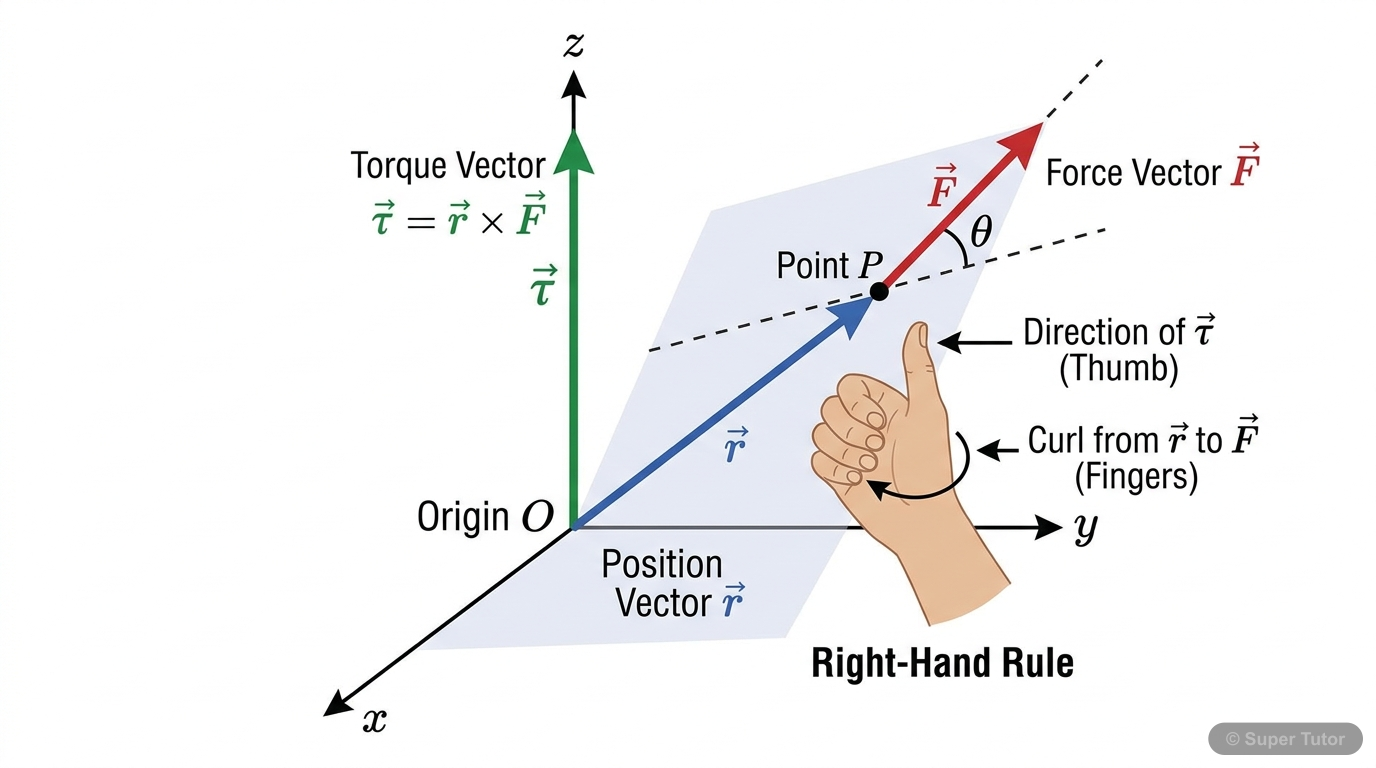
Learn better with visuals Super Tutor pairs illustrations like this with notes and quizzes for Rotational Motion of a Rigid Body: Moment of Inertia.
State the definition of torque and write its vector formula.
Answer
Torque is the moment of a force about an axis or point. Formula: τ = r × F. Magnitude: τ = rF sinθ. It is a vector quantity. Unit: N-m.
A force of 10 N is applied perpendicular to a door at a distance of 0.5 m from the hinge. Find the torque.
Answer
Given: F = 10 N, r = 0.5 m, θ = 90° Formula: τ = rF sinθ Step 1: τ = (0.5 m)(10 N)sin90° Step 2: τ = (0.5)(10)(1) N-m Step 3: τ = 5 N-m Answer: 5 N-m…
Why is torque maximum when force is applied perpendicular to the position vector?
Answer
Because τ = rF sinθ and sin90° = 1. Only the transverse component of force contributes to torque, so a right-angle push produces the greatest turning effect. A door opens most easily when pushed at it…
A force is applied at the hinge line of a door. Why does it not produce rotation?
Answer
At the hinge line, r = 0. Since τ = r × F, torque becomes zero. So even a large force cannot produce rotation if the lever arm is zero.
State the difference between work and torque.
Answer
Work is scalar and torque is vector. Both have the same dimensions [ML²T⁻²] and both can be written in N-m, but work is measured as joule while torque is measured as newton-metre.
A force of 20 N acts on a point 3 m from the axis at an angle of 30° with the position vector. Find the torque.
Answer
Given: F = 20 N, r = 3 m, θ = 30° Formula: τ = rF sinθ Step 1: τ = (3 m)(20 N)sin30° Step 2: τ = 60 × 1/2 N-m Step 3: τ = 30 N-m Answer: 30 N-m…
State the definition of angular momentum and write its vector formula.
Answer
Angular momentum is the moment of linear momentum about an axis. Formula: L = r × p. Magnitude: L = rp sinθ. Unit: kg-m²-s⁻¹ or J-s.
A particle has linear momentum 6 kg-m/s and is 2 m from the axis with momentum perpendicular to r. Find angular momentum.
Answer
Given: p = 6 kg-m/s, r = 2 m, θ = 90° Formula: L = rp sinθ Step 1: L = (2 m)(6 kg-m/s)sin90° Step 2: L = 12 kg-m²-s⁻¹ Answer: 12 kg-m²-s⁻¹…
+30 more flashcards
Practise AllFrequently Asked Questions
What are the important topics in Rotational Motion of a Rigid Body: Moment of Inertia for ICSE Class 11 Physics?
How many flashcards are available for Rotational Motion of a Rigid Body: Moment of Inertia?
How should I revise Rotational Motion of a Rigid Body: Moment of Inertia for Class 11 exams?
Sources & Official References
Content is aligned to the official syllabus. Refer to the board website for the latest curriculum.
More resources for Rotational Motion of a Rigid Body: Moment of Inertia
Practice Quiz
Test yourself with a quick quiz
Important Questions
Exam-style questions with answers
Revision Notes
Key points for last-minute revision
Formula Sheet
The chapter's formulas in one place
Chapter Summary
Understand the chapter at a glance
Concept Maps
See how topics connect
Study Plan
Step-by-step plan for this chapter
Syllabus
What topics to cover
For serious students
Get the full Rotational Motion of a Rigid Body: Moment of Inertia chapter — start free.
Quizzes, flashcards, an AI doubt solver and a study plan for ICSE Class 11 Physics. Free to start, no card needed.