Behaviour of Perfect Gases and Kinetic Theory of Gases — Practice Quiz
ICSE · Class 11 · Physics
Try a 4-question quiz on Behaviour of Perfect Gases and Kinetic Theory of Gases for ICSE Class 11 Physics: tap an answer to check it and see why.
Interactive on Super Tutor
Studying Behaviour of Perfect Gases and Kinetic Theory of Gases? Get the full interactive chapter.
Quizzes, flashcards, AI doubt-solver and a step-by-step study plan — built for practice quiz and more.
Free trial, no card needed.
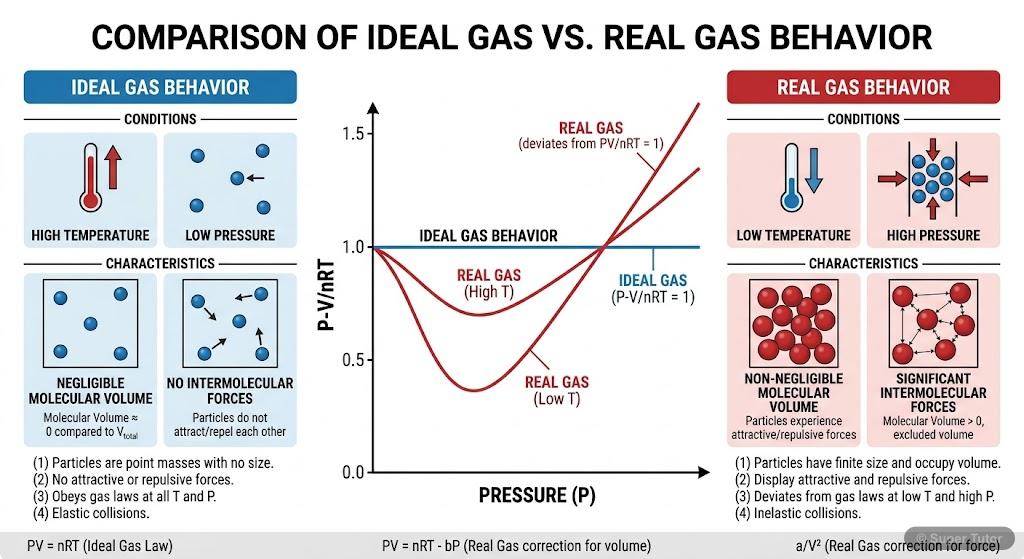
An illustration from Super Tutor's Behaviour of Perfect Gases and Kinetic Theory of Gases chapter — alongside flashcards, concept maps and practice questions.
Quick Quiz: Behaviour of Perfect Gases and Kinetic Theory of Gases
0/4Tap an answer to check it instantly. No sign-up needed for these 4.
The ideal gas equation for μ moles of a gas is given by:
The numerical value of the universal gas constant R is:
According to the kinetic theory of gases, the pressure exerted by a gas on the walls of the container is due to:
The expression for pressure of an ideal gas derived from kinetic theory is P = (1/3)ρv̄², where ρ is the density and v̄² is the mean square speed. If the density of a gas is 1.29 kg/m³ and the mean square speed of its molecules is 4.0 × 10⁵ m²/s², what is the pressure of the gas?
Sample Questions
The root mean square (rms) speed of gas molecules is given by vrms = √(3RT/M). If the temperature of a gas is increased 4 times (keeping M constant), the rms speed becomes:
Show answer
2 times the original speed
Step 1: vrms = √(3RT/M), so vrms ∝ √T. Step 2: If T becomes 4T, then new vrms = √(3R × 4T / M) = 2 × √(3RT/M). Step 3: So new vrms = 2 × original vrms. Step 4: Option A is wrong (that would apply if vrms ∝ T, not √T). Option C is wrong (4² = 16 is incorrect reasoning). Option D would apply if T doubled, not quadrupled.
The average kinetic energy of one molecule of an ideal gas at absolute temperature T is:
Show answer
(3/2)kT
Step 1: For 1 mole of gas, average kinetic energy = (3/2)RT. Step 2: 1 mole contains N molecules (Avogadro's number). Step 3: Average KE per molecule = (3/2)RT / N = (3/2)(R/N)T = (3/2)kT, where k = R/N is Boltzmann's constant. Step 4: Option A is the KE of 1 mole, not 1 molecule. Option B is missing the factor 3 (that would be for 1 degree of freedom). Option D equals (3/2)kT but written in a confusing form; however, it equals the same thing, yet option C is the standard form.
A monoatomic gas molecule (like helium) has how many degrees of freedom?
Show answer
3
Step 1: Degrees of freedom represent the number of independent ways a molecule can possess energy. Step 2: A monoatomic molecule (single atom) can only translate (move) in 3D space — along X, Y, and Z axes. Step 3: Its rotational kinetic energy is negligible because its moment of inertia is extremely small. Step 4: So it has 3 translational degrees of freedom only. Step 5: 5 degrees of freedom is for diatomic gases, and 6 is for triatomic/polyatomic gases.
According to the Law of Equipartition of Energy, the average kinetic energy associated with each degree of freedom of a molecule at temperature T is:
Show answer
(1/2)kT
Step 1: The Law of Equipartition of Energy states that energy is equally distributed among all degrees of freedom. Step 2: The average energy per degree of freedom = (1/2)kT, where k is Boltzmann's constant. Step 3: For a molecule with f degrees of freedom, total average KE = f × (1/2)kT = (f/2)kT. Step 4: For a monoatomic gas (f=3): total KE = (3/2)kT — this is the total, not per degree of freedom. Option A (kT) and D (1/3 kT) are incorrect values.
+41 more questions on Behaviour of Perfect Gases and Kinetic Theory of Gases (ICSE Class 11 Physics)
Practise AllFrequently Asked Questions
What are the important topics in Behaviour of Perfect Gases and Kinetic Theory of Gases for ICSE Class 11 Physics?
How many practice questions are there for Behaviour of Perfect Gases and Kinetic Theory of Gases?
Sources & Official References
Content is aligned to the official syllabus. Refer to the board website for the latest curriculum.
More resources for Behaviour of Perfect Gases and Kinetic Theory of Gases
Important Questions
Exam-style questions with answers
Revision Notes
Key points for last-minute revision
Formula Sheet
The chapter's formulas in one place
Chapter Summary
Understand the chapter at a glance
Concept Maps
See how topics connect
Study Plan
Step-by-step plan for this chapter
Flashcards
Quick-fire cards for active recall
Syllabus
What topics to cover
For serious students
Get the full Behaviour of Perfect Gases and Kinetic Theory of Gases chapter — start free.
Quizzes, flashcards, an AI doubt solver and a study plan for ICSE Class 11 Physics. Free to start, no card needed.