Uniform Circular Motion — Practice Quiz
ICSE · Class 11 · Physics
Try a 4-question quiz on Uniform Circular Motion for ICSE Class 11 Physics: tap an answer to check it and see why. 44 questions in the full chapter test.
Interactive on Super Tutor
Studying Uniform Circular Motion? Get the full interactive chapter.
Quizzes, flashcards, AI doubt-solver and a step-by-step study plan — built for practice quiz and more.
Free trial, no card needed.
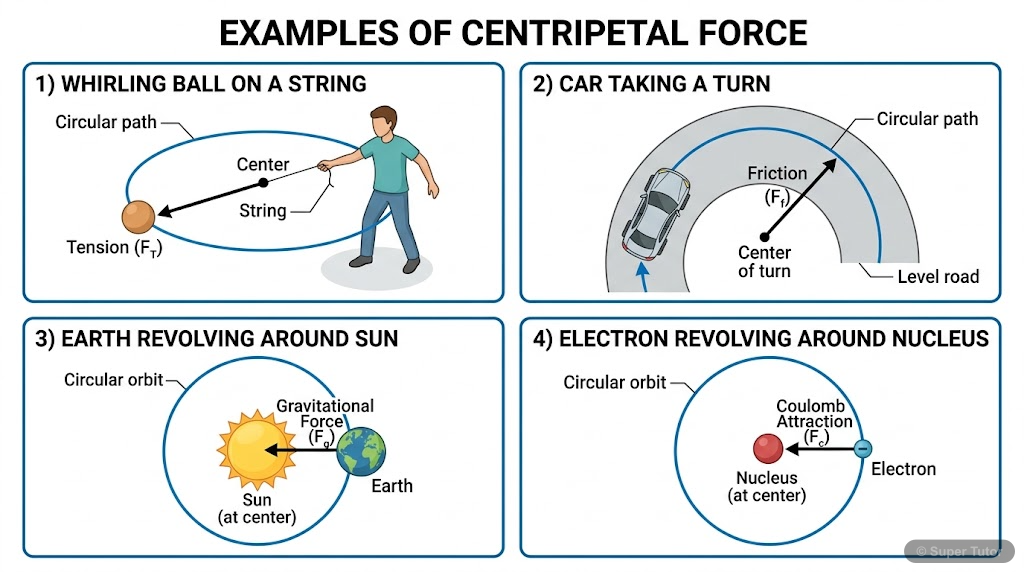
Learn better with visuals Super Tutor pairs illustrations like this with notes and quizzes for Uniform Circular Motion.
Quick Quiz: Uniform Circular Motion
0/4Tap an answer to check it instantly. No sign-up needed for these 4.
A particle moves on a circular path of radius 2 m with a constant speed of 4 m/s. What is the magnitude of its centripetal acceleration?
In uniform circular motion, which of the following quantities remains CONSTANT?
A particle completes one revolution in 4 seconds on a circular path. What is its angular velocity in rad/s?
The relationship between linear velocity (v), angular velocity (ω), and radius (r) is:
Sample Questions
A particle moves in a circle of radius 0.5 m with an angular velocity of 6 rad/s. What is its linear speed?
Show answer
3 m/s
Step 1: Use the formula v = rω. Step 2: r = 0.5 m, ω = 6 rad/s. Step 3: v = 0.5 × 6 = 3 m/s. Option B (12 m/s) is wrong — it incorrectly uses v = 2rω. Option C (6 m/s) is wrong — it ignores the radius factor. Option D (0.5 m/s) is wrong — it uses v = r/ω instead of v = rω. Always include units in your calculation to avoid such errors.
What is the direction of centripetal acceleration of a particle moving in a circle?
Show answer
Towards the centre of the circle
Step 1: In uniform circular motion, the velocity of the particle is always tangential (along the tangent to the circle). Step 2: The change in velocity (Δv) as the particle moves from one point to another is directed towards the centre of the circle. Step 3: Since acceleration = change in velocity / time, the acceleration is also directed towards the centre. Step 4: This is why it is called 'centripetal' acceleration — the word 'centripetal' means 'centre-seeking'. Option A is the direction of velocity, not acceleration. Option B is the direction of centrifugal force (pseudo force). Option D i
A car of mass 1000 kg moves on a circular road of radius 50 m at a speed of 10 m/s. What is the centripetal force acting on the car?
Show answer
2000 N
Step 1: Formula for centripetal force is F = mv²/r. Step 2: Given: m = 1000 kg, v = 10 m/s, r = 50 m. Step 3: F = 1000 × (10)² / 50 = 1000 × 100 / 50 = 100000/50 = 2000 N. Option A (200 N) is wrong — it uses m × v / r instead of m × v²/r. Option C (500 N) is wrong — it uses m × g/r approximately. Option D (5000 N) is wrong — it divides by the wrong value. Always remember to square the velocity in the centripetal force formula.
When a car moves on a level circular road, the centripetal force is provided by:
Show answer
Frictional force between tyres and road
Step 1: For a car moving on a level (horizontal) circular road, we need a force directed towards the centre of the circular path. Step 2: Gravity acts vertically downward and is balanced by the normal reaction of the road — neither provides the centripetal force. Step 3: The engine force propels the car forward (tangentially), not towards the centre. Step 4: The only horizontal force available is the friction between the tyres and the road surface, which acts towards the centre of the turn. Step 5: This is why on wet or icy roads, cars tend to skid — friction is reduced and cannot provide the
+40 more questions on Uniform Circular Motion (ICSE Class 11 Physics)
Practise AllFrequently Asked Questions
What are the important topics in Uniform Circular Motion for ICSE Class 11 Physics?
How many practice questions are there for Uniform Circular Motion?
Sources & Official References
Content is aligned to the official syllabus. Refer to the board website for the latest curriculum.
More resources for Uniform Circular Motion
Important Questions
Exam-style questions with answers
Revision Notes
Key points for last-minute revision
Formula Sheet
The chapter's formulas in one place
Chapter Summary
Understand the chapter at a glance
Concept Maps
See how topics connect
Study Plan
Step-by-step plan for this chapter
Flashcards
Quick-fire cards for active recall
Syllabus
What topics to cover
For serious students
Get the full Uniform Circular Motion chapter — start free.
Quizzes, flashcards, an AI doubt solver and a study plan for ICSE Class 11 Physics. Free to start, no card needed.