Units and Measurements — Practice Quiz
ICSE · Class 11 · Physics
Try a 4-question quiz on Units and Measurements for ICSE Class 11 Physics: tap an answer to check it and see why. 42 questions in the full chapter test.
Interactive on Super Tutor
Studying Units and Measurements? Get the full interactive chapter.
Quizzes, flashcards, AI doubt-solver and a step-by-step study plan — built for practice quiz and more.
Free trial, no card needed.
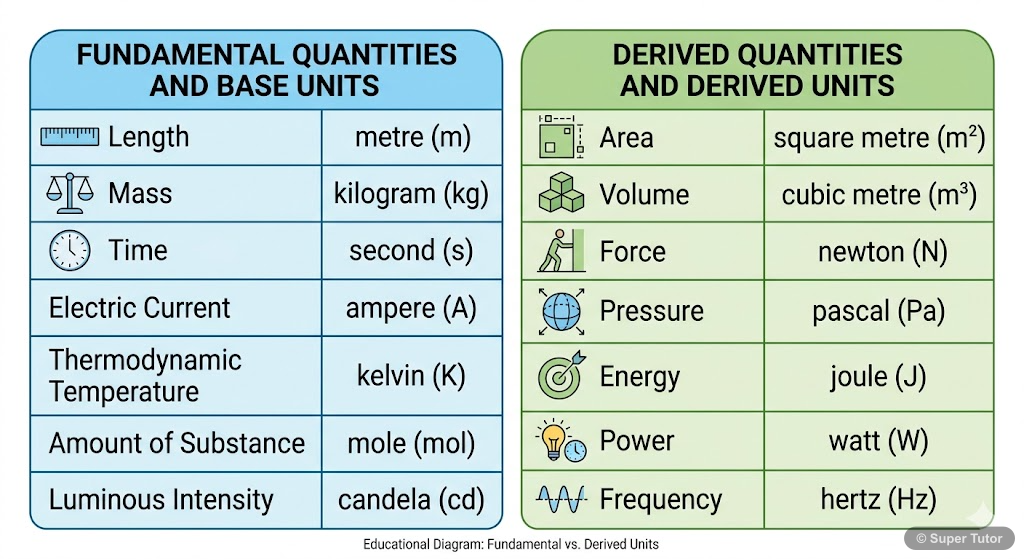
Learn better with visuals Super Tutor pairs illustrations like this with notes and quizzes for Units and Measurements.
Quick Quiz: Units and Measurements
0/4Tap an answer to check it instantly. No sign-up needed for these 4.
A student measures the length of a rod using a vernier callipers. The main scale reads 2.3 cm and the 6th division of the vernier scale coincides with a main scale division. If the least count of the vernier callipers is 0.01 cm, what is the length of the rod?
The pitch of a screw gauge is 1 mm and its circular scale has 100 divisions. A wire is measured and the main scale reads 3 mm while the 45th division of the circular scale coincides with the reference line. What is the diameter of the wire?
Which of the following is the correct SI unit for luminous intensity?
The mass of an electron is 9.11 × 10⁻³¹ kg and the mass of a proton is 1.67 × 10⁻²⁷ kg. By how many orders of magnitude is a proton heavier than an electron?
Sample Questions
The density of a cube is calculated from ρ = m/l³. If the percentage error in the measurement of mass m is 2% and in the measurement of length l is 1%, what is the maximum percentage error in the calculated density?
Show answer
5%
Step 1: Write the formula for density. ρ = m / l³ Step 2: Apply the rule for error propagation in products and powers. For a quantity Z = xᵃ / yᵇ, the maximum percentage error is: (ΔZ/Z) × 100 = a(Δx/x) × 100 + b(Δy/y) × 100 Step 3: Identify the powers of each variable. Here, m has power 1 and l has power 3. Step 4: Calculate the maximum percentage error. (Δρ/ρ) × 100 = 1 × (Δm/m) × 100 + 3 × (Δl/l) × 100 = 1 × 2% + 3 × 1% = 2% + 3% = 5% Why other options are wrong: - 3%: Only adds 2% + 1%, ignoring the power of 3 for length. - 2%: Considers only the error in mass. - 1%: Considers only the
1 parsec is approximately equal to how many light years?
Show answer
3.26 ly
Step 1: Recall the values of parsec and light year in metres. 1 parsec (pc) = 3.084 × 10¹⁶ m 1 light year (ly) = 9.46 × 10¹⁵ m Step 2: Convert parsec to light years. 1 pc = 3.084 × 10¹⁶ m / (9.46 × 10¹⁵ m/ly) = (3.084 / 9.46) × 10¹ ly = 0.326 × 10¹ ly = 3.26 ly Step 3: Interpretation. 1 parsec is the distance at which the Earth's orbital radius (1 AU) subtends an angle of 1 arc-second. It equals 3.26 light years. Why other options are wrong: - 1.50 ly: This is approximately 1 AU expressed differently — a confusion with AU. - 9.46 ly: This confuses the value of 1 light year (9.46 × 10¹⁵ m) w
How many significant figures are present in the number 0.006700?
Show answer
4
Step 1: Apply the rules for significant figures one by one. Step 2: Leading zeros (zeros before the first non-zero digit) are NOT significant. In 0.006700, the zeros before 6 (i.e., 0.00) are leading zeros → NOT significant. Step 3: The digits 6, 7 are non-zero digits → SIGNIFICANT. Step 4: Trailing zeros AFTER the decimal point ARE significant. The two zeros after 7 (i.e., 00) are trailing zeros after the decimal → SIGNIFICANT. Step 5: Count the significant figures: 6, 7, 0, 0 → 4 significant figures. Why other options are wrong: - 7: This counts all digits including leading zeros, which
The time period T of a simple pendulum is given by T = 2π√(l/g). If the length l is measured with 2% error and g is taken as exact, what is the percentage error in T?
Show answer
1%
Step 1: Write the formula for time period. T = 2π√(l/g) = 2π (l/g)^(1/2) = 2π × l^(1/2) × g^(-1/2) Step 2: Apply the error propagation rule for powers. (ΔT/T) × 100 = (1/2)(Δl/l) × 100 + (1/2)(Δg/g) × 100 Step 3: Since g is taken as exact, Δg = 0. (ΔT/T) × 100 = (1/2) × 2% + 0 = 1% The key concept here is that l appears as l^(1/2) (square root), so its power is 1/2, and the percentage error gets multiplied by 1/2. Why other options are wrong: - 2%: This forgets to multiply by the power 1/2; it directly takes the error in l. - 4%: This incorrectly multiplies by 2 instead of 1/2. - 0.5%: Thi
+38 more questions on Units and Measurements (ICSE Class 11 Physics)
Practise AllFrequently Asked Questions
What are the important topics in Units and Measurements for ICSE Class 11 Physics?
How many practice questions are there for Units and Measurements?
Sources & Official References
Content is aligned to the official syllabus. Refer to the board website for the latest curriculum.
More resources for Units and Measurements
Important Questions
Exam-style questions with answers
Revision Notes
Key points for last-minute revision
Formula Sheet
The chapter's formulas in one place
Chapter Summary
Understand the chapter at a glance
Concept Maps
See how topics connect
Study Plan
Step-by-step plan for this chapter
Flashcards
Quick-fire cards for active recall
Syllabus
What topics to cover
For serious students
Get the full Units and Measurements chapter — start free.
Quizzes, flashcards, an AI doubt solver and a study plan for ICSE Class 11 Physics. Free to start, no card needed.