Behaviour of Perfect Gases and Kinetic Theory of Gases — Flashcards
ICSE · Class 11 · Physics
35 flashcards for Behaviour of Perfect Gases and Kinetic Theory of Gases (ICSE Class 11 Physics) to test yourself on key terms and facts.
Interactive on Super Tutor
Studying Behaviour of Perfect Gases and Kinetic Theory of Gases? Get the full interactive chapter.
Quizzes, flashcards, AI doubt-solver and a step-by-step study plan — built for flashcards and more.
Free trial, no card needed.
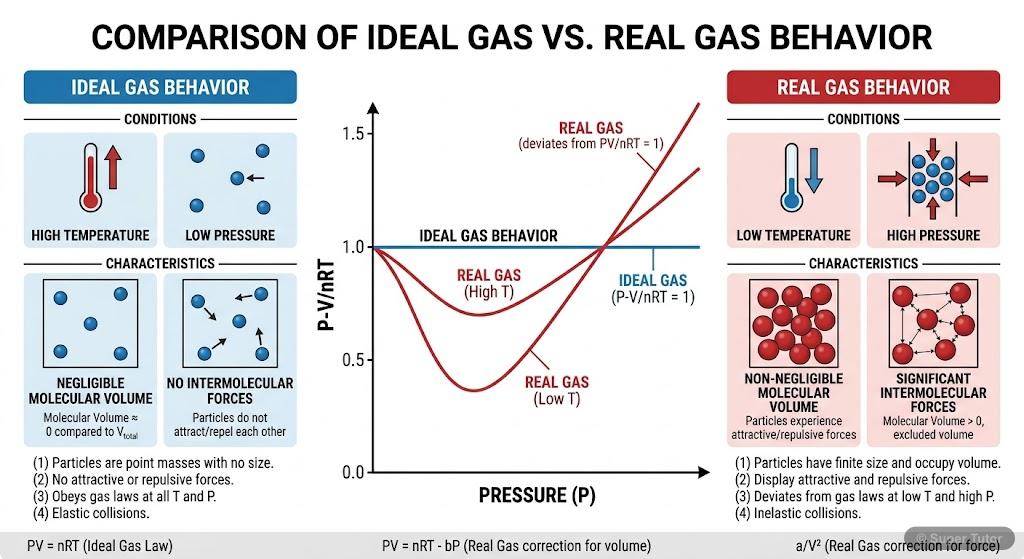
An illustration from Super Tutor's Behaviour of Perfect Gases and Kinetic Theory of Gases chapter — alongside flashcards, concept maps and practice questions.
State the definition of a perfect gas.
Answer
A perfect gas is an imaginary gas that strictly obeys Boyle's law, Charles' law and the law of pressure under all conditions. Its molecules are infinitesimally small and there is no intermolecular att…
Why can a perfect gas not be converted into liquid or solid state?
Answer
There is no force of attraction between its molecules. A liquid or solid needs attraction between molecules, so a perfect gas cannot be liquefied or solidified.
State the ideal gas equation for one mole and for n molecules.
Answer
For 1 mole: PV = RT. For n molecules: PV = nkT. Here R is the universal gas constant and k is the Boltzmann constant.
A gas has pressure 1.013 x 10^5 N m^-2, volume 22.4 x 10^-3 m^3 and temperature 273 K. Find the value of R.
Answer
Given: P = 1.013 x 10^5 N m^-2, V = 22.4 x 10^-3 m^3, T = 273 K, n = 1 mole. Formula: R = PV/T Step 1: PV = (1.013 x 10^5)(22.4 x 10^-3) N m = 2269.12 J Step 2: R = 2269.12 / 273 J mol^-1 K^-1 Step 3:…
A gas has 2.5 moles, pressure P and temperature T. What is the ideal gas equation used to relate P, V and T?
Answer
Formula: PV = muRT Meaning: mu is number of moles. Use it when the amount of gas is given in moles. Example: For 2.5 moles, PV = 2.5RT.
A gas sample contains 4.0 x 10^23 molecules at temperature T and volume V. Find the relation between P, V and T using PV = nkT.
Answer
Given: n = 4.0 x 10^23 molecules Formula: PV = nkT Substitution: PV = (4.0 x 10^23)kT Answer: The product PV is directly proportional to the number of molecules and temperature.
Why do real gases approach ideal gas behaviour at low pressure and high temperature?
Answer
At low pressure, molecules are far apart, so intermolecular attraction becomes small. At high temperature, molecules move faster and the effect of attraction becomes less important. So real gases beha…
State the main assumptions of kinetic theory for an ideal gas.
Answer
1. Gas molecules are very small and identical. 2. They move rapidly in straight lines in all directions. 3. Collisions between molecules are perfectly elastic. 4. Duration of collision is negligible.
+27 more flashcards
Practise AllFrequently Asked Questions
What are the important topics in Behaviour of Perfect Gases and Kinetic Theory of Gases for ICSE Class 11 Physics?
How many flashcards are available for Behaviour of Perfect Gases and Kinetic Theory of Gases?
How should I revise Behaviour of Perfect Gases and Kinetic Theory of Gases for Class 11 exams?
Sources & Official References
Content is aligned to the official syllabus. Refer to the board website for the latest curriculum.
More resources for Behaviour of Perfect Gases and Kinetic Theory of Gases
Practice Quiz
Test yourself with a quick quiz
Important Questions
Exam-style questions with answers
Revision Notes
Key points for last-minute revision
Formula Sheet
The chapter's formulas in one place
Chapter Summary
Understand the chapter at a glance
Concept Maps
See how topics connect
Study Plan
Step-by-step plan for this chapter
Syllabus
What topics to cover
For serious students
Get the full Behaviour of Perfect Gases and Kinetic Theory of Gases chapter — start free.
Quizzes, flashcards, an AI doubt solver and a study plan for ICSE Class 11 Physics. Free to start, no card needed.