Thermodynamics — Practice Quiz
ICSE · Class 11 · Physics
Try a 4-question quiz on Thermodynamics for ICSE Class 11 Physics: tap an answer to check it and see why. 44 questions in the full chapter test.
Interactive on Super Tutor
Studying Thermodynamics? Get the full interactive chapter.
Quizzes, flashcards, AI doubt-solver and a step-by-step study plan — built for practice quiz and more.
Free trial, no card needed.
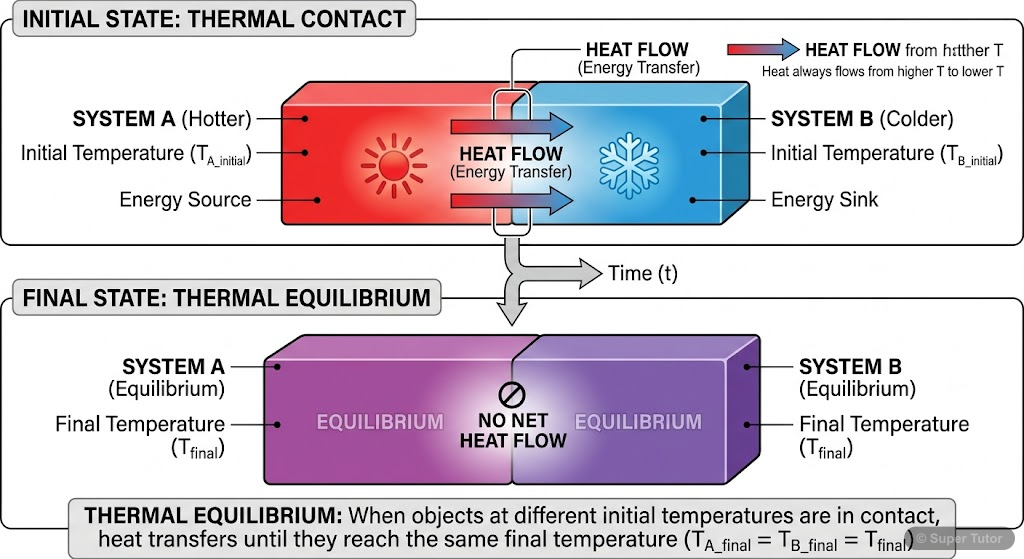
One of 6 illustrations for Thermodynamics in Super Tutor — alongside flashcards, concept maps and practice questions.
Quick Quiz: Thermodynamics
0/4Tap an answer to check it instantly. No sign-up needed for these 4.
A gas undergoes a cyclic process represented by a closed P-V curve traced in the clockwise direction. The area enclosed by the curve is 500 J. Which of the following statements is correct?
In an adiabatic process, 200 J of work is done ON the gas by an external agent. What is the change in internal energy of the gas?
A system absorbs 500 J of heat and does 300 J of work on the surroundings. In the next process, it absorbs 200 J of heat and 100 J of work is done on it. What is the total change in internal energy of the system after both processes?
During an isothermal expansion of an ideal gas, the gas absorbs 800 J of heat from a reservoir. What is the work done by the gas and the change in its internal energy?
Sample Questions
Water of mass 1 kg is converted to steam at 100°C and 1 atm pressure. Given: Latent heat of vaporisation L = 2.26 × 10⁶ J/kg, volume of steam Vᵥ = 1.671 m³, volume of water Vₗ = 0.001 m³, P = 1.01 × 10⁵ Pa. What is the change in internal energy (ΔU) during this process?
Show answer
ΔU ≈ 2.09 × 10⁶ J
Step 1: Heat absorbed Q = mL = 1 × 2.26 × 10⁶ = 2.26 × 10⁶ J. Step 2: Work done by the system W = P × ΔV = P(Vᵥ - Vₗ) = 1.01 × 10⁵ × (1.671 - 0.001) = 1.01 × 10⁵ × 1.670 = 1.6867 × 10⁵ ≈ 1.69 × 10⁵ J. Step 3: By First Law: ΔU = Q - W = 2.26 × 10⁶ - 1.69 × 10⁵ = 2.26 × 10⁶ - 0.169 × 10⁶ ≈ 2.091 × 10⁶ J. Step 4: So ΔU ≈ 2.09 × 10⁶ J. Step 5: The heat supplied is used partly in increasing internal energy (breaking molecular bonds) and partly in doing external work (against atmospheric pressure). Option B ignores the work done. Option C is just the work done. Option D is wrong - temperature is con
In a P-V diagram, a gas is taken from state i to state f along two different paths: Path 1 (iaf) and Path 2 (ibf). Along path iaf, pressure is first increased at constant volume from i to a, then volume is increased at constant pressure from a to f. Along path ibf, volume is first increased at const
Show answer
Change in internal energy (ΔU)
Step 1: Internal energy U is a state function - it depends only on the state of the system, not on the path taken to reach that state. Step 2: Since both paths start from the same initial state i and end at the same final state f, ΔU = U_f - U_i is the same for both paths. Step 3: Work done W depends on the path (W = ∫PdV). The area under Path iaf is larger than under Path ibf (as shown by the P-V diagram analysis in the textbook). Step 4: Since Q = ΔU + W and ΔU is same but W is different, Q must also be different for the two paths. Step 5: This is the fundamental distinction between state fu
A gas is compressed isochorically (at constant volume) and its pressure increases from 2 × 10⁵ Pa to 5 × 10⁵ Pa. If 400 J of heat is supplied to the gas, what is the change in internal energy?
Show answer
400 J
Step 1: In an isochoric process, the volume remains constant (ΔV = 0). Step 2: Work done by the gas: W = P × ΔV = P × 0 = 0 J. Step 3: Apply the First Law: ΔU = Q - W = 400 - 0 = 400 J. Step 4: All the heat supplied goes entirely into increasing the internal energy of the gas. Step 5: The pressure change data (from 2 × 10⁵ to 5 × 10⁵ Pa) is extra information - it does not affect the calculation because in an isochoric process, work done is always zero regardless of pressure change. This is a common trick in hard-level questions - don't be misled by extra data. Explosions in closed chambers are
According to the Zeroth Law of Thermodynamics, if system A is in thermal equilibrium with system C, and system B is also in thermal equilibrium with system C, then which of the following correctly explains WHY A and B are in thermal equilibrium with each other?
Show answer
Since T_A = T_C and T_B = T_C, it follows that T_A = T_B, meaning no net heat transfer occurs between A and B.
Step 1: Thermal equilibrium between two bodies means their temperatures are equal and there is no net heat flow between them. Step 2: If A is in thermal equilibrium with C, then T_A = T_C. Step 3: If B is in thermal equilibrium with C, then T_B = T_C. Step 4: From Step 2 and 3: T_A = T_C = T_B, so T_A = T_B. Equal temperatures mean no net heat transfer between A and B, so they are in thermal equilibrium. Step 5: The Zeroth Law does NOT require same mass, specific heat, internal energy, or material - it is purely about temperature equality. This law is the basis for defining temperature as a me
+40 more questions on Thermodynamics (ICSE Class 11 Physics)
Practise AllFrequently Asked Questions
What are the important topics in Thermodynamics for ICSE Class 11 Physics?
How many practice questions are there for Thermodynamics?
Sources & Official References
Content is aligned to the official syllabus. Refer to the board website for the latest curriculum.
More resources for Thermodynamics
Important Questions
Exam-style questions with answers
Revision Notes
Key points for last-minute revision
Formula Sheet
The chapter's formulas in one place
Chapter Summary
Understand the chapter at a glance
Concept Maps
See how topics connect
Study Plan
Step-by-step plan for this chapter
Flashcards
Quick-fire cards for active recall
Syllabus
What topics to cover
For serious students
Get the full Thermodynamics chapter — start free.
Quizzes, flashcards, an AI doubt solver and a study plan for ICSE Class 11 Physics. Free to start, no card needed.