Heat Transfer — Practice Quiz
ICSE · Class 11 · Physics
Try a 4-question quiz on Heat Transfer for ICSE Class 11 Physics: tap an answer to check it and see why. 42 questions in the full chapter test.
Interactive on Super Tutor
Studying Heat Transfer? Get the full interactive chapter.
Quizzes, flashcards, AI doubt-solver and a step-by-step study plan — built for practice quiz and more.
Free trial, no card needed.
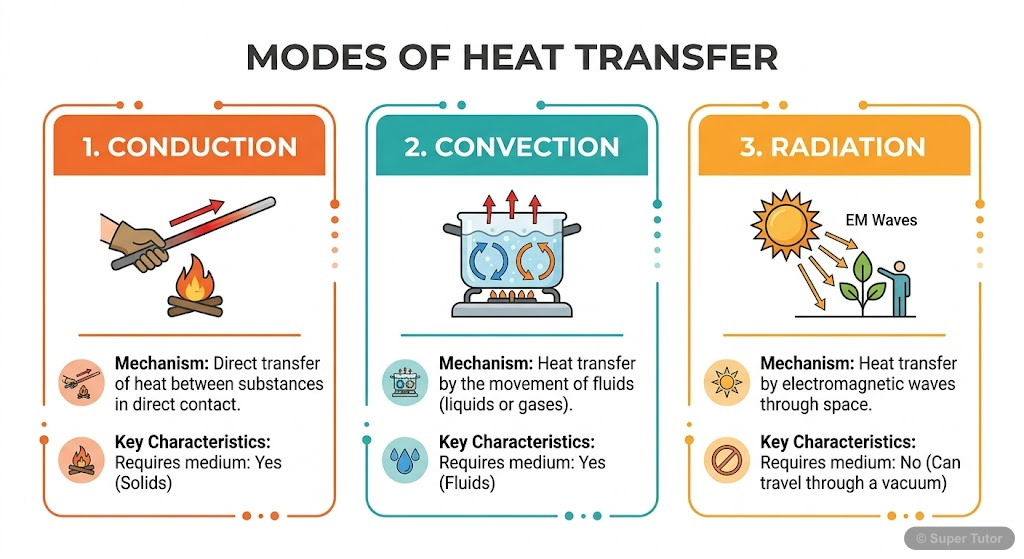
One of 2 illustrations for Heat Transfer in Super Tutor — alongside flashcards, concept maps and practice questions.
Quick Quiz: Heat Transfer
0/4Tap an answer to check it instantly. No sign-up needed for these 4.
A metallic slab of area 0.5 m², length 0.1 m, and thermal conductivity 50 W m⁻¹ K⁻¹ has its faces maintained at 100°C and 20°C. What is the rate of heat flow (in watts) through the slab in steady state?
Two slabs of equal thickness l and equal cross-sectional area A are joined in series. Their thermal conductivities are K₁ = 4 W m⁻¹ K⁻¹ and K₂ = 12 W m⁻¹ K⁻¹. What is the equivalent thermal conductivity of the combination?
The temperature of a black body is doubled. By what factor does the total radiant energy emitted per second per unit area increase?
According to Wien's displacement law, the wavelength at which maximum energy is emitted by a black body at temperature 5800 K is approximately: (Wien's constant b = 2.9 × 10⁻³ m K)
Sample Questions
In Searle's method to find thermal conductivity, four thermometers T₁, T₂, T₃, T₄ are used. Which thermometers measure the temperature of the rod, and which measure the temperature of flowing water?
Show answer
T₁, T₂ measure rod temperature; T₃, T₄ measure water temperature
Step 1: In Searle's apparatus, thermometers T₁ and T₂ are inserted into holes C and D drilled in the rod itself (with mercury for good thermal contact). They record the steady-state temperature gradient along the rod. Step 2: Thermometers T₃ and T₄ measure the inlet and outlet temperatures of the cooling water flowing through the spiral copper tube wound at the cold end. Step 3: The formula K = mc(θ₄ - θ₃)l / [A(θ₁ - θ₂)t] uses all four readings to calculate K. The wrong options confuse the arrangement of the thermometers.
A black body at 727°C emits heat at a certain rate. If its temperature is reduced to 227°C, the new rate of heat emission will be what fraction of the original rate?
Show answer
1/16
Step 1: Convert temperatures to Kelvin: T₁ = 727 + 273 = 1000 K, T₂ = 227 + 273 = 500 K. Step 2: By Stefan's law, E ∝ T⁴. So E₂/E₁ = (T₂/T₁)⁴ = (500/1000)⁴ = (1/2)⁴ = 1/16. Step 3: The new emission rate is 1/16 of the original. Common error: Using Celsius instead of Kelvin gives (227/727)⁴ ≈ 1/136, which is wrong. Always convert to Kelvin for Stefan's law.
Two slabs of equal length l and same cross-sectional area A are connected in parallel. Their thermal conductivities are K₁ and K₂. What is the equivalent thermal conductivity?
Show answer
(K₁ + K₂) / 2
Step 1: For parallel combination with equal areas A₁ = A₂ = A, the equivalent conductivity formula is: K = (K₁A₁ + K₂A₂) / (A₁ + A₂). Step 2: With A₁ = A₂ = A: K = (K₁A + K₂A) / (2A) = (K₁ + K₂) / 2. This is the arithmetic mean of the two conductivities. Wrong options: K₁K₂/(K₁+K₂) is the formula for electrical resistors in parallel; 2K₁K₂/(K₁+K₂) is the formula for series combination of equal-thickness slabs; (K₁+K₂) is not a valid formula.
A hot body at temperature T is placed in a room at temperature T₀. According to Newton's law of cooling, the rate of fall of temperature of the body is proportional to:
Show answer
T - T₀
Step 1: Newton's law of cooling states that the rate of loss of heat is proportional to the temperature difference between the body and its surroundings: -dQ/dt ∝ (T - T₀). Step 2: Since dQ = ms dT, this gives: -dT/dt = K(T - T₀), where K is a positive constant. Step 3: So the rate of fall of temperature is proportional to (T - T₀), which is the simple temperature difference. Note: The T⁴ - T₀⁴ term appears in Stefan-Boltzmann law for net radiation, not in Newton's law of cooling. Newton's law is valid only for small temperature differences.
+38 more questions on Heat Transfer (ICSE Class 11 Physics)
Practise AllFrequently Asked Questions
What are the important topics in Heat Transfer for ICSE Class 11 Physics?
How many practice questions are there for Heat Transfer?
Sources & Official References
Content is aligned to the official syllabus. Refer to the board website for the latest curriculum.
More resources for Heat Transfer
Important Questions
Exam-style questions with answers
Revision Notes
Key points for last-minute revision
Formula Sheet
The chapter's formulas in one place
Chapter Summary
Understand the chapter at a glance
Concept Maps
See how topics connect
Study Plan
Step-by-step plan for this chapter
Flashcards
Quick-fire cards for active recall
Syllabus
What topics to cover
For serious students
Get the full Heat Transfer chapter — start free.
Quizzes, flashcards, an AI doubt solver and a study plan for ICSE Class 11 Physics. Free to start, no card needed.