Flow of Liquids — Practice Quiz
ICSE · Class 11 · Physics
Try a 4-question quiz on Flow of Liquids for ICSE Class 11 Physics: tap an answer to check it and see why. 41 questions in the full chapter test.
Interactive on Super Tutor
Studying Flow of Liquids? Get the full interactive chapter.
Quizzes, flashcards, AI doubt-solver and a step-by-step study plan — built for practice quiz and more.
Free trial, no card needed.
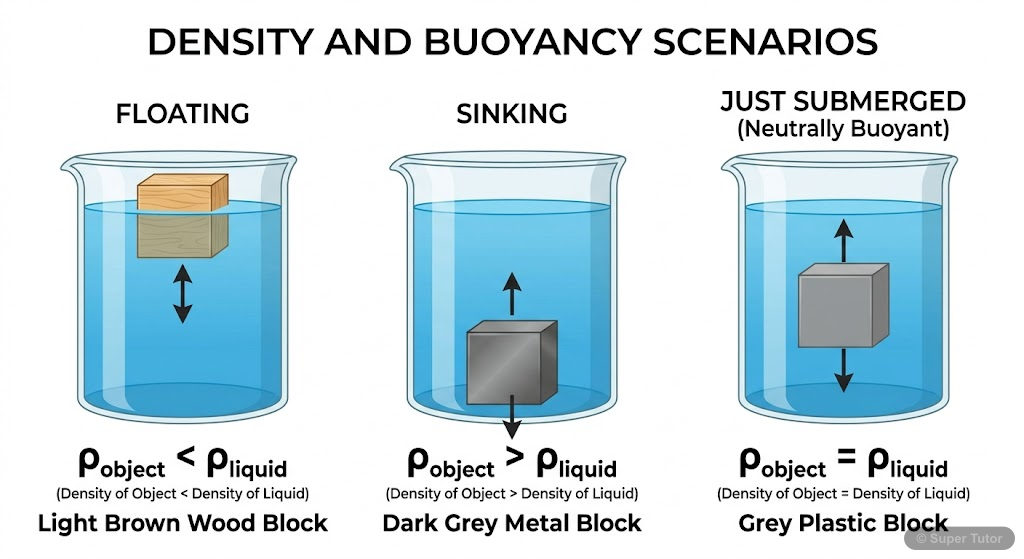
One of 11 illustrations for Flow of Liquids in Super Tutor — alongside flashcards, concept maps and practice questions.
Quick Quiz: Flow of Liquids
0/4Tap an answer to check it instantly. No sign-up needed for these 4.
An ideal liquid has two important properties. Which of the following correctly describes both properties of an ideal liquid?
In streamlined (laminar) flow, which of the following statements is TRUE about streamlines?
The Reynolds number for water flowing through a narrow tube is found to be 2500. What type of flow is this?
Newton's law of viscosity states that the viscous force F between two layers of a liquid is given by F = −η A (dv/dz). If the area of contact A = 2 m², velocity gradient dv/dz = 5 s⁻¹, and η = 0.1 kg m⁻¹ s⁻¹, what is the magnitude of the viscous force?
Sample Questions
What are the SI unit and dimensions of the coefficient of viscosity (η)?
Show answer
Unit: kg m⁻¹ s⁻¹ ; Dimensions: [M L⁻¹ T⁻¹]
From the formula η = F / [A × (dv/dz)]: Step 1: Dimensions of F = [M L T⁻²]. Step 2: Dimensions of A = [L²]. Step 3: Dimensions of dv/dz = [L T⁻¹ / L] = [T⁻¹]. Step 4: Therefore η = [M L T⁻²] / ([L²][T⁻¹]) = [M L T⁻²] / [L² T⁻¹] = [M L⁻¹ T⁻¹]. The SI unit is kg m⁻¹ s⁻¹, also called 1 decapoise = 10 poise. Option B is wrong (dimensions of momentum per unit area). Option C is wrong (these are dimensions of pressure). Option D has an extra negative power of L.
Stokes' law gives the viscous force on a small sphere of radius r moving with terminal velocity v through a medium of viscosity η. Which formula correctly represents Stokes' law?
Show answer
F = 6π η r v
Stokes' law states that the viscous (drag) force on a small sphere moving through a homogeneous medium is F = 6π η r v. Here η is the coefficient of viscosity of the medium, r is the radius of the sphere, and v is the velocity of the sphere. Option A is wrong (coefficient is 4π, not 6π). Option C is wrong (r should be to the power 1, not r²). Option D is wrong (v should be to the power 1, not v²). The number 6π comes from the mathematical derivation by Stokes for a sphere.
The Principle of Continuity states that for a liquid flowing through a tube of non-uniform cross-section, the product A × v is constant. If water flows through a pipe of cross-sectional area 4 cm² at a velocity of 3 m/s, what is the velocity at a constriction where the area is 2 cm²?
Show answer
6 m/s
Principle of Continuity: A₁v₁ = A₂v₂. Step 1: Write given values — A₁ = 4 cm², v₁ = 3 m/s, A₂ = 2 cm². Step 2: Apply continuity equation — 4 × 3 = 2 × v₂. Step 3: Solve for v₂ — v₂ = 12/2 = 6 m/s. The velocity doubles when the area is halved. Option A (1.5 m/s) is wrong — this would be the answer if the student divided instead of multiplied (thinking velocity decreases when area decreases). Option B (3 m/s) is wrong — velocity is not constant throughout. Option D (12 m/s) is wrong — this comes from v₂ = A₁ × v₁ without dividing by A₂.
Bernoulli's theorem for a flowing liquid can be written as P + ½ρv² + ρgh = constant. What does each term in this equation represent (per unit volume)?
Show answer
P = pressure energy, ½ρv² = kinetic energy, ρgh = potential energy
In Bernoulli's equation, each term represents energy per unit volume: (1) P is the pressure energy per unit volume (work done by pressure forces). (2) ½ρv² is the kinetic energy per unit volume (since KE per unit volume = ½(m/V)v² = ½ρv²). (3) ρgh is the potential energy per unit volume (since PE per unit volume = (m/V)gh = ρgh). Bernoulli's theorem is essentially the law of conservation of energy for a flowing ideal liquid. All other options incorrectly assign the terms.
+37 more questions on Flow of Liquids (ICSE Class 11 Physics)
Practise AllFrequently Asked Questions
What are the important topics in Flow of Liquids for ICSE Class 11 Physics?
How many practice questions are there for Flow of Liquids?
Sources & Official References
Content is aligned to the official syllabus. Refer to the board website for the latest curriculum.
More resources for Flow of Liquids
Important Questions
Exam-style questions with answers
Revision Notes
Key points for last-minute revision
Formula Sheet
The chapter's formulas in one place
Chapter Summary
Understand the chapter at a glance
Concept Maps
See how topics connect
Study Plan
Step-by-step plan for this chapter
Flashcards
Quick-fire cards for active recall
Syllabus
What topics to cover
For serious students
Get the full Flow of Liquids chapter — start free.
Quizzes, flashcards, an AI doubt solver and a study plan for ICSE Class 11 Physics. Free to start, no card needed.