Dimensional Analysis — Practice Quiz
ICSE · Class 11 · Physics
Try a 4-question quiz on Dimensional Analysis for ICSE Class 11 Physics: tap an answer to check it and see why. 41 questions in the full chapter test.
Interactive on Super Tutor
Studying Dimensional Analysis? Get the full interactive chapter.
Quizzes, flashcards, AI doubt-solver and a step-by-step study plan — built for practice quiz and more.
Free trial, no card needed.
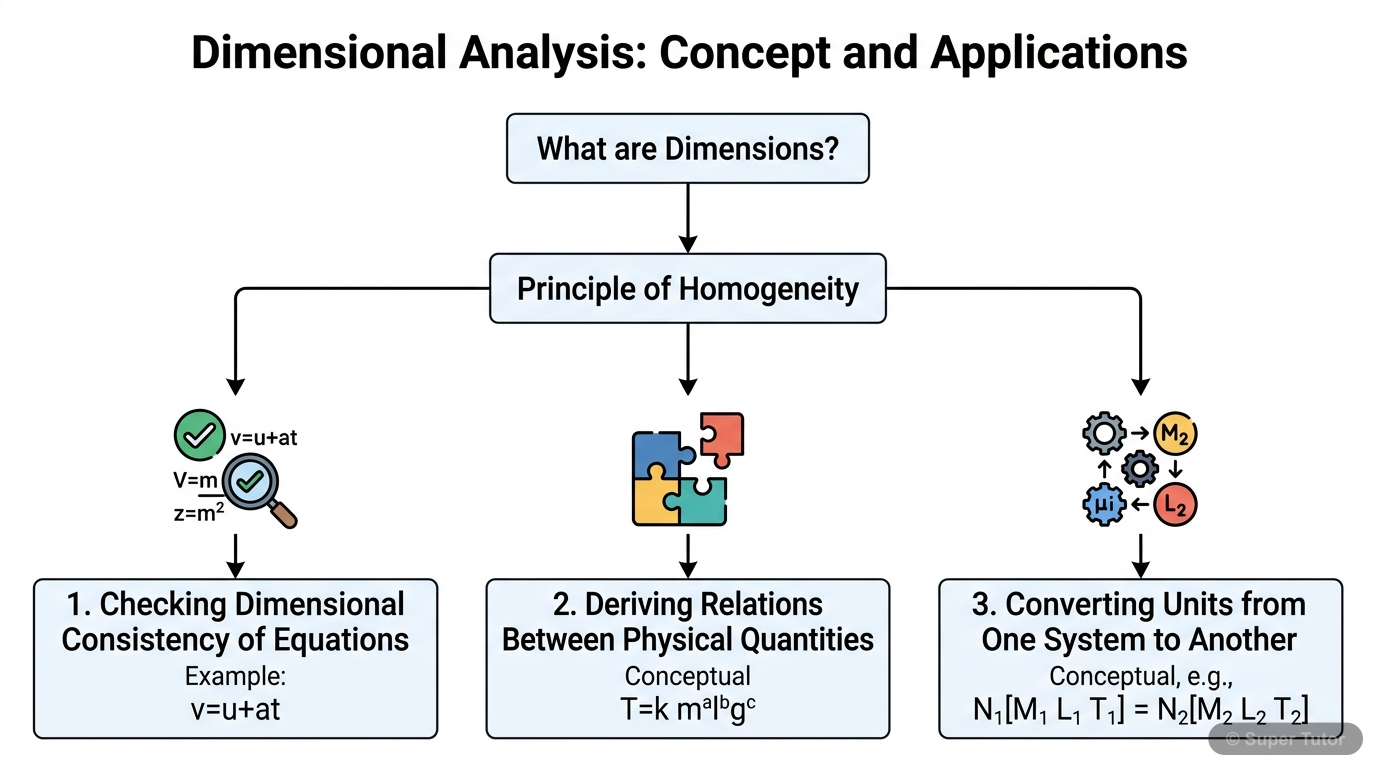
One of 5 illustrations for Dimensional Analysis in Super Tutor — alongside flashcards, concept maps and practice questions.
Quick Quiz: Dimensional Analysis
0/4Tap an answer to check it instantly. No sign-up needed for these 4.
What are the dimensions of velocity?
The dimensional formula of force is [MLT⁻²]. What is the SI unit of force derived from this dimensional formula?
Which of the following physical quantities is dimensionless?
What is the dimensional formula of work done?
Sample Questions
The principle of homogeneity states that in any valid physical equation, the dimensions of every term on both sides must be:
Show answer
The same
Step 1: The principle of homogeneity is a fundamental rule in dimensional analysis. Step 2: It states that every equation relating physical quantities must be dimensionally homogeneous. Step 3: This means the dimensions of each term on the left-hand side must equal the dimensions of each term on the right-hand side. Step 4: This principle is used to check the correctness of equations and to derive new relations. If dimensions differ, the equation is definitely wrong.
What is the dimensional formula of pressure?
Show answer
[ML⁻¹T⁻²]
Step 1: Pressure = Force / Area. Step 2: Force = [MLT⁻²], Area = [L²]. Step 3: Pressure = [MLT⁻²] / [L²] = [ML⁻¹T⁻²]. Step 4: Option B is force, option C is work/energy, option D has wrong power of L. Note: Stress and coefficient of elasticity also have the same dimensional formula [ML⁻¹T⁻²].
Using the formula n₂ = n₁(M₁/M₂)ᵃ(L₁/L₂)ᵇ(T₁/T₂)ᶜ, convert 1 newton into dynes. (Dimensional formula of force = [MLT⁻²])
Show answer
10⁵ dynes
Step 1: Force dimensional formula = [M¹L¹T⁻²], so a=1, b=1, c=−2. Step 2: MKS: M₁=1 kg=10³ g, L₁=1 m=10² cm, T₁=T₂=1 s. Step 3: n₂ = 1 × (10³g/g)¹ × (10²cm/cm)¹ × (1)⁻². Step 4: n₂ = 1 × 10³ × 10² × 1 = 10⁵. Step 5: Therefore 1 Newton = 10⁵ dynes. Common error: Students forget to substitute the correct powers from the dimensional formula.
The dimensional formula of Planck's constant h is obtained from E = hν, where E is energy and ν is frequency. What is the dimensional formula of h?
Show answer
[ML²T⁻¹]
Step 1: From E = hν, we get h = E/ν. Step 2: Dimension of E (energy) = [ML²T⁻²]. Step 3: Dimension of ν (frequency) = [T⁻¹]. Step 4: h = [ML²T⁻²] / [T⁻¹] = [ML²T⁻²] × [T] = [ML²T⁻¹]. Step 5: Option B is energy, option C is power, option D is momentum. Planck's constant is a dimensional constant.
+37 more questions on Dimensional Analysis (ICSE Class 11 Physics)
Practise AllFrequently Asked Questions
What are the important topics in Dimensional Analysis for ICSE Class 11 Physics?
How many practice questions are there for Dimensional Analysis?
Sources & Official References
Content is aligned to the official syllabus. Refer to the board website for the latest curriculum.
More resources for Dimensional Analysis
Important Questions
Exam-style questions with answers
Revision Notes
Key points for last-minute revision
Formula Sheet
The chapter's formulas in one place
Chapter Summary
Understand the chapter at a glance
Concept Maps
See how topics connect
Study Plan
Step-by-step plan for this chapter
Flashcards
Quick-fire cards for active recall
Syllabus
What topics to cover
For serious students
Get the full Dimensional Analysis chapter — start free.
Quizzes, flashcards, an AI doubt solver and a study plan for ICSE Class 11 Physics. Free to start, no card needed.