Dimensional Analysis — Chapter Summary
ICSE · Class 11 · Physics
Summary of Dimensional Analysis for ICSE Class 11 Physics. Key concepts: The dimensions of a physical, Force and Every equation relating.
Interactive on Super Tutor
Studying Dimensional Analysis? Get the full interactive chapter.
Quizzes, flashcards, AI doubt-solver and a step-by-step study plan — built for chapter summary and more.
Free trial, no card needed.
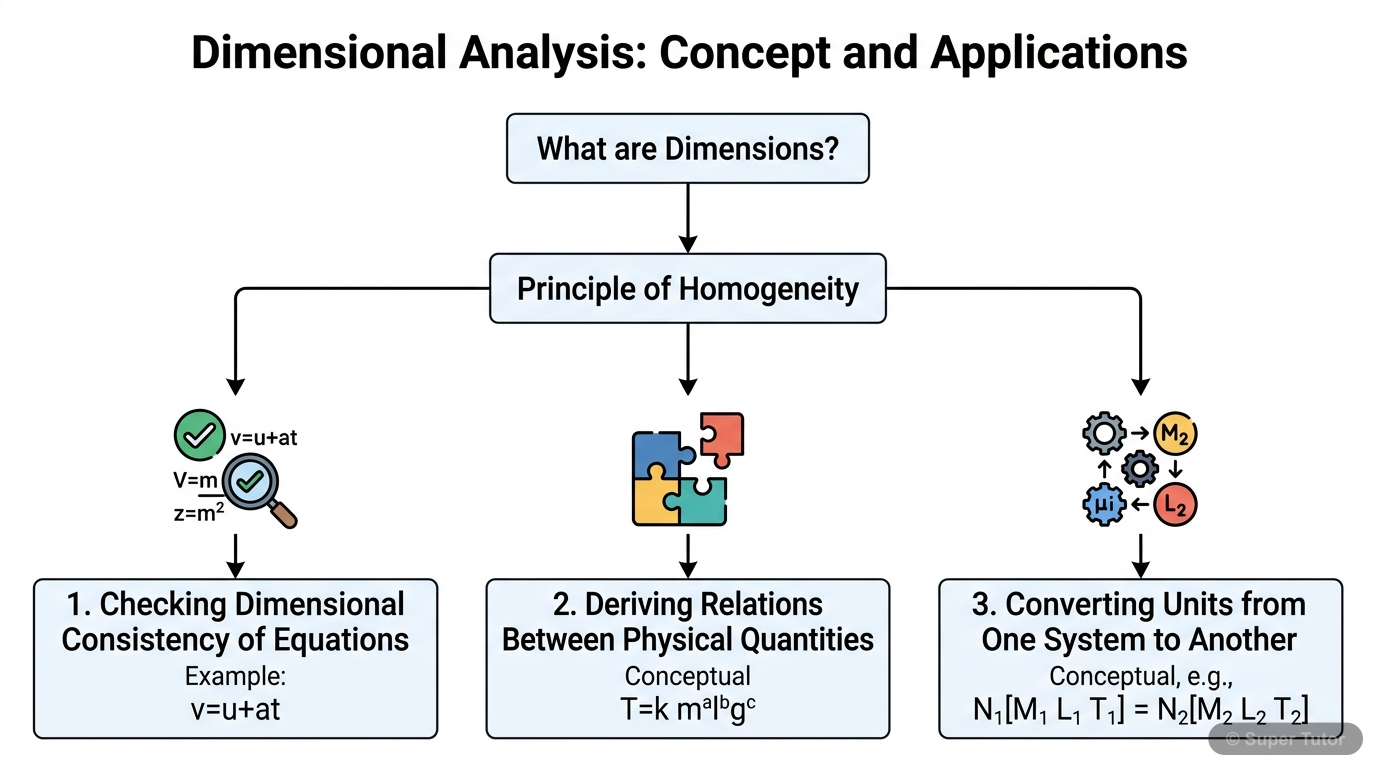
One of 5 illustrations for Dimensional Analysis in Super Tutor — alongside flashcards, concept maps and practice questions.
Overview
Dimensional analysis gives a systematic way to express physical quantities in terms of fundamental dimensions such as length, mass, time, and temperature. A physical quantity can be written as a dimensional formula of the form [L^a M^b T^c]. This helps in understanding units, checking equations, con
Key Concepts
The dimensions of a physical quantity
The dimensions of a physical quantity are the powers to which the fundamental units are raised to obtain its derived unit. In mechanics, dimensions ar
Force
Force, velocity, work, momentum, and heat are dimensional variables. Strain, angle, Poisson's ratio, and relative density are non-dimensional variable
Every equation relating physical quantities must
Every equation relating physical quantities must be dimensionally homogeneous, so the dimensions of all terms must be the same. Only quantities with t
If a physical quantity has dimensions
If a physical quantity has dimensions [M^a L^b T^c], then the numerical values in two systems are related by n2 = n1 (M1/M2)^a (L1/L2)^b (T1/T2)^c.
For a simple pendulum
For a simple pendulum, dimensional analysis gives T = k sqrt(l/g), and experimentally k = 2 pi, so T = 2 pi sqrt(l/g). The time period does not depend
Learning Objectives
- Understand the meaning of dimensions and dimensional formulae.
- Write dimensional formulae for common physical quantities and constants.
- Use dimensional homogeneity to check whether a physical equation is correct.
- Convert the numerical value of a physical quantity from one system of units to another.
- Derive relations for the time period of a simple pendulum and the frequency of a stretched string using dimensional analysis.
Frequently Asked Questions
What are the important topics in Dimensional Analysis for ICSE Class 11 Physics?
How should I revise Dimensional Analysis for Class 11 exams?
Sources & Official References
Content is aligned to the official syllabus. Refer to the board website for the latest curriculum.
More resources for Dimensional Analysis
Practice Quiz
Test yourself with a quick quiz
Important Questions
Exam-style questions with answers
Revision Notes
Key points for last-minute revision
Formula Sheet
The chapter's formulas in one place
Concept Maps
See how topics connect
Study Plan
Step-by-step plan for this chapter
Flashcards
Quick-fire cards for active recall
Syllabus
What topics to cover
For serious students
Get the full Dimensional Analysis chapter — start free.
Quizzes, flashcards, an AI doubt solver and a study plan for ICSE Class 11 Physics. Free to start, no card needed.