Uniform Circular Motion — Chapter Summary
ICSE · Class 11 · Physics
Summary of Uniform Circular Motion for ICSE Class 11 Physics. Part of the ICSE Class 11 Physics syllabus. Circular motion is motion in a plane along.
Interactive on Super Tutor
Studying Uniform Circular Motion? Get the full interactive chapter.
Quizzes, flashcards, AI doubt-solver and a step-by-step study plan — built for chapter summary and more.
Free trial, no card needed.
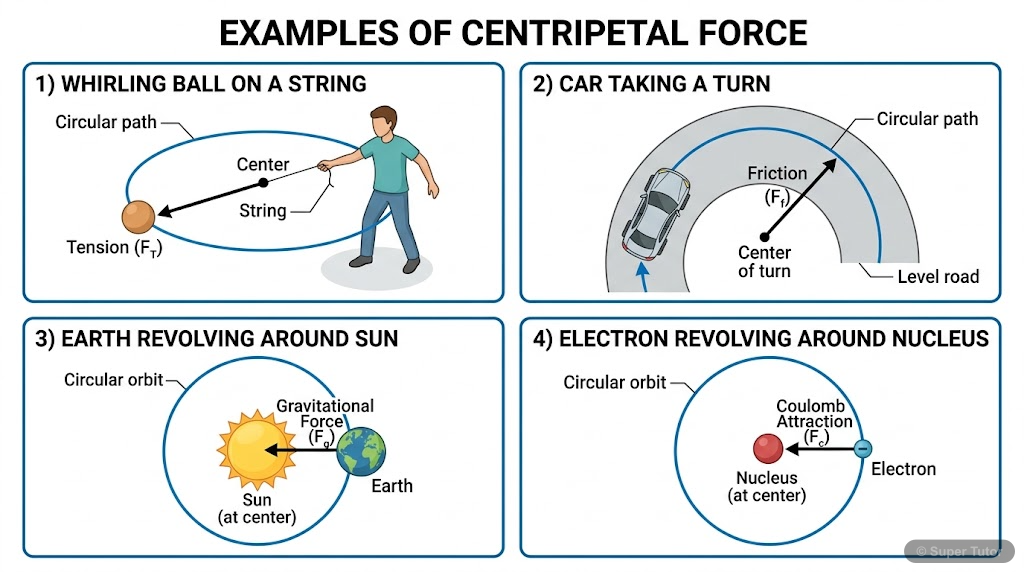
Learn better with visuals Super Tutor pairs illustrations like this with notes and quizzes for Uniform Circular Motion.
Overview
Circular motion is motion in a plane along a circular path. In uniform circular motion, speed stays constant while velocity changes continuously because the direction changes at every point. This creates centripetal acceleration towards the centre, and the force responsible for it is called centripe
Key Concepts
Circular motion is motion in
Circular motion is motion in a plane along a circular path. Examples include the motion of Earth around the Sun, wheel rotation, electron motion aroun
A particle moves on a circular
A particle moves on a circular path with constant speed. The speed remains constant, but the velocity changes continuously because its direction keeps
A particle moves on a circular
A particle moves on a circular path with variable speed. Both speed and velocity change with time, so tangential acceleration also appears along with
Angular displacement is the angle swept
Angular displacement is the angle swept out by the radius vector in a given time interval. It is given by Δθ = ΔS/r, where ΔS is arc length and r is r
Angular velocity is the rate
Angular velocity is the rate of change of angular displacement. Instantaneous angular velocity is ω = dθ/dt. Its unit is rad/s and its dimensional for
Learning Objectives
- Understand the meaning of circular motion and uniform circular motion
- Distinguish between uniform and non-uniform circular motion
- Define angular displacement, angular velocity, and their units
- Relate linear velocity to angular velocity
- Explain centripetal acceleration and tangential acceleration
Frequently Asked Questions
What are the important topics in Uniform Circular Motion for ICSE Class 11 Physics?
How should I revise Uniform Circular Motion for Class 11 exams?
Sources & Official References
Content is aligned to the official syllabus. Refer to the board website for the latest curriculum.
More resources for Uniform Circular Motion
Practice Quiz
Test yourself with a quick quiz
Important Questions
Exam-style questions with answers
Revision Notes
Key points for last-minute revision
Formula Sheet
The chapter's formulas in one place
Concept Maps
See how topics connect
Study Plan
Step-by-step plan for this chapter
Flashcards
Quick-fire cards for active recall
Syllabus
What topics to cover
For serious students
Get the full Uniform Circular Motion chapter — start free.
Quizzes, flashcards, an AI doubt solver and a study plan for ICSE Class 11 Physics. Free to start, no card needed.