Units and Measurements — Flashcards
ICSE · Class 11 · Physics
60 flashcards for Units and Measurements (ICSE Class 11 Physics) to test yourself on key terms and facts. Part of the ICSE Class 11 Physics syllabus.
Interactive on Super Tutor
Studying Units and Measurements? Get the full interactive chapter.
Quizzes, flashcards, AI doubt-solver and a step-by-step study plan — built for flashcards and more.
Free trial, no card needed.
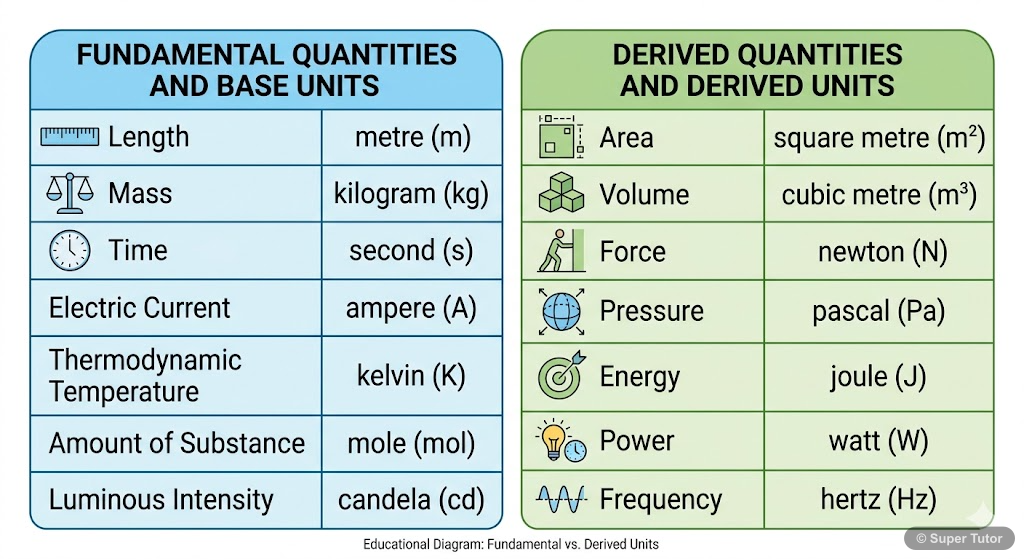
Learn better with visuals Super Tutor pairs illustrations like this with notes and quizzes for Units and Measurements.
State the meaning of a physical quantity.
Answer
A quantity linked to a physical phenomenon and subjected to measurement is called a physical quantity. Examples: length, mass, time, force, speed.
Why is physics called a science of measurement?
Answer
Physics depends on measuring quantities like distance, mass, time, force, and speed to describe natural phenomena clearly in numbers. Without measurement, description remains incomplete.
What are fundamental quantities in mechanics?
Answer
Length, mass, and time are fundamental quantities in mechanics. Their units are fundamental units because they cannot be derived from one another.
State the SI base units for length, mass, and time.
Answer
Length = metre (m), mass = kilogram (kg), time = second (s).
State the unit-numerical value invariance relation.
Answer
n1(u1) = n2(u2). It means the product of numerical value and unit remains constant when the unit changes.
A length is 20 m. What is it in cm and mm?
Answer
Given: 20 m. 1 m = 100 cm, so 20 m = 20 × 100 cm = 2000 cm. Also, 1 m = 1000 mm, so 20 m = 20 × 1000 mm = 20000 mm. Answer: 2000 cm or 20000 mm.
What is the SI and metric status of CGS, MKS, FPS, and SI?
Answer
CGS, MKS, and SI are metric systems. FPS is a non-metric British system and is rarely used.
State two reasons why SI is preferred.
Answer
SI is rational, meaning one unit is used for one physical quantity. SI is coherent, meaning derived units are obtained without numerical factors.
+52 more flashcards
Practise AllFrequently Asked Questions
What are the important topics in Units and Measurements for ICSE Class 11 Physics?
How many flashcards are available for Units and Measurements?
How should I revise Units and Measurements for Class 11 exams?
Sources & Official References
Content is aligned to the official syllabus. Refer to the board website for the latest curriculum.
More resources for Units and Measurements
Practice Quiz
Test yourself with a quick quiz
Important Questions
Exam-style questions with answers
Revision Notes
Key points for last-minute revision
Formula Sheet
The chapter's formulas in one place
Chapter Summary
Understand the chapter at a glance
Concept Maps
See how topics connect
Study Plan
Step-by-step plan for this chapter
Syllabus
What topics to cover
For serious students
Get the full Units and Measurements chapter — start free.
Quizzes, flashcards, an AI doubt solver and a study plan for ICSE Class 11 Physics. Free to start, no card needed.