Vibrations of Stretched Strings — Revision Notes
ICSE · Class 11 · Physics
Vibrations of Stretched Strings revision notes for ICSE Class 11 Physics: 4 topics in quick points. Part of the ICSE Class 11 Physics syllabus.
Interactive on Super Tutor
Studying Vibrations of Stretched Strings? Get the full interactive chapter.
Quizzes, flashcards, AI doubt-solver and a step-by-step study plan — built for revision notes and more.
Free trial, no card needed.
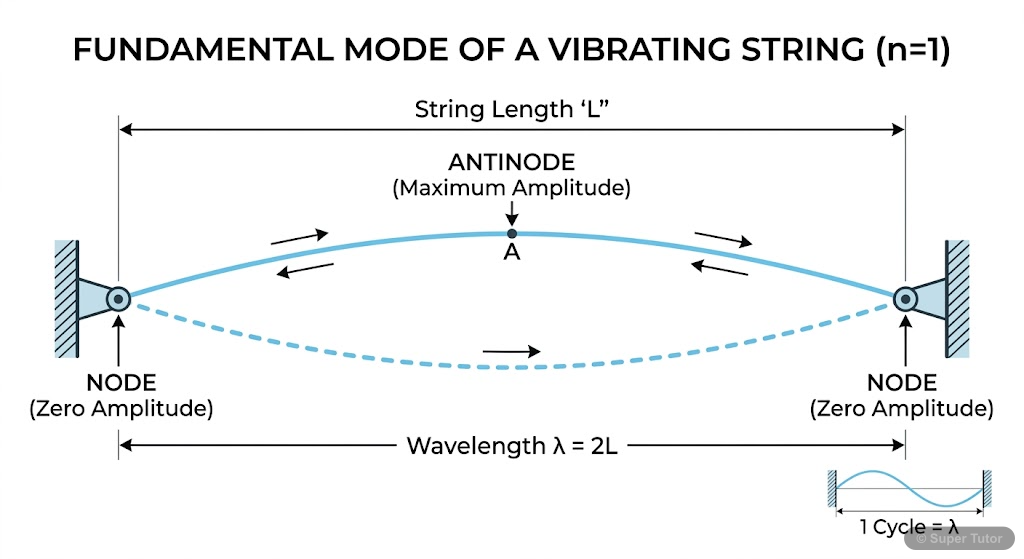
Learn better with visuals Super Tutor pairs illustrations like this with notes and quizzes for Vibrations of Stretched Strings.
Key Topics to Revise
1. Stretched String and Wave Speed
- A string is a wire or fibre of uniform diameter and is perfectly flexible, with no rigidity.
- A wire clamped at both ends and plucked in the middle produces transverse progressive waves that travel towards both ends.
- The speed of transverse waves on a stretched wire depends on tension T and mass per unit length m.
2. Laws of Vibrations of Stretched Strings
- Law of Length: for a given string under a given tension, frequency varies inversely as vibrating length.
- Law of Tension: for a uniform string of given length and material, frequency varies directly as the square-root of tension.
- Law of Mass: for a given tension and vibrating length, frequency varies inversely as the square-root of mass per unit length.
3. Standing Waves and Modes of Vibration
- A wave moving on the string reflects at the fixed end with a phase change of pi.
- Superposition of incident and reflected waves produces a stationary wave.
- The resultant equation is not a travelling wave because its argument is not of the form vt ± x.
4. Positions of Nodes and Antinodes
- In the pth mode, there are p + 1 nodes.
- Nodes are at x = 0, l/p, 2l/p, 3l/p, ..., l.
- Antinodes are at x = l/(2p), 3l/(2p), 5l/(2p), ..., (2p - 1)l/(2p).
Get complete notes with diagrams and examples
Full NotesKey Concepts
Frequently Asked Questions
What are the important topics in Vibrations of Stretched Strings for ICSE Class 11 Physics?
How should I revise Vibrations of Stretched Strings for Class 11 exams?
Sources & Official References
Content is aligned to the official syllabus. Refer to the board website for the latest curriculum.
More resources for Vibrations of Stretched Strings
Practice Quiz
Test yourself with a quick quiz
Important Questions
Exam-style questions with answers
Formula Sheet
The chapter's formulas in one place
Chapter Summary
Understand the chapter at a glance
Concept Maps
See how topics connect
Study Plan
Step-by-step plan for this chapter
Flashcards
Quick-fire cards for active recall
Syllabus
What topics to cover
For serious students
Get the full Vibrations of Stretched Strings chapter — start free.
Quizzes, flashcards, an AI doubt solver and a study plan for ICSE Class 11 Physics. Free to start, no card needed.