Wave Motion — Revision Notes
ICSE · Class 11 · Physics
Wave Motion revision notes for ICSE Class 11 Physics: 4 topics in quick points. Part of the ICSE Class 11 Physics syllabus.
Interactive on Super Tutor
Studying Wave Motion? Get the full interactive chapter.
Quizzes, flashcards, AI doubt-solver and a step-by-step study plan — built for revision notes and more.
Free trial, no card needed.
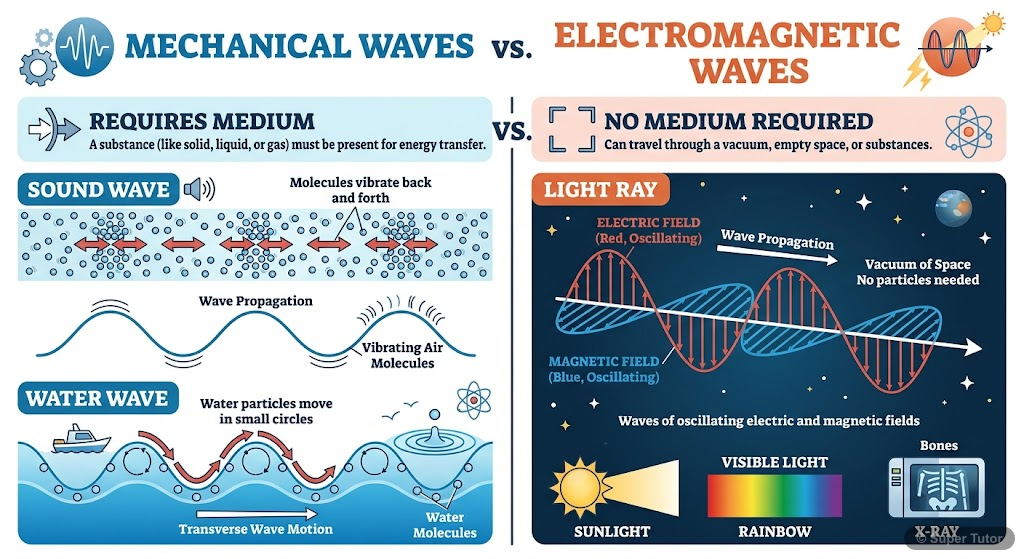
Learn better with visuals Super Tutor pairs illustrations like this with notes and quizzes for Wave Motion.
Key Topics to Revise
1. Mechanical Waves and Basic Ideas
- A mechanical wave is a disturbance that travels through a material medium with definite speed without changing its form.
- Mechanical waves transmit energy and momentum, not the matter.
- The transmission is possible because of elasticity and inertia of the medium.
2. Speed of Wave Motion in Solids, Liquids and Strings
- Mechanical waves can be transverse or longitudinal.
- Transverse waves travel in solids only.
- Longitudinal waves travel in solids, liquids and gases.
3. Newton’s Formula and Laplace’s Correction
- Newton assumed that sound propagation in gases is isothermal.
- Under this assumption, Boyle’s law gives isothermal bulk modulus BT = P.
- Newton’s formula for the speed of sound in gases is v = √(P/ρ).
4. Variation of Speed of Sound in Air
- At constant temperature, pressure change does not affect the speed of sound in a gas.
- At constant temperature, P/ρ remains constant.
- Speed of sound in a gas is directly proportional to the square root of absolute temperature.
Get complete notes with diagrams and examples
Full NotesKey Concepts
Frequently Asked Questions
What are the important topics in Wave Motion for ICSE Class 11 Physics?
How should I revise Wave Motion for Class 11 exams?
Sources & Official References
Content is aligned to the official syllabus. Refer to the board website for the latest curriculum.
More resources for Wave Motion
Practice Quiz
Test yourself with a quick quiz
Important Questions
Exam-style questions with answers
Formula Sheet
The chapter's formulas in one place
Chapter Summary
Understand the chapter at a glance
Concept Maps
See how topics connect
Study Plan
Step-by-step plan for this chapter
Flashcards
Quick-fire cards for active recall
Syllabus
What topics to cover
For serious students
Get the full Wave Motion chapter — start free.
Quizzes, flashcards, an AI doubt solver and a study plan for ICSE Class 11 Physics. Free to start, no card needed.