Medieval India (D) Composite Culture — Syllabus
ICSE · Class 9 · History & Civics
What Medieval India (D) Composite Culture covers in ICSE Class 9 History & Civics: 4 topics, for the 2026-27 session.
Interactive on Super Tutor
Studying Medieval India (D) Composite Culture? Get the full interactive chapter.
Quizzes, flashcards, AI doubt-solver and a step-by-step study plan — built for syllabus and more.
Free trial, no card needed.
One of 5 illustrations for Medieval India (D) Composite Culture in Super Tutor — alongside flashcards, concept maps and practice questions.
Topics in Medieval India (D) Composite Culture
1. Meaning and Growth of Composite Culture
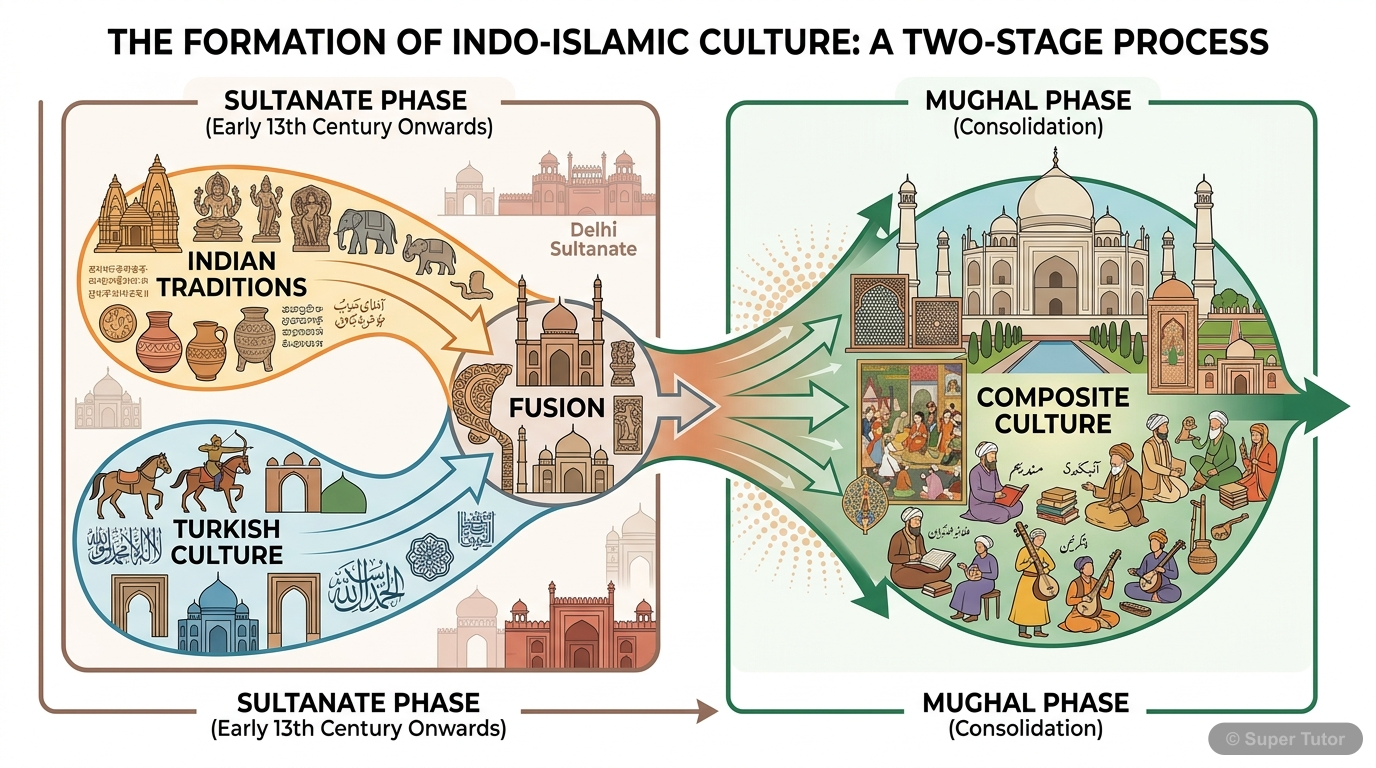
- The establishment of the Delhi Sultanate towards the beginning of the 13th century marked the beginning of a new phase in the cultural development of the country.
- The interaction of the Turks with the Indians led to the development of Indo-Islamic culture.
- Composite culture was neither purely Persian nor entirely Indian; it was a fusion of the best elements of both.
2. Bijak and Kabir
- Bijak is the compilation of the verses of Sant Kabir Das.
- Kabir was a disciple of the Bhakti saint Ramananda.
- He was born in mid-15th century to a Brahmin widow who abandoned him near a tank in Benaras.
3. Guru Granth Sahib and Guru Nanak Dev
- Guru Arjan Dev compiled Guru Nanak Dev's hymns along with those of his four successors and other saints into the Adi Granth Sahib in Amritsar, Punjab.
- Guru Gobind Singh included the compositions of Guru Teg Bahadur, after which the scripture was called Guru Granth Sahib.
- Guru Granth Sahib is written in the Gurmukhi script.
4. Ajmer Sharief and Khwajah Moinuddin Chishti
- Ajmer Sharief is the holy shrine of Khwajah Moinuddin Chishti.
- It is located at Ajmer in Rajasthan.
- Khwajah Moinuddin Chishti came to India with Mahmud of Ghazni and made Ajmer his headquarters till his death in AD 1236.
Key Concepts
Central concept: Composite culture in medieval India
Work through every topic in Medieval India (D) Composite Culture with notes and quizzes
Start This ChapterFrequently Asked Questions
What are the important topics in Medieval India (D) Composite Culture for ICSE Class 9 History & Civics?
How should I revise Medieval India (D) Composite Culture for Class 9 exams?
Sources & Official References
Content is aligned to the official syllabus. Refer to the board website for the latest curriculum.
More resources for Medieval India (D) Composite Culture
Practice Quiz
Test yourself with a quick quiz
Important Questions
Exam-style questions with answers
Revision Notes
Key points for last-minute revision
Chapter Summary
Understand the chapter at a glance
Concept Maps
See how topics connect
Study Plan
Step-by-step plan for this chapter
Flashcards
Quick-fire cards for active recall
For serious students
Get the full Medieval India (D) Composite Culture chapter — start free.
Quizzes, flashcards, an AI doubt solver and a study plan for ICSE Class 9 History & Civics. Free to start, no card needed.