Medieval India (D) Composite Culture — Flashcards
ICSE · Class 9 · History & Civics
40 flashcards for Medieval India (D) Composite Culture (ICSE Class 9 History & Civics) to test yourself on key terms and facts.
Interactive on Super Tutor
Studying Medieval India (D) Composite Culture? Get the full interactive chapter.
Quizzes, flashcards, AI doubt-solver and a step-by-step study plan — built for flashcards and more.
Free trial, no card needed.
One of 5 illustrations for Medieval India (D) Composite Culture in Super Tutor — alongside flashcards, concept maps and practice questions.
What is composite culture in medieval India?
Answer
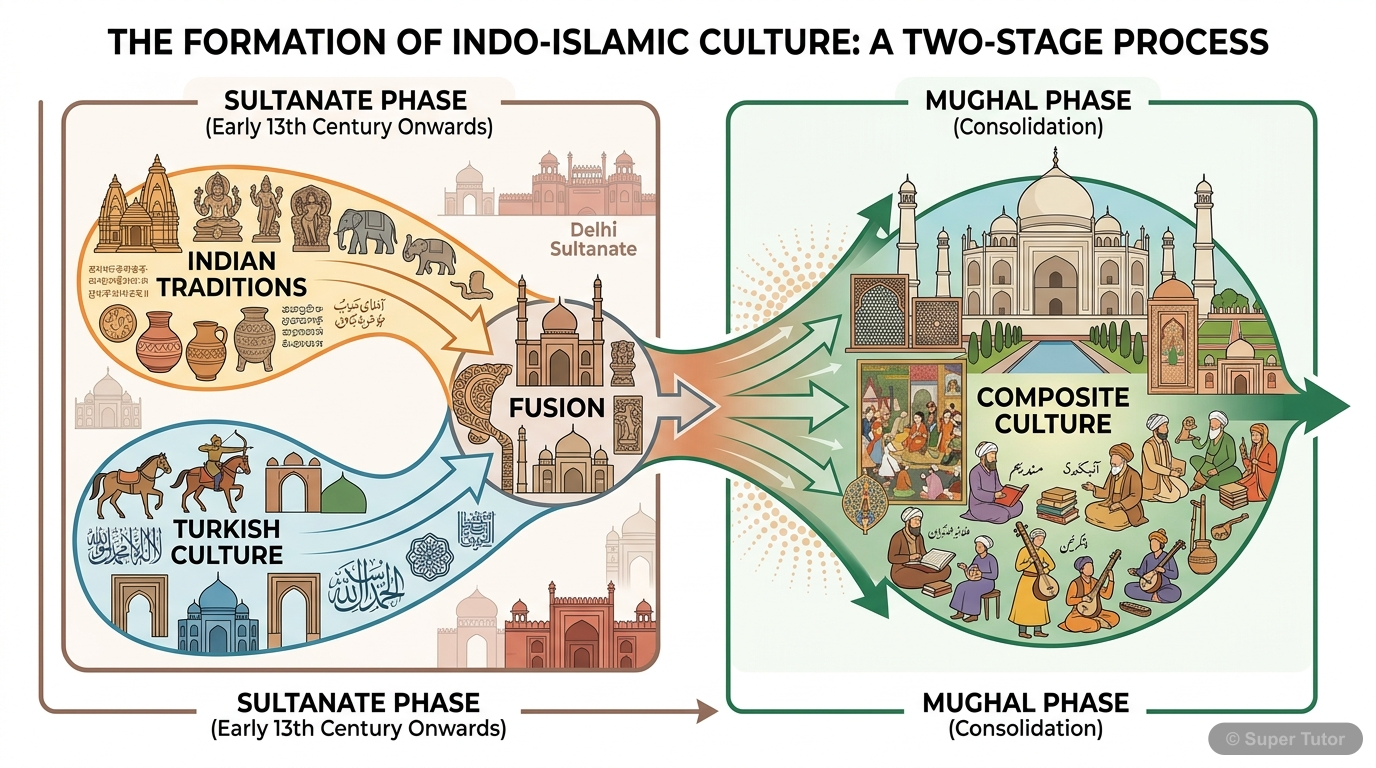
Composite culture was a new Indo-Islamic culture formed through the interaction of Turks and Indians. It was neither purely Persian nor entirely Indian, but a fusion of the best elements of both.
Why did the beginning of the Delhi Sultanate matter for cultural change?
Answer
The establishment of the Delhi Sultanate towards the beginning of the 13th century marked the beginning of a new phase in the cultural development of the country. It opened the way for closer contact …
What were the two phases of growth of Indo-Islamic composite culture?
Answer
The two phases were the Sultanate phase and the Mughal phase. The Sultanate phase marked the fusion of Indian traditions with Turkish culture, and the Mughal phase marked the consolidation of this com…
Bijak: what is it and why is it important?
Answer
Bijak is the compilation of the verses of Kabir. It is an important source of composite culture because Kabir's teachings promoted equality, devotion to God, and harmony among communities.
Who was Kabir, and how was he brought up?
Answer
Kabir was a poet-saint and a disciple of the Bhakti saint Ramananda. He was born in the mid-15th century to a Brahmin widow, abandoned near a tank in Benaras, and rescued and brought up by the Muslim …
What are the three main sections of Bijak?
Answer
The three main sections of Bijak are Sakhi, Ramaini, and Shabda. Sakhi is in couplet form, Ramaini is usually longer and based on a musical raga, and Shabda is the loosest metrical form.
What do Kabir's teachings say about God and society?
Answer
Kabir taught that there is only one God, though He may be worshipped under many names. He also taught that all men are equal before God and rejected caste distinctions, idol worship, empty rituals, an…
Kabir's teaching on devotion and behaviour: what is the main idea?
Answer
Kabir taught that devotion to God and good actions are the only means of salvation. He believed that a person must be free from dishonesty, insincerity, and hypocrisy to reach God.
+32 more flashcards
Practise AllFrequently Asked Questions
What are the important topics in Medieval India (D) Composite Culture for ICSE Class 9 History & Civics?
How many flashcards are available for Medieval India (D) Composite Culture?
How should I revise Medieval India (D) Composite Culture for Class 9 exams?
Sources & Official References
Content is aligned to the official syllabus. Refer to the board website for the latest curriculum.
More resources for Medieval India (D) Composite Culture
Practice Quiz
Test yourself with a quick quiz
Important Questions
Exam-style questions with answers
Revision Notes
Key points for last-minute revision
Chapter Summary
Understand the chapter at a glance
Concept Maps
See how topics connect
Study Plan
Step-by-step plan for this chapter
Syllabus
What topics to cover
For serious students
Get the full Medieval India (D) Composite Culture chapter — start free.
Quizzes, flashcards, an AI doubt solver and a study plan for ICSE Class 9 History & Civics. Free to start, no card needed.