The Vedic Period — Flashcards
ICSE · Class 9 · History & Civics
44 flashcards for The Vedic Period (ICSE Class 9 History & Civics) to test yourself on key terms and facts. Sample: "What are the two main phases.
Interactive on Super Tutor
Studying The Vedic Period? Get the full interactive chapter.
Quizzes, flashcards, AI doubt-solver and a step-by-step study plan — built for flashcards and more.
Free trial, no card needed.
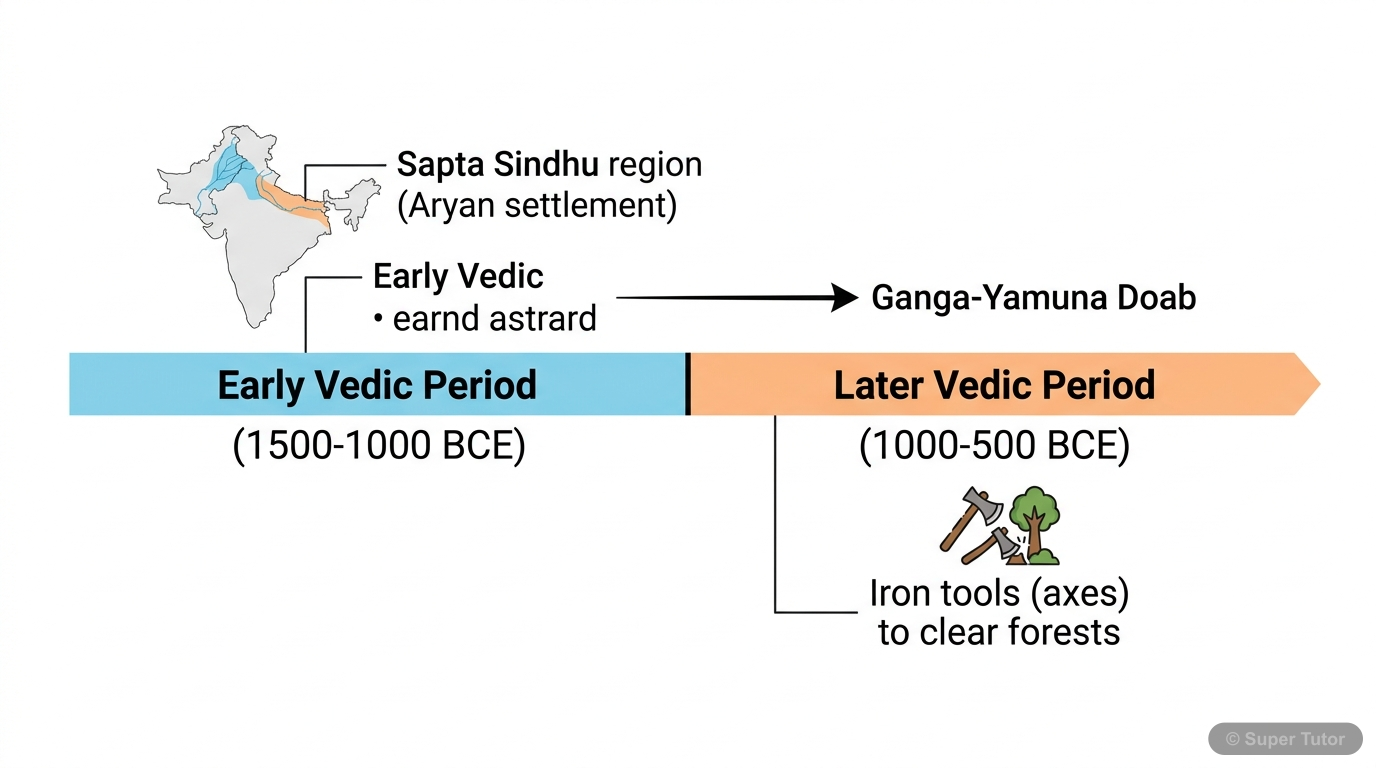
Learn better with visuals Super Tutor pairs illustrations like this with notes and quizzes for The Vedic Period.
What are the two main phases of the Vedic Period?
Answer
The two main phases are the Early Vedic Period, from 1500 BCE to 1000 BCE, and the Later Vedic Age, from 1000 BCE to 500 BCE. The Early Vedic Period is linked with the first settlement of Aryans in In…
Why is the Early Vedic Period called the Early Vedic Period?
Answer
It is called the Early Vedic Period because most of the hymns of the Rig Veda were composed during this time. These hymns give important information about the life, society, and religion of Early Vedi…
What is the Rig Veda?
Answer
The Rig Veda is the oldest of the four Vedas and the oldest religious text in the world. It is divided into 10 mandalas and contains the famous Gayatri Mantra. It is often called The First Testament o…
What does the Sama Veda deal with?
Answer
The Sama Veda means Sweet Song or melody. It contains hymns borrowed from the Rig Veda and these hymns were sung by priests during sacrifices.
What is special about the Yajur Veda?
Answer
The Yajur Veda deals with hymns recited during yajnas. It has two recensions, called Krishna or Black Yajur Veda and Shukla or White Yajur Veda. It gives information about rituals and religious life.
What does the Atharva Veda focus on?
Answer
The Atharva Veda deals with magic, charms against evil spirits and diseases, and medicines. It also includes hymns related to knowledge, action, and invocation.
What do Shruti and Smriti mean in Vedic literature?
Answer
Shruti refers to Vedic literature believed to be revealed by God and passed on orally from generation to generation. Smriti refers to literature composed by the Rishis. These are the two broad parts o…
Which writings belong to Later Vedic texts?
Answer
The Later Vedic texts include the remaining Vedas and their branches such as the Brahmanas, Aranyakas, and Upanishads. They belong mainly to the Later Vedic Age.
+36 more flashcards
Practise AllFrequently Asked Questions
What are the important topics in The Vedic Period for ICSE Class 9 History & Civics?
How many flashcards are available for The Vedic Period?
How should I revise The Vedic Period for Class 9 exams?
Sources & Official References
Content is aligned to the official syllabus. Refer to the board website for the latest curriculum.
More resources for The Vedic Period
Practice Quiz
Test yourself with a quick quiz
Important Questions
Exam-style questions with answers
Revision Notes
Key points for last-minute revision
Chapter Summary
Understand the chapter at a glance
Concept Maps
See how topics connect
Study Plan
Step-by-step plan for this chapter
Syllabus
What topics to cover
For serious students
Get the full The Vedic Period chapter — start free.
Quizzes, flashcards, an AI doubt solver and a study plan for ICSE Class 9 History & Civics. Free to start, no card needed.