International Trade (Part 2) — NCERT Solutions
Madhya Pradesh Board · Class 12 · Geography
NCERT Solutions for International Trade (Part 2), Madhya Pradesh Board Class 12 Geography: 7 textbook questions solved step by step.
Interactive on Super Tutor
Studying International Trade? Get the full interactive chapter.
Quizzes, flashcards, AI doubt-solver and a step-by-step study plan — built for NCERT solutions and more.
Free trial, no card needed.
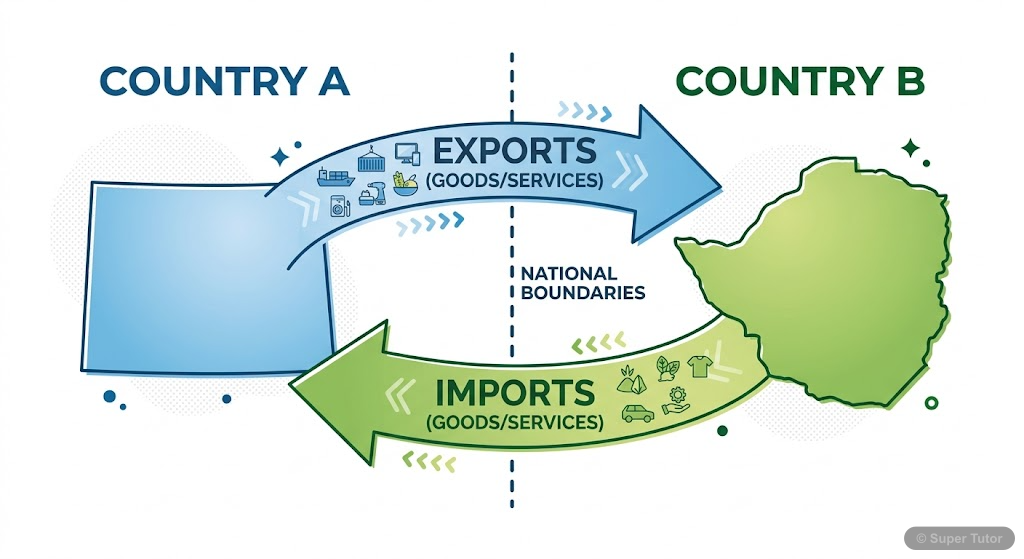
One of 16 illustrations for International Trade in Super Tutor — alongside flashcards, concept maps and practice questions.
The first 4 solutions are open to read. The other 3 are free with a Super Tutor account.
EXERCISES — Chapter: International Trade (Fundamentals of Human Geography, Class 12)
1(i)Most of the world's great ports are classified as:
(a) Naval Ports
(b) Oil Ports
(c) Comprehensive Ports
(d) Industrial PortsShow solution
Correct Answer: (c) Comprehensive Ports
Justification: Most of the world's great ports handle a large variety of goods — both imports and exports — and serve diverse functions including commercial, industrial, and passenger traffic. Such ports are called Comprehensive Ports. Examples include London, Mumbai, and New York.
1(ii)Which one of the following continents has the maximum flow of global trade?
(a) Asia
(b) North America
(c) Europe
(d) AfricaShow solution
Correct Answer: (c) Europe
Justification: Europe has a highly developed network of industrialised nations with dense intra-regional and inter-regional trade links. It accounts for the largest share of global trade flows, driven by countries like Germany, France, the Netherlands, and the United Kingdom.
2(i)What is the basic function of the World Trade Organisation?Show solution
Given: A question about the role of the WTO in international trade.
Answer: The World Trade Organisation (WTO) was established in 1995 as the successor to GATT (General Agreement on Tariffs and Trade). Its basic functions are:
- To set the rules and regulations governing international trade among member nations.
- To promote free and fair trade by reducing tariff and non-tariff barriers.
- To settle trade disputes between member countries through a structured dispute-resolution mechanism.
- To ensure that trade flows as smoothly, predictably, and freely as possible across the globe.
In essence, the WTO acts as a global watchdog for international trade, ensuring that trade policies of member nations conform to agreed-upon rules.
2(ii)Why is it detrimental for a nation to have negative balance of payments?Show solution
Given: A question on the consequences of a negative (unfavourable) balance of payments.
Answer: A negative balance of payments (also called an unfavourable balance of trade) means that a country's imports exceed its exports in terms of value.
This is detrimental because:
- The country has to pay more foreign exchange than it earns, leading to a depletion of its foreign exchange reserves.
- It creates a debt burden as the country may need to borrow from international institutions to finance the deficit.
- It weakens the national currency, leading to inflation and higher prices of imported goods.
- It indicates that domestic industries are not competitive enough in the global market, which can lead to unemployment and slower economic growth.
Thus, a persistent negative balance of payments undermines a nation's economic stability and financial sovereignty.
Free with a Super Tutor account
Free with a Super Tutor account
Free with a Super Tutor account
3 more solved questions in International Trade
They are free with a Super Tutor account, along with practice quizzes and flashcards for this chapter. Free to start, no card needed.
Frequently Asked Questions
What are the important topics in International Trade for Madhya Pradesh Board Class 12 Geography?
Are these NCERT Solutions for International Trade free?
How should I revise International Trade for the Madhya Pradesh Board Class 12 board exam?
Sources & Official References
Content is aligned to the official syllabus. Refer to the board website for the latest curriculum.
More resources for International Trade
Practice Quiz
Test yourself with a quick quiz
Important Questions
Exam-style questions with answers
Revision Notes
Key points for last-minute revision
Chapter Summary
Understand the chapter at a glance
Concept Maps
See how topics connect
Study Plan
Step-by-step plan for this chapter
Flashcards
Quick-fire cards for active recall
Syllabus
What topics to cover
For serious students
Get the full International Trade chapter — start free.
Quizzes, flashcards, an AI doubt solver and a study plan for Madhya Pradesh Board Class 12 Geography. Free to start, no card needed.