Secondary Activities — NCERT Solutions
Madhya Pradesh Board · Class 12 · Geography
NCERT Solutions for Secondary Activities, Madhya Pradesh Board Class 12 Geography: 12 textbook questions solved step by step. Covers Exercises.
Interactive on Super Tutor
Studying Secondary Activities? Get the full interactive chapter.
Quizzes, flashcards, AI doubt-solver and a step-by-step study plan — built for NCERT solutions and more.
Free trial, no card needed.
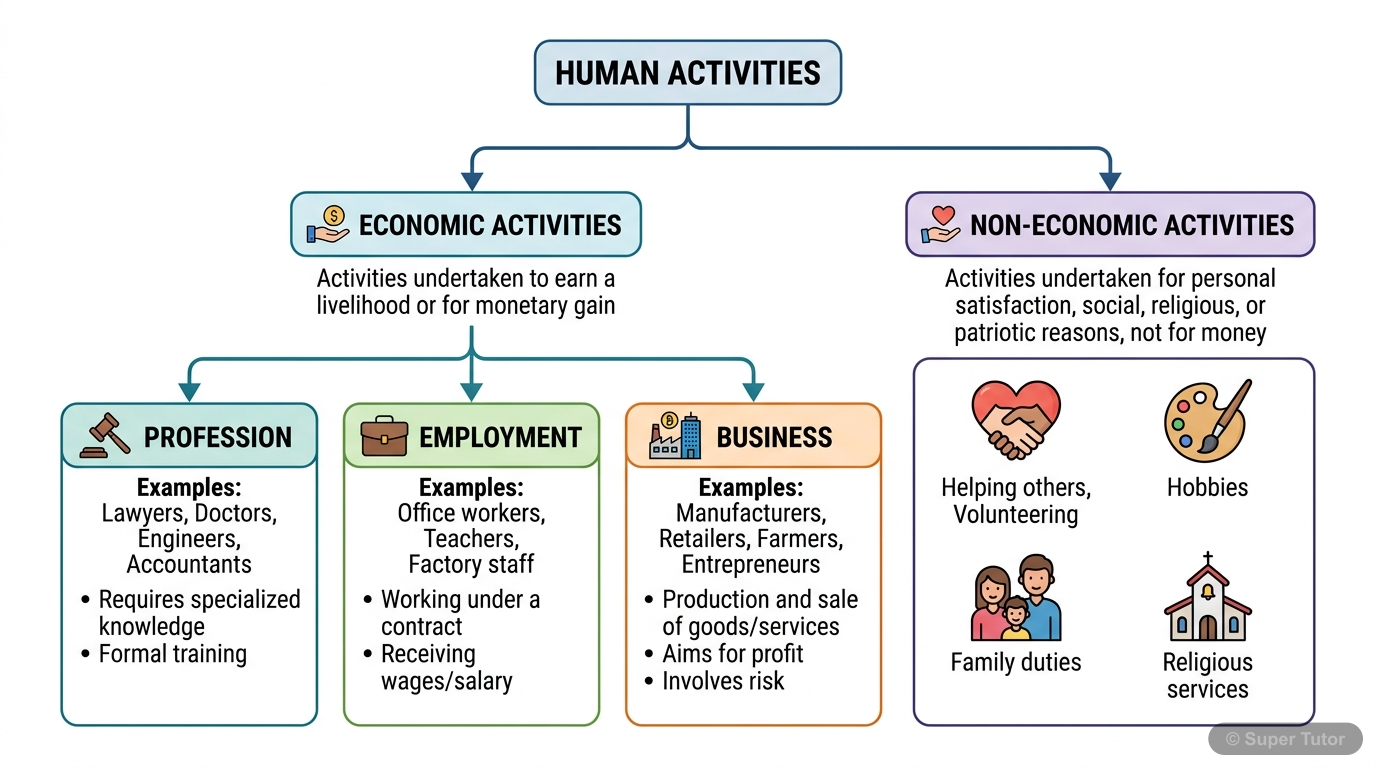
Learn better with visuals Super Tutor pairs illustrations like this with notes and quizzes for Secondary Activities.
The first 6 solutions are open to read. The other 6 are free with a Super Tutor account.
Exercises
1(i)Which one of the following statements is wrong?
(a) Cheap water transport has facilitated the jute mill industry along the Hugli.
(b) Sugar, cotton textiles and vegetable oils are footloose industries.
(c) The development of hydro-electricity and petroleum reduced, to a great extent, the importance of coal energy as a locational factor for industry.
(d) Port towns in India have attracted industries.Show solution
Correct Answer: (b) Sugar, cotton textiles and vegetable oils are footloose industries.
Justification: Sugar, cotton textiles and vegetable oils are NOT footloose industries. They are raw-material oriented industries — sugar mills are located near sugarcane fields, cotton textile mills near cotton-growing areas, and oil mills near oilseed-producing regions. Footloose industries are those that can be located anywhere regardless of the source of raw materials or markets (e.g., electronics, gem-cutting). Hence, statement (b) is wrong.
1(ii)In which one of the following types of economy are the factors of production owned individually?
(a) Capitalist
(b) Mixed
(c) Socialist
(d) NoneShow solution
Correct Answer: (a) Capitalist
Justification: In a capitalist economy, the factors of production — land, labour, capital and enterprise — are privately (individually) owned. Individuals and private firms make decisions about production and distribution, driven by the profit motive. In a socialist economy, the state owns the means of production, while a mixed economy has both private and state ownership.
1(iii)Which one of the following types of industries produces raw materials for other industries?
(a) Cottage Industries
(b) Small-scale Industries
(c) Basic Industries
(d) Footloose IndustriesShow solution
Correct Answer: (c) Basic Industries
Justification: Basic industries (also called key industries) produce raw materials and semi-finished goods that serve as inputs for other industries. For example, the iron and steel industry produces steel used by the automobile, shipbuilding and machinery industries. Cottage and small-scale industries produce consumer goods, while footloose industries have no strong locational tie to raw materials.
1(iv)Which one of the following pairs is correctly matched?
(a) Automobile industry — Los Angeles
(b) Shipbuilding industry — Lusaka
(c) Aircraft industry — FlorenceShow solution
Correct Answer: (a) Automobile industry — Los Angeles
Justification: Los Angeles (Southern California, USA) is a well-known centre for the automobile and aerospace/aircraft manufacturing industry. Lusaka is the capital of Zambia and is not a major shipbuilding centre (shipbuilding requires coastal locations). Florence (Italy) is famous for fashion and leather goods, not aircraft manufacturing. Hence, pair (a) is correctly matched.
2(i)Write a short note on High-Tech industry in about 30 words.Show solution
High-Tech Industry:
High-tech industry refers to the latest generation of manufacturing activities based on intensive research and development (R&D). It involves the production of computers, robots, precision instruments, aerospace equipment, and telecommunication devices. Workers are highly skilled professionals (scientists, engineers). Such industries are often clustered in technopolies — science parks or technology corridors — such as Silicon Valley (USA). They represent the cutting edge of modern industrial development.
2(ii)Write a short note on Manufacturing in about 30 words.Show solution
Manufacturing:
Manufacturing is the process of converting raw materials into finished goods of higher value using power-driven machines. It is a secondary activity that transforms natural resources into useful products — for example, converting iron ore into steel or cotton into cloth. Manufacturing contributes significantly to national income, employment and economic development. It ranges from small cottage industries to large-scale automated factories.
Free with a Super Tutor account
Free with a Super Tutor account
Free with a Super Tutor account
Free with a Super Tutor account
Free with a Super Tutor account
Free with a Super Tutor account
6 more solved questions in Secondary Activities
They are free with a Super Tutor account, along with practice quizzes and flashcards for this chapter. Free to start, no card needed.
Frequently Asked Questions
What are the important topics in Secondary Activities for Madhya Pradesh Board Class 12 Geography?
Are these NCERT Solutions for Secondary Activities free?
How should I revise Secondary Activities for the Madhya Pradesh Board Class 12 board exam?
Sources & Official References
Content is aligned to the official syllabus. Refer to the board website for the latest curriculum.
More resources for Secondary Activities
Practice Quiz
Test yourself with a quick quiz
Important Questions
Exam-style questions with answers
Revision Notes
Key points for last-minute revision
Chapter Summary
Understand the chapter at a glance
Concept Maps
See how topics connect
Study Plan
Step-by-step plan for this chapter
Flashcards
Quick-fire cards for active recall
Syllabus
What topics to cover
For serious students
Get the full Secondary Activities chapter — start free.
Quizzes, flashcards, an AI doubt solver and a study plan for Madhya Pradesh Board Class 12 Geography. Free to start, no card needed.