Primary Activities — NCERT Solutions
Madhya Pradesh Board · Class 12 · Geography
NCERT Solutions for Primary Activities, Madhya Pradesh Board Class 12 Geography: 14 textbook questions solved step by step. Covers Exercises.
Interactive on Super Tutor
Studying Primary Activities? Get the full interactive chapter.
Quizzes, flashcards, AI doubt-solver and a step-by-step study plan — built for NCERT solutions and more.
Free trial, no card needed.
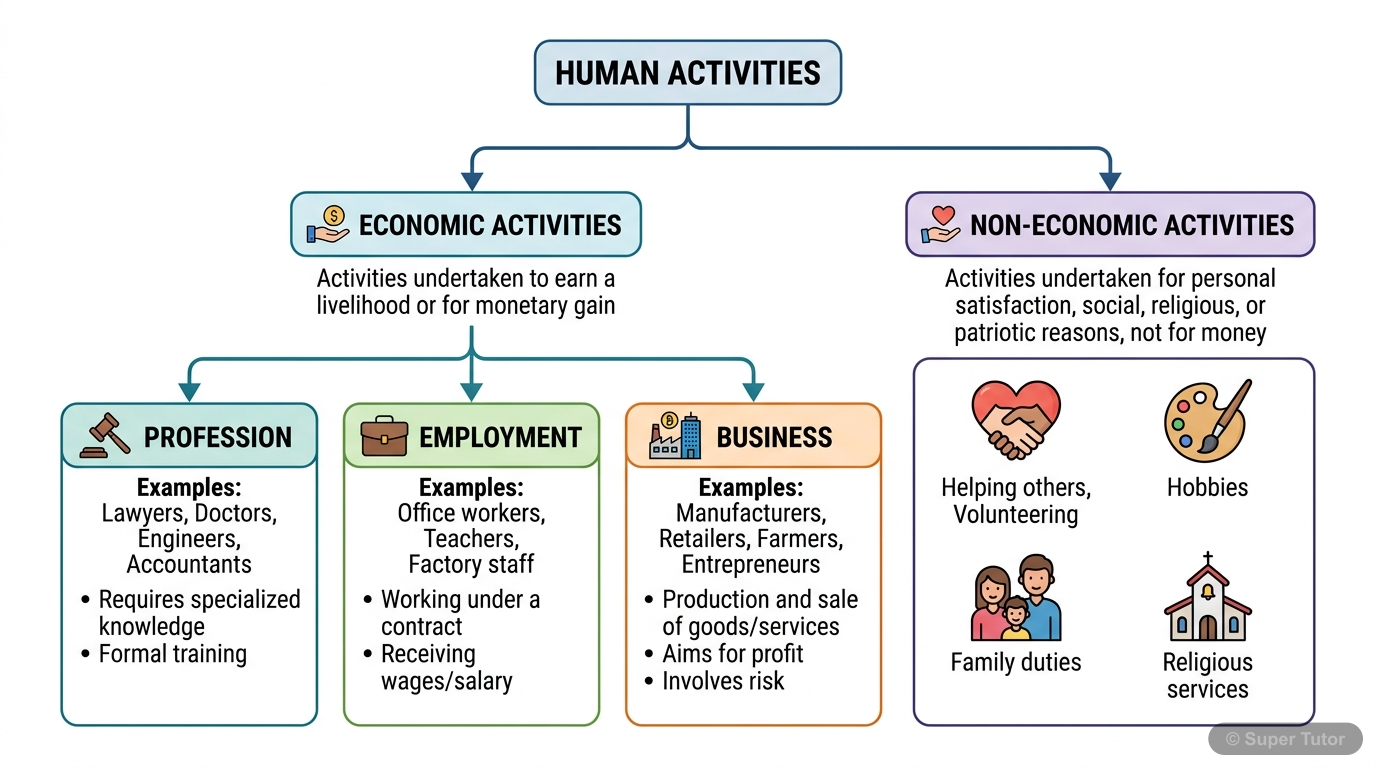
Learn better with visuals Super Tutor pairs illustrations like this with notes and quizzes for Primary Activities.
The first 7 solutions are open to read. The other 7 are free with a Super Tutor account.
Exercises
1(i)Which one of the following is not a plantation crop?
(a) Coffee
(b) Sugarcane
(c) Wheat
(d) RubberShow solution
Correct Answer: (c) Wheat
Justification: Coffee, sugarcane, and rubber are all plantation crops grown on large estates, typically in tropical regions. Wheat is a food grain crop grown through extensive or intensive grain cultivation, not as a plantation crop.
1(ii)In which one of the following countries co-operative farming was the most successful experiment?
(a) Russia
(b) Denmark
(c) India
(d) The NetherlandsShow solution
Correct Answer: (b) Denmark
Justification: Co-operative farming has been most successful in Denmark, where farmers pool their resources, share machinery, and collectively market their produce. Denmark is regarded as the model country for co-operative farming in the world.
1(iii)Growing of flowers is called:
(a) Truck farming
(b) Factory farming
(c) Mixed farming
(d) FloricultureShow solution
Correct Answer: (d) Floriculture
Justification: Floriculture refers specifically to the cultivation of flowers and ornamental plants. It is a specialised branch of horticulture practised near urban and peri-urban areas where demand for flowers is high.
1(iv)Which one of the following types of cultivation was developed by European colonists?
(a) Kolkoz
(b) Viticulture
(c) Mixed farming
(d) PlantationShow solution
Correct Answer: (d) Plantation
Justification: Plantation agriculture was introduced and developed by European colonists in tropical and sub-tropical regions of Asia, Africa, and Latin America to grow commercial crops like tea, coffee, rubber, and sugarcane for export to European markets.
1(v)In which one of the following regions is extensive commercial grain cultivation not practised?
(a) American Canadian prairies
(b) European Steppes
(c) Pampas of Argentina
(d) Amazon BasinShow solution
Correct Answer: (d) Amazon Basin
Justification: Extensive commercial grain cultivation requires large, flat, fertile land with a suitable climate. The Amazon Basin is covered by dense tropical rainforest with high rainfall and humidity, making it unsuitable for extensive commercial grain cultivation.
1(vi)In which of the following types of agriculture is the farming of citrus fruit very important?
(a) Market gardening
(b) Plantation agriculture
(c) Mediterranean agriculture
(d) Co-operative farmingShow solution
Correct Answer: (c) Mediterranean agriculture
Justification: Mediterranean agriculture is practised in regions around the Mediterranean Sea and similar climatic zones. The warm, dry summers and mild, wet winters are ideal for growing citrus fruits (oranges, lemons, grapes), olives, and figs, making citrus cultivation a hallmark of this type of agriculture.
1(vii)Which one type of agriculture amongst the following is also called 'slash and burn agriculture'?
(a) Extensive subsistence agriculture
(b) Primitive subsistence agriculture
(c) Extensive commercial grain cultivation
(d) Mixed farmingShow solution
Correct Answer: (b) Primitive subsistence agriculture
Justification: Primitive subsistence agriculture, also known as shifting cultivation or 'slash and burn' agriculture, involves clearing a patch of forest by cutting and burning vegetation, cultivating it for a few years, and then moving on to a new patch when soil fertility declines. It is known by different names in different regions — Jhumming (India), Milpa (Central America), Ladang (Malaysia), etc.
(a) Dairy farming
(b) Mixed farming
(c) Plantation agriculture
(d) Commercial grain farming
Free with a Super Tutor account
Free with a Super Tutor account
Free with a Super Tutor account
Free with a Super Tutor account
Free with a Super Tutor account
Free with a Super Tutor account
Free with a Super Tutor account
7 more solved questions in Primary Activities
They are free with a Super Tutor account, along with practice quizzes and flashcards for this chapter. Free to start, no card needed.
Frequently Asked Questions
What are the important topics in Primary Activities for Madhya Pradesh Board Class 12 Geography?
Are these NCERT Solutions for Primary Activities free?
How should I revise Primary Activities for the Madhya Pradesh Board Class 12 board exam?
Sources & Official References
Content is aligned to the official syllabus. Refer to the board website for the latest curriculum.
More resources for Primary Activities
Practice Quiz
Test yourself with a quick quiz
Important Questions
Exam-style questions with answers
Revision Notes
Key points for last-minute revision
Chapter Summary
Understand the chapter at a glance
Concept Maps
See how topics connect
Study Plan
Step-by-step plan for this chapter
Flashcards
Quick-fire cards for active recall
Syllabus
What topics to cover
For serious students
Get the full Primary Activities chapter — start free.
Quizzes, flashcards, an AI doubt solver and a study plan for Madhya Pradesh Board Class 12 Geography. Free to start, no card needed.