Land Resources and Agriculture — NCERT Solutions
Madhya Pradesh Board · Class 12 · Geography
NCERT Solutions for Land Resources and Agriculture, Madhya Pradesh Board Class 12 Geography: 12 textbook questions solved step by step.
Interactive on Super Tutor
Studying Land Resources and Agriculture? Get the full interactive chapter.
Quizzes, flashcards, AI doubt-solver and a step-by-step study plan — built for NCERT solutions and more.
Free trial, no card needed.
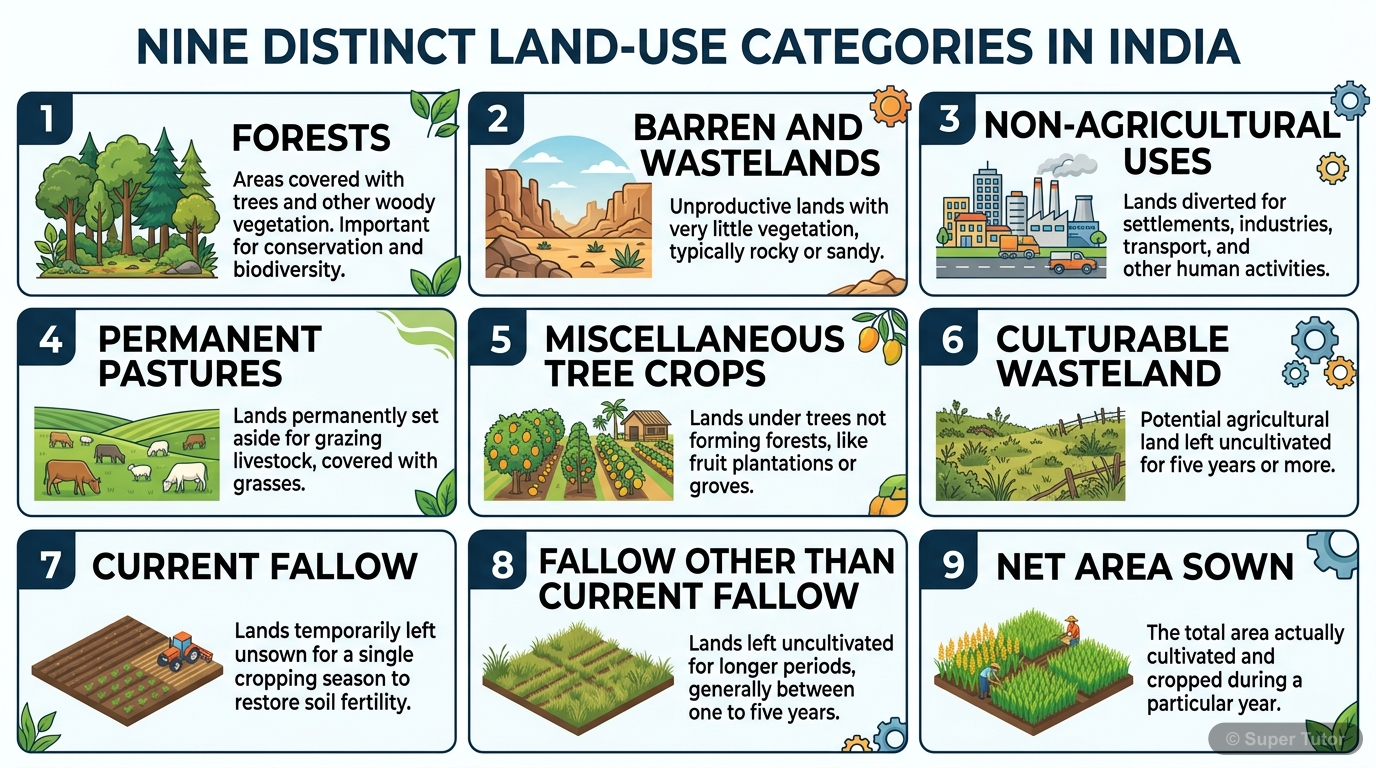
One of 8 illustrations for Land Resources and Agriculture in Super Tutor — alongside flashcards, concept maps and practice questions.
The first 6 solutions are open to read. The other 6 are free with a Super Tutor account.
EXERCISES — Land Resources and Agriculture
1(i)Which one of the following is NOT a land-use category?
(a) Fallow land
(b) Marginal land
(c) Net Area Sown
(d) Culturable WastelandShow solution
Correct Answer: (b) Marginal land
Justification: The standard land-use categories used in India include Fallow land, Net Area Sown, Culturable Wasteland, Forest land, Land put to non-agricultural uses, etc. 'Marginal land' is an economic/agricultural term used to describe land of poor productivity, but it is not an official land-use category in the Indian land-use classification system.
1(ii)What one of the following is the main reason due to which share of forest has shown an increase in the last forty years?
(a) Extensive and efficient efforts of afforestation
(b) Increase in community forest land
(c) Increase in notified area allocated for forest growth
(d) Better peoples' participation in managing forest area.Show solution
Correct Answer: (c) Increase in notified area allocated for forest growth
Justification: The recorded increase in forest area in India over the last four decades is largely due to the administrative/legal reclassification — i.e., more land has been officially notified and recorded under forest cover by the government. This does not necessarily mean actual tree cover has increased proportionally; it primarily reflects an increase in the notified/reserved area allocated for forests.
1(iii)Which one of the following is the main form of degradation in irrigated areas?
(a) Gully erosion
(b) Wind erosion
(c) Salinisation of soils
(d) Siltation of landShow solution
Correct Answer: (c) Salinisation of soils
Justification: In irrigated areas, excessive and faulty irrigation leads to waterlogging, which causes salts to rise to the surface through capillary action. This results in salinisation and alkalisation of soils, making the land infertile. Gully and wind erosion are more characteristic of rainfed/arid areas, not irrigated zones.
1(iv)Which one of the following crops is not cultivated under dryland farming?
(a) Ragi
(b) Jowar
(c) Groundnut
(d) SugarcaneShow solution
Correct Answer: (d) Sugarcane
Justification: Dryland farming is practised in areas with low rainfall (less than 75 cm annually) and without irrigation. Crops like Ragi, Jowar, and Groundnut are drought-resistant and well-suited to dryland conditions. Sugarcane requires a large and continuous supply of water throughout its long growing season and is therefore a wetland/irrigated crop, not a dryland crop.
1(v)In which of the following group of countries of the world, HYVs of wheat and rice were developed?
(a) Japan and Australia
(b) U.S.A. and Japan
(c) Mexico and Philippines
(d) Mexico and SingaporeShow solution
Correct Answer: (c) Mexico and Philippines
Justification: High Yielding Varieties (HYVs) of crops were developed as part of the Green Revolution. HYV wheat was developed at the International Maize and Wheat Improvement Centre (CIMMYT) in Mexico, while HYV rice was developed at the International Rice Research Institute (IRRI) in the Philippines. These varieties were later introduced in India in the mid-1960s.
2(i)Differentiate between barren and wasteland and culturable wasteland.Show solution
Given: Two land-use categories — Barren & Wasteland and Culturable Wasteland.
Difference:
| Basis | Barren and Wasteland | Culturable Wasteland |
|---|---|---|
| Definition | Land that cannot be brought under cultivation at all, even with high investment. | Land that is currently not under cultivation but can be brought under cultivation with effort and investment. |
| Examples | Deserts, rocky mountains, snow-covered peaks, ravines. | Degraded forests, waterlogged land, land affected by salinity — which can be reclaimed. |
| Possibility of cultivation | Not possible. | Possible with reclamation measures. |
In short: Barren wasteland is permanently uncultivable, whereas culturable wasteland is temporarily uncultivated but has the potential to be reclaimed for agriculture.
Free with a Super Tutor account
Free with a Super Tutor account
Free with a Super Tutor account
Free with a Super Tutor account
Free with a Super Tutor account
Free with a Super Tutor account
6 more solved questions in Land Resources and Agriculture
They are free with a Super Tutor account, along with practice quizzes and flashcards for this chapter. Free to start, no card needed.
Frequently Asked Questions
What are the important topics in Land Resources and Agriculture for Madhya Pradesh Board Class 12 Geography?
Are these NCERT Solutions for Land Resources and Agriculture free?
How should I revise Land Resources and Agriculture for the Madhya Pradesh Board Class 12 board exam?
Sources & Official References
Content is aligned to the official syllabus. Refer to the board website for the latest curriculum.
More resources for Land Resources and Agriculture
Practice Quiz
Test yourself with a quick quiz
Important Questions
Exam-style questions with answers
Revision Notes
Key points for last-minute revision
Formula Sheet
The chapter's formulas in one place
Chapter Summary
Understand the chapter at a glance
Concept Maps
See how topics connect
Study Plan
Step-by-step plan for this chapter
Flashcards
Quick-fire cards for active recall
Syllabus
What topics to cover
For serious students
Get the full Land Resources and Agriculture chapter — start free.
Quizzes, flashcards, an AI doubt solver and a study plan for Madhya Pradesh Board Class 12 Geography. Free to start, no card needed.