Tertiary and Quaternary Activities — NCERT Solutions
Madhya Pradesh Board · Class 12 · Geography
NCERT Solutions for Tertiary and Quaternary Activities, Madhya Pradesh Board Class 12 Geography: 14 textbook questions solved step by step.
Interactive on Super Tutor
Studying Tertiary and Quaternary Activities? Get the full interactive chapter.
Quizzes, flashcards, AI doubt-solver and a step-by-step study plan — built for NCERT solutions and more.
Free trial, no card needed.
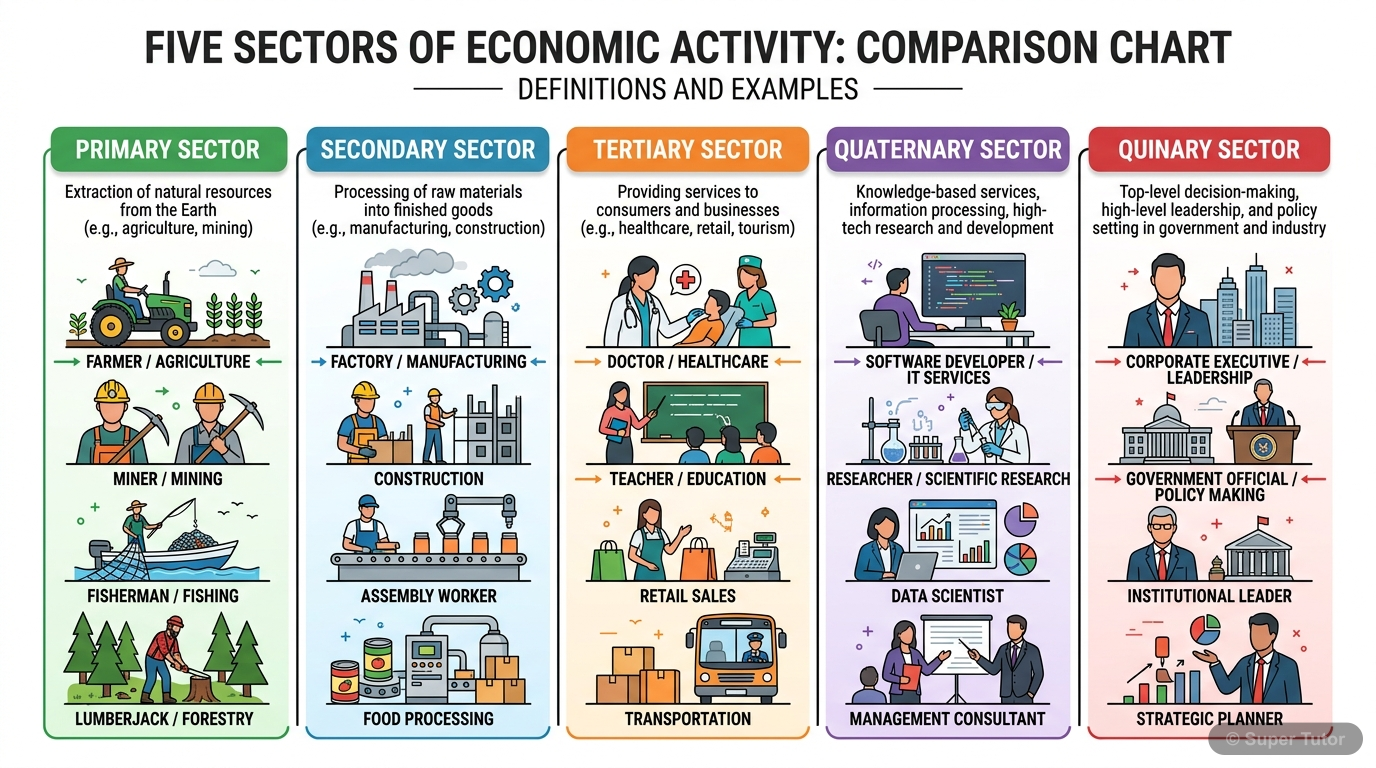
Learn better with visuals Super Tutor pairs illustrations like this with notes and quizzes for Tertiary and Quaternary Activities.
The first 7 solutions are open to read. The other 7 are free with a Super Tutor account.
Exercises
1(i)Which one of the following is a tertiary activity?
(a) Farming
(b) Trading
(c) Weaving
(d) HuntingShow solution
Correct Answer: (b) Trading
Justification: Tertiary activities involve the provision of services rather than the production of goods. Trading (buying and selling of goods) is a service activity and hence belongs to the tertiary sector. Farming belongs to the primary sector, weaving to the secondary sector, and hunting to the primary sector.
1(ii)Which one of the following activities is NOT a secondary sector activity?
(a) Iron Smelting
(b) Catching fish
(c) Making garments
(d) Basket WeavingShow solution
Correct Answer: (b) Catching fish
Justification: Secondary sector activities involve the processing or manufacturing of raw materials into finished goods. Catching fish is a primary sector activity (extraction of natural resources directly from nature). Iron smelting, making garments, and basket weaving all involve processing/manufacturing, so they belong to the secondary sector.
1(iii)Which one of the following sectors provides most of the employment in Delhi, Mumbai, Chennai and Kolkata?
(a) Primary
(b) Quaternary
(c) Secondary
(d) ServiceShow solution
Correct Answer: (d) Service
Justification: Delhi, Mumbai, Chennai, and Kolkata are major metropolitan cities of India. In large urban centres, the service (tertiary) sector — which includes trade, transport, banking, education, health, administration, etc. — provides the maximum employment to the urban workforce.
1(iv)Jobs that involve high degrees and level of innovations are known as:
(a) Secondary activities
(b) Quaternary activities
(c) Quinary activities
(d) Primary activitiesShow solution
Correct Answer: (c) Quinary activities
Justification: Quinary activities represent the highest level of decision-making in a society or economy. They involve top executives and officials in government, business, education, health, and research who are engaged in the creation, re-arrangement, and interpretation of new and existing ideas. These jobs require the highest level of innovation and specialised knowledge.
1(v)Which one of the following activities is related to quaternary sector?
(a) Manufacturing computers
(b) Paper and Raw pulp production
(c) University teaching
(d) Printing booksShow solution
Correct Answer: (c) University teaching
Justification: Quaternary activities centre on the collection, production, and dissemination of information and knowledge. University teaching involves the generation and transfer of knowledge and is therefore a quaternary activity. Manufacturing computers and printing books are secondary activities, while paper and raw pulp production is also a secondary/primary activity.
1(vi)Which one out of the following statements is not true?
(a) Outsourcing reduces costs and increases efficiency.
(b) At times engineering and manufacturing jobs can also be outsourced.
(c) BPOs have better business opportunities as compared to KPOs.
(d) There may be dissatisfaction among job seekers in the countries that outsource the job.Show solution
Correct Answer: (c) BPOs have better business opportunities as compared to KPOs.
Justification: This statement is NOT true. Knowledge Process Outsourcing (KPOs) require higher levels of skill, expertise, and knowledge (e.g., legal services, research and analytics, financial consulting), and therefore offer better business opportunities and higher value than Business Process Outsourcing (BPOs), which handle routine tasks like data entry and customer support.
2(i)Explain retail trading service.Show solution
Given/Concept: Retail trading is a component of tertiary (service) sector activities.
Answer: Retail trading is the business activity concerned with the sale of goods directly to consumers. It is the last link in the chain of distribution between the producer and the consumer. Retail traders operate through fixed establishments such as shops, stores, and supermarkets, or through mobile vendors and street markets. They buy goods in bulk from wholesalers and sell them in small quantities to individual customers. Modern retail trading also includes e-commerce and online shopping platforms. It provides employment to a large number of people and plays a vital role in making goods accessible to consumers.
Free with a Super Tutor account
Free with a Super Tutor account
Free with a Super Tutor account
Free with a Super Tutor account
Free with a Super Tutor account
Free with a Super Tutor account
Free with a Super Tutor account
7 more solved questions in Tertiary and Quaternary Activities
They are free with a Super Tutor account, along with practice quizzes and flashcards for this chapter. Free to start, no card needed.
Frequently Asked Questions
What are the important topics in Tertiary and Quaternary Activities for Madhya Pradesh Board Class 12 Geography?
Are these NCERT Solutions for Tertiary and Quaternary Activities free?
How should I revise Tertiary and Quaternary Activities for the Madhya Pradesh Board Class 12 board exam?
Sources & Official References
Content is aligned to the official syllabus. Refer to the board website for the latest curriculum.
More resources for Tertiary and Quaternary Activities
Practice Quiz
Test yourself with a quick quiz
Important Questions
Exam-style questions with answers
Revision Notes
Key points for last-minute revision
Chapter Summary
Understand the chapter at a glance
Concept Maps
See how topics connect
Study Plan
Step-by-step plan for this chapter
Flashcards
Quick-fire cards for active recall
Syllabus
What topics to cover
For serious students
Get the full Tertiary and Quaternary Activities chapter — start free.
Quizzes, flashcards, an AI doubt solver and a study plan for Madhya Pradesh Board Class 12 Geography. Free to start, no card needed.