Human Settlements — NCERT Solutions
Madhya Pradesh Board · Class 12 · Geography
NCERT Solutions for Human Settlements, Madhya Pradesh Board Class 12 Geography: 7 textbook questions solved step by step.
Interactive on Super Tutor
Studying Human Settlements? Get the full interactive chapter.
Quizzes, flashcards, AI doubt-solver and a step-by-step study plan — built for NCERT solutions and more.
Free trial, no card needed.
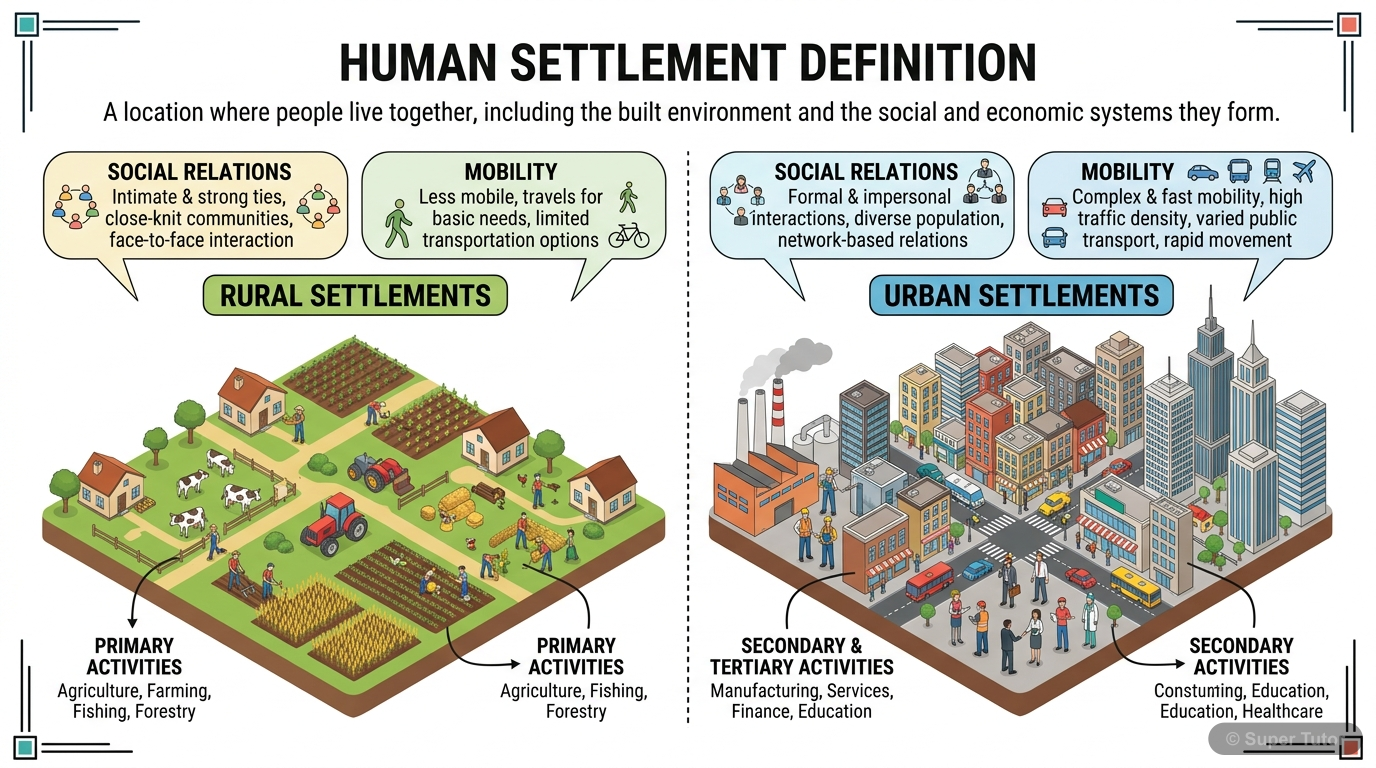
One of 10 illustrations for Human Settlements in Super Tutor — alongside flashcards, concept maps and practice questions.
The first 4 solutions are open to read. The other 3 are free with a Super Tutor account.
EXERCISES — Human Settlements
1(i)Which one of the following towns is NOT located on a river bank?
(a) Agra
(b) Bhopal
(c) Patna
(d) KolkataShow solution
Correct Answer: (b) Bhopal
Justification: Agra is located on the river Yamuna, Patna on the river Ganga, and Kolkata on the river Hooghly (a distributary of the Ganga). Bhopal, the capital of Madhya Pradesh, is not situated on a river bank; it is located near artificial lakes (Upper Lake and Lower Lake). Hence, Bhopal is NOT located on a river bank.
1(ii)Which one of the following is NOT the part of the definition of a town as per the census of India?
(a) Population density of 400 persons per sq km.
(b) Presence of municipality, corporation, etc.
(c) More than 75% of the population engaged in primary sector.
(d) Population size of more than 5,000 persons.Show solution
Correct Answer: (c) More than 75% of the population engaged in primary sector.
Justification: As per the Census of India, a settlement is classified as a town if it satisfies the following criteria: (i) a minimum population of 5,000 persons, (ii) at least 75% of the male working population engaged in non-primary (i.e., secondary and tertiary) activities, and (iii) a population density of at least 400 persons per sq km. Additionally, all statutory towns (having a municipality, corporation, cantonment board, etc.) are also classified as towns. Therefore, option (c) — 'more than 75% engaged in the primary sector' — is NOT part of the definition; in fact, it is the opposite condition.
1(iii)In which one of the following environments does one expect the presence of dispersed rural settlements?
(a) Alluvial plains of Ganga
(b) Arid and semi-arid regions of Rajasthan
(c) Lower valleys of Himalayas
(d) Forests and hills in north-eastShow solution
Correct Answer: (d) Forests and hills in north-east
Justification: Dispersed or isolated settlements are found in areas where the terrain is rugged, resources are scarce, and the land is fragmented — such as forests, hills, and tribal regions of north-east India. In such areas, individual homesteads or hamlets are scattered far apart. In contrast, the alluvial plains of the Ganga and arid regions of Rajasthan tend to have nucleated settlements where people cluster together near water sources or fertile land.
2(i)What are garrison towns? What is their function?Show solution
Answer:
Given/Concept: Garrison towns (also called Cantonment towns) are settlements that developed primarily to serve military purposes.
Definition: Garrison towns are towns that emerged and grew around military establishments such as army camps, cantonments, and defence installations.
Function: Their primary function is to provide accommodation, administrative support, and logistical facilities to the armed forces. They house military personnel, their families, and the supporting civilian population. Examples include Ambala, Jalandhar, Mhow, Babina, and Udhampur.
These towns are generally well-planned with separate residential areas (cantonment areas) and are administered by Cantonment Boards under the Ministry of Defence.
Free with a Super Tutor account
Free with a Super Tutor account
Free with a Super Tutor account
3 more solved questions in Human Settlements
They are free with a Super Tutor account, along with practice quizzes and flashcards for this chapter. Free to start, no card needed.
Frequently Asked Questions
What are the important topics in Human Settlements for Madhya Pradesh Board Class 12 Geography?
Are these NCERT Solutions for Human Settlements free?
How should I revise Human Settlements for the Madhya Pradesh Board Class 12 board exam?
Sources & Official References
Content is aligned to the official syllabus. Refer to the board website for the latest curriculum.
More resources for Human Settlements
Practice Quiz
Test yourself with a quick quiz
Important Questions
Exam-style questions with answers
Revision Notes
Key points for last-minute revision
Chapter Summary
Understand the chapter at a glance
Concept Maps
See how topics connect
Study Plan
Step-by-step plan for this chapter
Flashcards
Quick-fire cards for active recall
Syllabus
What topics to cover
For serious students
Get the full Human Settlements chapter — start free.
Quizzes, flashcards, an AI doubt solver and a study plan for Madhya Pradesh Board Class 12 Geography. Free to start, no card needed.