Gravitation — Important Questions
NIOS · Class 10 · Science & Tech
91 important questions from Gravitation for NIOS Class 10 Science & Tech, with answers. Written for the board exams 2027.
Interactive on Super Tutor
Studying Gravitation? Get the full interactive chapter.
Quizzes, flashcards, AI doubt-solver and a step-by-step study plan — built for important questions and more.
Free trial, no card needed.
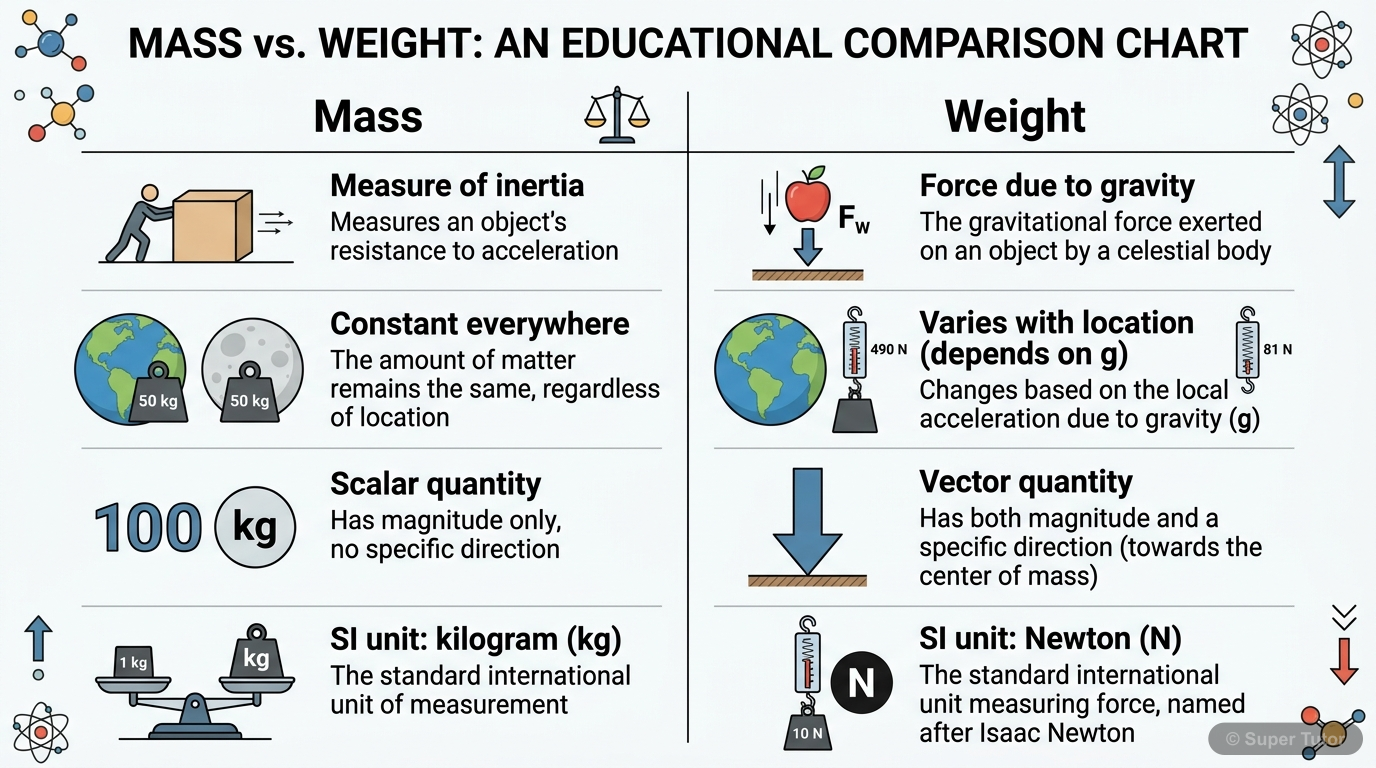
Learn better with visuals Super Tutor pairs illustrations like this with notes and quizzes for Gravitation.
Important Questions from Gravitation
When an object falls freely under gravity, its weight is:
Show answer
Zero (weightless)
Step 1: Weight is the force exerted by an object on a support (like a weighing scale). Step 2: When an object falls freely, both the object and any measuring device fall with the same acceleration g. Step 3: Since there's no relative motion between the object and measuring device, no force is exerted on the support. Step 4: This creates the condition of weightlessness - the apparent weight becomes zero. Step 5: Astronauts in orbit experience this same effect as they're in continuous free fall around Earth.
According to Archimedes' principle, the buoyant force on a submerged object equals:
Show answer
Weight of the fluid displaced
Step 1: Archimedes' principle states that when a body is immersed in a fluid, it experiences an upward force. Step 2: This upward force (buoyant force) equals the weight of the fluid that gets displaced by the object. Step 3: The displaced fluid volume equals the volume of the submerged part of the object. Step 4: Buoyant force = ρ_fluid × V_displaced × g, which equals the weight of displaced fluid. Step 5: This principle explains why ships float and helps in calculating the apparent loss of weight in fluids.
Two objects of different masses are dropped from the same height. Ignoring air resistance, which statement is correct?
Show answer
They reach the ground at the same time
Step 1: All objects near Earth's surface experience the same acceleration due to gravity (g = 9.8 ms⁻²). Step 2: From the equation s = ut + ½gt², time to fall depends only on height and acceleration, not mass. Step 3: Since both objects start from rest (u = 0) and same height, they take the same time. Step 4: Galileo demonstrated this principle by dropping objects from the Tower of Pisa. Step 5: Air resistance can affect this in real conditions, but in vacuum, all objects fall at the same rate regardless of mass.
The SI unit of weight is:
Show answer
Newton (N)
Step 1: Weight is the gravitational force acting on an object, calculated as W = mg. Step 2: Since weight is a force, it has the same SI unit as force, which is Newton (N). Step 3: Kilogram (kg) is the unit of mass, not weight. Step 4: ms⁻² is the unit of acceleration, and Joule (J) is the unit of energy. Step 5: Many people confuse mass and weight - mass is measured in kg, but weight (the gravitational force) is measured in Newtons.
+87 more questions on Gravitation (NIOS Class 10 Science & Tech)
Practise AllFrequently Asked Questions
What are the important topics in Gravitation for NIOS Class 10 Science & Tech?
How many important questions are there in Gravitation?
Sources & Official References
Content is aligned to the official syllabus. Refer to the board website for the latest curriculum.
More resources for Gravitation
Practice Quiz
Test yourself with a quick quiz
Revision Notes
Key points for last-minute revision
Formula Sheet
The chapter's formulas in one place
Chapter Summary
Understand the chapter at a glance
Concept Maps
See how topics connect
Study Plan
Step-by-step plan for this chapter
Flashcards
Quick-fire cards for active recall
Syllabus
What topics to cover
For serious students
Get the full Gravitation chapter — start free.
Quizzes, flashcards, an AI doubt solver and a study plan for NIOS Class 10 Science & Tech. Free to start, no card needed.