Force and Motion — Important Questions
NIOS · Class 10 · Science & Tech
92 important questions from Force and Motion for NIOS Class 10 Science & Tech, with answers. Written for the board exams 2027.
Interactive on Super Tutor
Studying Force and Motion? Get the full interactive chapter.
Quizzes, flashcards, AI doubt-solver and a step-by-step study plan — built for important questions and more.
Free trial, no card needed.
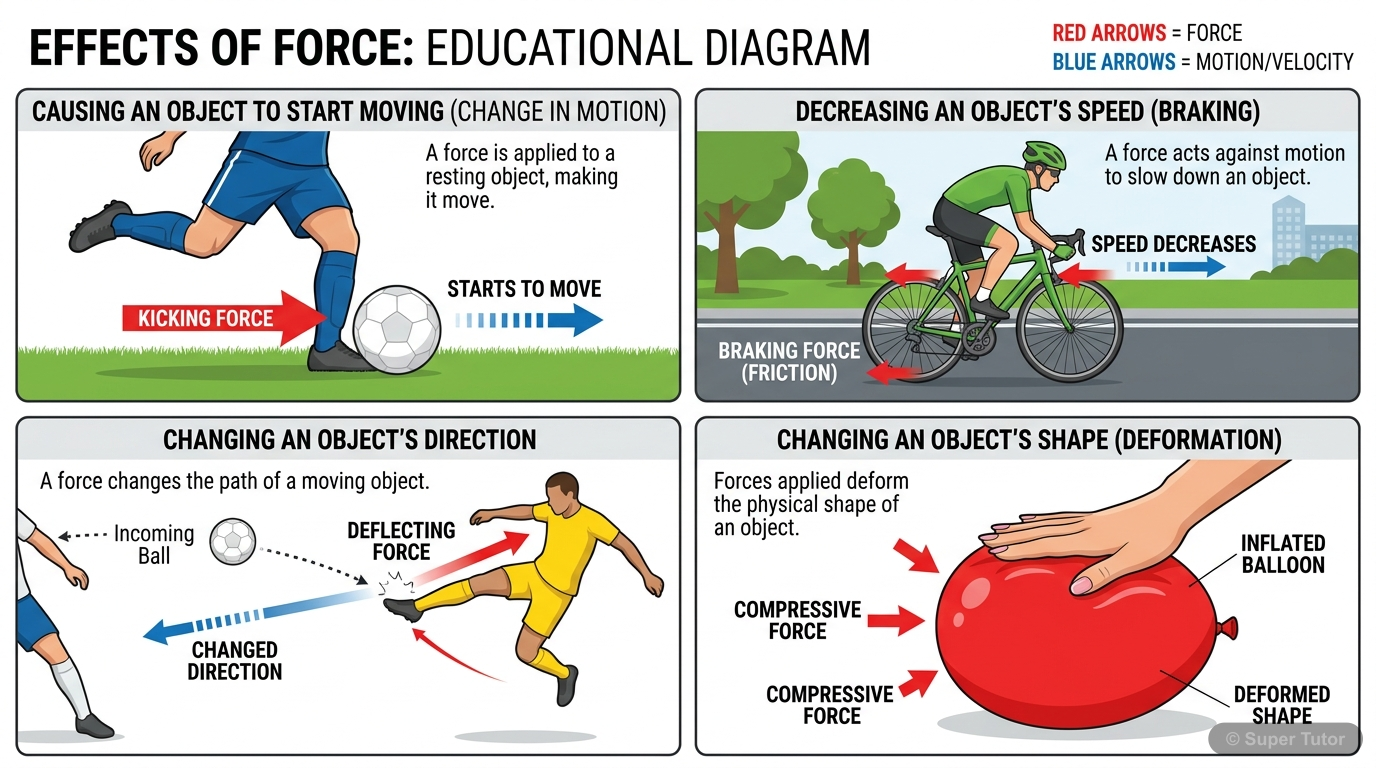
One of 23 illustrations for Force and Motion in Super Tutor — alongside flashcards, concept maps and practice questions.
Important Questions from Force and Motion
What happens to the shape of a balloon when equal forces are applied from opposite sides?
Show answer
Its shape changes
Step 1: When equal forces act from opposite sides, they form balanced forces. Step 2: Balanced forces do not cause motion because they cancel each other out. Step 3: However, balanced forces can still change the shape of deformable objects. Step 4: The balloon gets compressed because both forces push inward, changing its shape from round to flattened. Step 5: This demonstrates that balanced forces don't cause motion but can cause deformation in flexible objects.
The SI unit of force is:
Show answer
Newton
Step 1: The SI unit of force is the Newton (N), named after Sir Isaac Newton. Step 2: One Newton is defined as the force that gives a mass of 1 kg an acceleration of 1 m/s². Step 3: From F = ma, we get 1 N = 1 kg × 1 m/s² = 1 kg⋅m/s². Step 4: To feel what 1 N is like, hold a 100g mass in your palm - that's approximately 1 N of force. Step 5: Other units are: kg for mass, Pascal for pressure, and Joule for energy.
Why do passengers fall backward when a bus starts suddenly?
Show answer
Due to inertia of rest
Step 1: Initially, both the bus and passengers are at rest. Step 2: When the bus starts suddenly, the floor moves forward with the bus. Step 3: The passengers' feet, in contact with the floor, also start moving forward. Step 4: However, the upper body of passengers tends to remain at rest due to inertia of rest. Step 5: This causes the passengers to fall backward relative to the bus. This is a classic example of Newton's First Law in action.
What is pressure?
Show answer
Force ÷ Area
Step 1: Pressure is defined as force per unit area, or Pressure = Force ÷ Area. Step 2: This means the same force applied over a smaller area creates higher pressure. Step 3: For example, a nail has a pointed tip to concentrate force over a tiny area, creating high pressure to penetrate wood. Step 4: The SI unit of pressure is N/m² or Pascal (Pa). Step 5: Understanding this helps explain why broad straps are comfortable (distribute force over larger area, reducing pressure) while thin straps are uncomfortable.
+88 more questions on Force and Motion (NIOS Class 10 Science & Tech)
Practise AllFrequently Asked Questions
What are the important topics in Force and Motion for NIOS Class 10 Science & Tech?
How many important questions are there in Force and Motion?
Sources & Official References
Content is aligned to the official syllabus. Refer to the board website for the latest curriculum.
More resources for Force and Motion
Practice Quiz
Test yourself with a quick quiz
Revision Notes
Key points for last-minute revision
Formula Sheet
The chapter's formulas in one place
Chapter Summary
Understand the chapter at a glance
Concept Maps
See how topics connect
Study Plan
Step-by-step plan for this chapter
Flashcards
Quick-fire cards for active recall
Syllabus
What topics to cover
For serious students
Get the full Force and Motion chapter — start free.
Quizzes, flashcards, an AI doubt solver and a study plan for NIOS Class 10 Science & Tech. Free to start, no card needed.