Natural Environment — Important Questions
NIOS · Class 10 · Science & Tech
45 important questions from Natural Environment for NIOS Class 10 Science & Tech, with answers. Covers Population Growth and Dispersal.
Interactive on Super Tutor
Studying Natural Environment? Get the full interactive chapter.
Quizzes, flashcards, AI doubt-solver and a step-by-step study plan — built for important questions and more.
Free trial, no card needed.
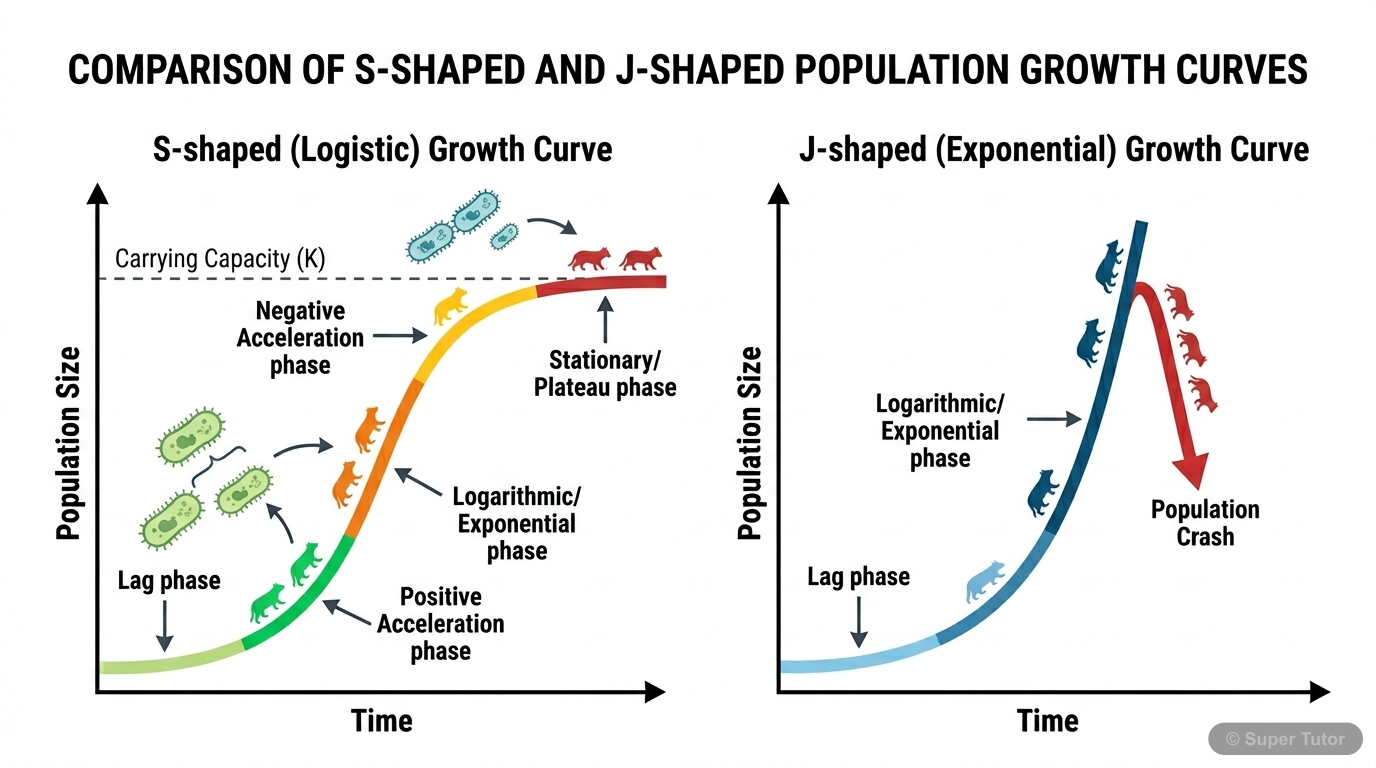
Learn better with visuals Super Tutor pairs illustrations like this with notes and quizzes for Natural Environment.
Important Questions from Natural Environment
What happens to energy as it moves up the food chain?
Show answer
It decreases at each level
Energy decreases as it moves up the food chain because energy flow is unidirectional and much energy is lost at each trophic level. When a herbivore eats plants, only a fraction of the plant's energy becomes new body mass in the herbivore. Most energy is lost as heat during metabolic processes like movement, digestion, and respiration. Similarly, when a carnivore eats the herbivore, only about 10% of the energy is transferred. This is why food chains are usually limited to 4-5 trophic levels, as there isn't enough energy to support higher levels.
Which gas do plants absorb during photosynthesis?
Show answer
Carbon dioxide
Plants absorb carbon dioxide from the atmosphere during photosynthesis. This carbon dioxide combines with water in the presence of sunlight and chlorophyll to produce glucose and oxygen. The reaction is: 6CO₂ + 6H₂O + sunlight → C₆H₁₂O₆ + 6O₂. This process is crucial for the carbon cycle as plants remove CO₂ from the atmosphere and convert it into organic compounds. The oxygen released as a byproduct is essential for the respiration of all living organisms, including humans.
What type of bacteria convert ammonia into nitrates in the nitrogen cycle?
Show answer
Nitrifying bacteria
Nitrifying bacteria like Nitrosomonas and Nitrosobacter convert ammonia into nitrates through the process of nitrification. This is a two-step process: first, ammonia is converted to nitrites, then nitrites are converted to nitrates. These nitrates can then be absorbed by plants for making proteins and nucleic acids. This process is essential in the nitrogen cycle as it makes nitrogen available in a form that plants can use. Without nitrifying bacteria, the nitrogen in dead organic matter would remain unavailable to plants.
Which adaptation helps aquatic plants like lotus float on water?
Show answer
Broad flat leaves with waxy coating
Aquatic plants like lotus have broad, flat leaves that provide a large surface area for flotation. The waxy coating on the upper surface acts as a water repellent, preventing water from collecting on the leaf surface and helping it stay afloat. The broad surface distributes the plant's weight over a large area, reducing the pressure on the water surface. Additionally, air spaces in the leaf tissues provide buoyancy. This adaptation allows the plant to access sunlight for photosynthesis while remaining anchored in the water through its roots.
+41 more questions on Natural Environment (NIOS Class 10 Science & Tech)
Practise AllFrequently Asked Questions
What are the important topics in Natural Environment for NIOS Class 10 Science & Tech?
How many important questions are there in Natural Environment?
Sources & Official References
Content is aligned to the official syllabus. Refer to the board website for the latest curriculum.
More resources for Natural Environment
For serious students
Get the full Natural Environment chapter — start free.
Quizzes, flashcards, an AI doubt solver and a study plan for NIOS Class 10 Science & Tech. Free to start, no card needed.